Follow Us on Google
…Says lives, economic development under threat
By Henry Uche
The Human and Environmental Development Agenda (HEDA Resource Centre) has issued a warning over the impact of climate change on Nigeria’s economy.
The centre said that Nigeria’s aspiration to upper-middle-income status by 2050 will face a serious challenge if decisive climate actions are not taken to contain the growing impacts of climate change.
According to HEDA, this could severely threaten lives, livelihoods, and the nation’s long-term economic development.
In its report titled, ‘Enhancing Accountability in Climate Adaptation Finance in Nigeria: Synthesis Report and Case Studies on Ecological Fund’, HEDA maintained that Nigeria currently stands at a defining climate crossroads as intensifying perennial floods, prolonged droughts, deadly heatwaves, rising sea levels and shifting weather patterns threaten lives, livelihoods and national development.
Referring to the 2022-2024 nationwide flooding that affected 34 out of 36 states, destroyed thousands of hectares of farmlands, and displaced thousands of people, with consequential health issues, HEDA maintained that there is a need for urgent national adaptation to the menace.
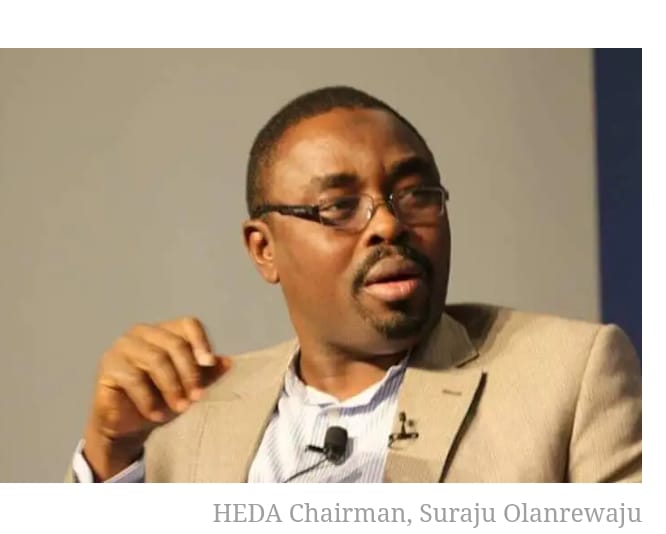
HEDA’s chairman, Olanrewaju Suraju, had explained that the peculiarity of Nigeria’s immediate challenge towards climate crises of intensifying floods, increased droughts, heat-waves, sea-level rise, ocean acidification and changing weather patterns, calls for prioritisation of climate adaptation for survival, pressing necessity to protect lives and livelihoods, and the country’s development prospects both now and in the future.
This priority, he revealed is reflected in national policy commitments like, the most recent Nationally Determined Contribution (NDC 3.0), National Climate Change Policy, Climate Change Act (2021), and National Adaptation Plan (NAP) Framework; yet, financing for adaptation remains inadequate, fragmented, and weakly-monitored.
He noted that with such weaknesses, Nigeria stands highly vulnerable to the vagaries of climate change. For instance, in the semi-arid north, communities grapple with recurrent droughts and declining rainfall; in the coastal south, rising sea levels and storm surges erase land and settlements; and across the nation, heat extremes and flooding have become defining risks.
HEDA boss pointed at Ecological Fund, one of Nigeria’s main domestic financing mechanisms for environmental challenges that captures these issues, demonstrating both the potential of adaptation finance, and the need to strengthen governance for achievement of beneficial climate adaptation financing in Nigeria, and African continent.
HEDA’s study examined how adaptation finance is managed and delivered in Nigeria, with a particular focus on Ecological Fund at selected case studies in Borno, Niger and Ondo states.
Using three entry points: (i) expenditure verification; (ii) institutional capacity assessment, and (iii) community-level outcomes, the study considers the processes involved in how climate adaptation funds achieve their intended purpose, how institutions leverage and administer the Ecological Fund for climate adaptation projects, and how affected communities experience the impacts of climate funds.
Projects selection were drawn from official records of Ecological Fund Projects between 2015 and 2022. Selection criteria included type of intervention (soil erosion and flood control, drought/desertification, pollution control), geographic distribution, implementation status, and feasibility of field verification. Data collection relied primarily on qualitative methods.
HEDA reported that, to enhance climate adaptation finance in Nigeria therefore, there is urgent need for critical adaptation funds accountability trackers unique to the Nigerian context, strengthening transparency in expenditure verification, building technical capacity at both federal and state levels, and embedding community priorities into planning.
Other News
“To enhance accountability of climate adaptation finance in Nigeria, there should be harmonisation of different, but related data, for presentation of more holistic data, such as unified dashboards for information, which the Media/Press can even highlight for better awareness by the particular host communities and the general public”
It was noted that state governors taking sole credits for joint State-Host Communities Projects or projects funded by Host Communities Trust/Boards is a very disturbing dynamics and needs to be addressed.
The study uncovered that allocation of Ecological Funds are mostly not transparent; however, an important means of tackling such issue can include public verification of budget and expenditure; community development agreement; institutional capacity preparedness; host communities’ awareness and understanding of their needs in terms of climate change adaptations; justifications and assessments of impacts/benefits of projects.
Others are: Aligning procedures of Ecological Fund coordinating authorities with international best practices; implementation of adaptation finance focal points and hubs; synergised communities adaptation with mitigations for broader positive impacts and better coordination; prioritisation of bottom-up interventions; multi-layered (but not duplicated) community engagements; communities’ awareness of every component of the ecological projects, funding, implementation, processes, and tracking, global goals, etc., as a participation model.
More discovery was apparently ‘absence of established frameworks on related budgeting at the national level’ to be able to easily track climate change adaptability financing – a key reason for overlapping and diversions of projects funds.
“Community ownership is crucial as well as interrogation of accountability and transparency on ecological funding by relevant anti-corruption agencies and other actors such as climate funds donors, CSOs, and host communities.
“Consistent involvements from the point of calls for each project until implementation and commissioning of projects by all relevant stakeholders are necessary. Regulators must also evaluate end-users’ phases of implemented projects even after commissioning.
“To further enhance accountability and transparency towards Ecological Fund-supported projects, incentivisation of Ecological Fund-supported project contractors/executors and evaluators for continued tracking as well as post adaptation-research transition plans are essential, to further enhance regulatory processes.
“There should as a matter of principle be, streamlining of climate funding into a Board with well-structured governance while fostering collaborations (in the form of coalitions) that can harness diverse strength into Climate Adaptation Finance Consortia. More so, an independent agency solely responsible for data collation on every awarded contracts, projects, and other interventions is encouraged as well.
“Furthermore, institutional and structural reforms can enhance accountability of climate adaptation finances in Nigeria especially through data disclosures and publication of assessments, ensuring transparency in financial flows, improving awareness of projects, mitigation of project risks, public validation of adaptation projects/citizens projects, and host community trust process” Suraju pointed out.
In addition, he highlighted that for proper prioritisation of Ecological Funded projects, there is need for a special stakeholders Forum consisting specific stakeholders like: Ministry of Budget and Planning, Bureau of Statistics, Lawmakers, especially, those in Oversight/Appropriation Committees, CSOs, for nation-wide monitoring and evaluation of the climate fund and projects.
Also, the need to strengthen civil society organizations by deepening community ownership of interventions was heralded. This includes prioritising community-driven projects, ensuring meaningful community representation in ecological fund project boards (including rights of reply or dedicated seats), enabling community presence at state budget presentations and legislative sessions, as well as recognising community-defined problems and priorities.
He stressed the need to address behavioural mindsets of both politicians and communities and to deliberately incorporate the private sector into climate adaptation efforts. These measures he assured are critical to reducing politically -driven intervention projects.
“Transparency is fundamental to effective climate governance. When external transparency is compromised, it becomes difficult to assess internal transparency. However, this assessment is more feasible where governance structures and procedures align with international standard practices. Ultimately, transparency is a gateway to better form of climate governance,” he affirmed.