Follow Us on Google
By Chinenye Anuforo
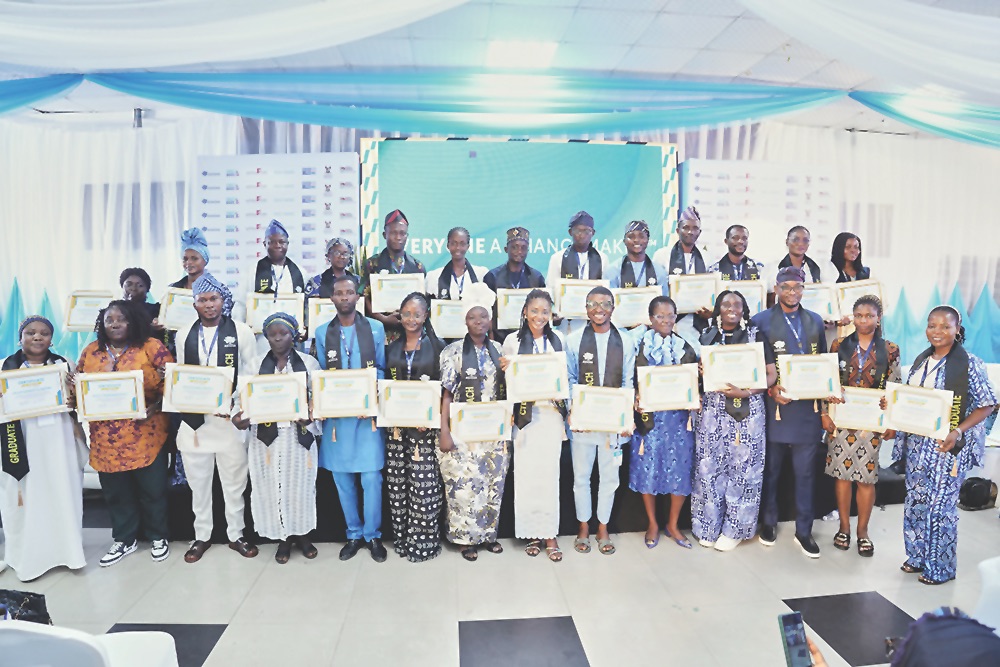
Ashoka Africa has marked a major milestone in its changemaking education drive with the graduation of 102 teachers and the induction of 400 new educators under its Changemaker Teacher Activation Program (CTeach) in Lagos.
The initiative, supported by Swiss Haute Horlogerie manufacturer Audemars Piguet through the global Time for Change partnership with First Book and Teach For All, equips public school teachers with the mindset and tools to nurture empathy, leadership, and problem-solving among students, positioning them as catalysts for transformation in Nigeria’s education system.
Speaking at the graduation ceremony in Lagos, the Co-President of Ashoka Africa and Director of CTeach, Ms. Angelou Ezilo, described the initiative as a transformative step in redefining how teaching and learning are approached across the continent. According to her, the program encourages teachers and students alike to see leadership as collaborative rather than hierarchical, promoting what she referred to as “center-out leadership.”
“These teachers have embarked on a journey of change,” she said. “They have been equipped with the tools and mindset to instill empathy, teamwork, and the courage to lead in themselves and their students. We want both teachers and learners to understand that everyone has the power to make a difference in their communities.”
The CTeach program, launched in September 2023, is part of the global Time for Change initiative implemented by Ashoka, First Book, and Teach For All, with catalytic support from Swiss Haute Horlogerie manufacturer Audemars Piguet. The initiative supports young people in under-resourced communities to become changemakers through teacher-led empowerment.
Ezilo explained that the current phase of the program focused on public school teachers across Lagos, with 102 teachers successfully completing the training. She added that plans are underway to expand the program to include 400 teachers in the next cohort, with the initiative already extending to Osun State and other African countries including Kenya, Senegal, and South Africa.
“Our direct impact comes from the teachers we train,” she said. “But the real change happens when these teachers return to their schools, share their experiences, and inspire others. This is how the movement grows, through collaboration, storytelling, and the ripple effect of changemaking.”
This year’s program carries the theme “Internalize, Integrate, Implement Changemaking,” which reinforces the path teachers take as they embrace changemaking as a personal philosophy, embed it into classroom culture, and implement it as a driver of community-wide transformation.
Among the graduates was Dr. Peace Sule, a teacher at Akoka Junior Secondary School, Lagos, who also holds titles as Global Teacher Prize Ambassador, Best Teacher in Nigeria 2024, and Best Teacher in Africa 2025. She described the training as a turning point in her teaching career and in her students’ learning experiences.
“Before CTeach, my students simply learned to pass exams,” she said. “After the training, they began identifying problems in their communities and developing creative solutions. It has completely changed the way they see learning and their role in society.”
Dr. Sule shared how her students initiated several community-driven projects after the program. Some groups focused on climate change and environmental safety, while others launched projects such as “Cultivating Without Land,” which involved planting crops in sacks to address food insecurity. Another group, called “Converting Waste to Wealth,” used fabric scraps from local tailors to create handbags. Others worked on beautifying the school environment through recycling and creative art.
“The transformation has been remarkable,” she said. “When I showed them the pictures of the school before and after, they were so proud. These are public school students making real impact in their environment. They deserve to be seen by the world.”
Ezilo noted that while the program currently targets underserved and under-resourced public schools, plans are in motion to extend it to private schools that are interested in the changemaking approach. She emphasized that all young people, regardless of their background, should have access to the skills and mindset needed to thrive in a changing world.
“Nigeria’s education system faces deep challenges—rote memorization, lack of empathy in classrooms, and a focus on short-term gains,” she said. “Through CTeach, we are changing that narrative. Students are now dreaming again. Instead of wanting to run away from the country, they’re saying, ‘I can fix this problem.’ That’s what changemaking is about.”
Ezilo also pointed out that the success of the program depends on collaboration across multiple levels of society. “We often say it takes a village to raise a child,” she noted. “At Ashoka, we believe it takes an ecosystem to raise a changemaker. Teachers, parents, community leaders, and policymakers all have a role to play.”
She described the challenges faced during implementation as opportunities for innovation and growth. “Education needs a new way of thinking—one that is empathetic, inclusive, and adaptive. The COVID-19 pandemic reminded us that we must be ready to think differently about how to educate and support our students. That’s what changemaking education is designed to do.”
With more than 500 teachers now part of the CTeach network across Nigeria and other African countries, Ashoka and its partners say they are building a future where changemaking is not an extracurricular activity, but the foundation of how young people are raised and educated.