Follow Us on Google
Ghana is rich in tourist attractions, and has managed to create marketable tourist products to sell, especially to the blacks in the diaspora. For the West African country, tourism is big business. There are so many tourist attractions in Ghana, even death and the art of mourning, or burying the dead has become tourist products that people visit to see.
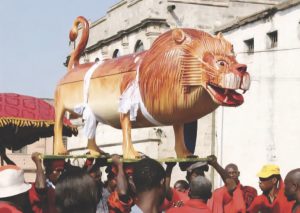
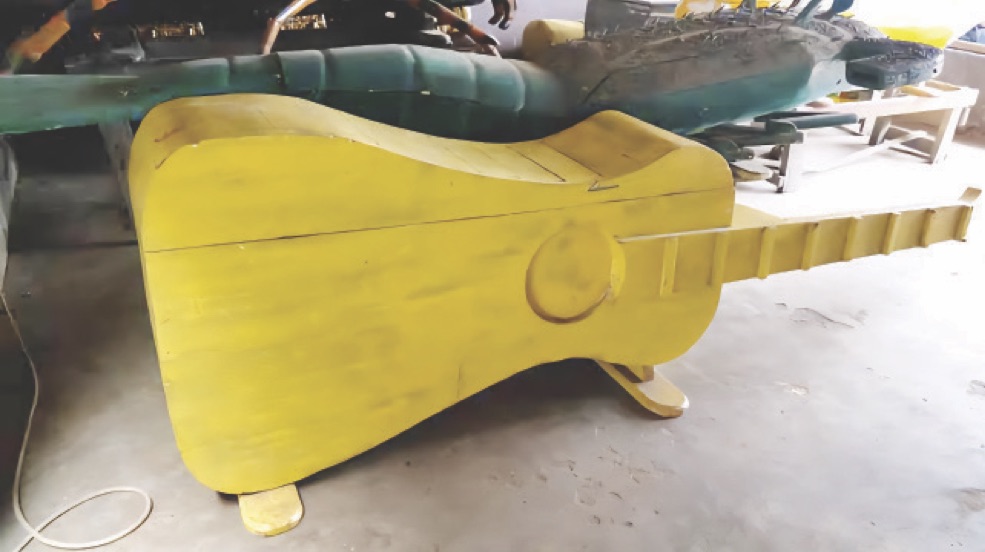
The Ghanaian burial rites have become a hit with tourists and it is something they eagerly go to see. The particular burial rite that has become most fascinating is the artistically crafted burial coffins called Fantastic After Life Vehicle (FAV). The Ga people of Ghana called these coffins ‘Abebuu Adekai or Abeduu Adekai’. These are coffins beautifully designed with wood and painted to reflect pieces of art works. Most of the artists in the creative coffin arts are found in the Greater Accra area.
Ghana may not necessarily have awesome tourist endowments that could rival sites such as the Pyramid of Egypt, the Petra of Jordan, the Rome Coliseum and such others, but the country has over the years built a tourism profile anchored on reliability. The reliability of infrastructural facilities, security and then a conscious effort to effectively promote their historical and ecotourism endowments and it is something many West African countries should learn from. The FAVs have added to the profile of Ghana as a destination.
During a recent visit to Ghana, outside the traditional places of tourist interest such as the Nkrumah Park and so on, the tour guide took the group to one of the art galleries around the Greater Accra area, not too far from the Labadi beach front. The owner of the gallery is one of the leading artists in Ghana. Initially, what one saw was the normal pieces of different kinds of artworks exploring different mediums, the normal beautiful painted splash of colours on media such as canvas, wood, and so on. Outside there were some wooden sculpted works. The designs vary from the regular art work to the grotesque and weird works that only come from the imagination of eccentric artists.
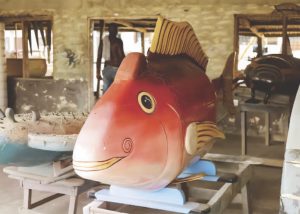
However, from the entrance of the gallery, there was a wooden sculpture of a gigantic larger than life size crab in multi-colours of white, red, brown and blue. Inside there other such sculptors of different items, a sport canvass with Nike written on it, a Tiger, a ferocious bird, a truck, fish, and so on. Apart from the size, these items were like any other sculpted work depicting these objects. Then the tour guide explained to me and others that were on the tour that these objects were coffins. And each of these coffins and each of them could sell for nothing less than the equivalent of 700 dollars, more than one million naira. We are in the gallery of one big collector of fantasy coffins or coffin arts.
One used to have the impression that when it comes to flamboyance in the celebration of the dead, no country comes close to Nigeria, but seeing these designers’ coffins, I was forced to have a rethink.
According to him, the coffin art has been around for more than 50 years and it is steeped in Ghanaian culture.
According to him, the choice of designer coffins to bury an illustrious loved one is predicated on the occupation of the deceased on what he cherished most in his lifetime. According to our tour guide the coffin is part of the burial ritual of a loved Ga tribe in Ghana.
The coffins show the social status, occupation, tastes, or desires of the departed. Some of these depict the mode through which the deceased earned his/her livelihood. The coffins are mainly designed to represent an aspect of the dead person’s life — such as a car if they were a driver, a fish if their livelihood was the sea, a snail-shaped coffin for a snail-seller or a sewing machine for a seamstress. They might also be symbolic elements of his life – such as a bottle of beer, a cigarette, hammers, mobile phones, hens, roosters, leopards, lions, canoes, cocoa beans or elephants.
An interesting audio clip from the gallery explains the custom and the setup of the process. According to the report, “For the Ga tribe in coastal Ghana, funerals are a time of mourning, but also of celebration. The Ga people believe that when their loved ones die, they move on into another life — and the Ga make sure they do so in style. They honour their dead with brightly coloured coffins that celebrate the way they lived.”
Just like the ancient Egyptians filled up the pyramids with food and water and basic amenities, the locals believe that this represents their afterlife and so it should be beautiful. There is also a downside to this practice – the risk of robbers apparently. That is why some of the most beautiful coffins are partially destroyed before they are buried.
A carpenter explains that the coffin acts as a home in the afterlife, so it must be beautiful. But he laments that after putting so much time into creating the coffin, it gets hidden underground.
“By the end of the day, they are going to bury this thing, which has taken so much time, so much energy…” he said.
The coffins vary with size and shape, and some of them might not be of considerable size. But for the locals, what is more important is the “representation” of the deceased than the practicalities associated with the departure.”
Some of the clients are poor locals, for whom the tradition costs them almost the earnings of an entire year. Thus, tradition does come at a cost. But again, tradition also comes with a strong symbolism.
The tradition is said to have started with a man called Kane Kwei who died in 1992. However, his family is still carrying on the tradition of making FAV coffins. His son Cedi Anang, explained how it started: “My father was the famous Kane Kwei. He started the tradition in Ghana. Formerly, he was just an ordinary carpenter engaged in making furniture. There was a time a wealthy fisherman died and his family decided to bury him with something that symbolised his occupation. They requested a coffin made in the shape of a lobster.” That was how the tradition started.
Although Accra Ghana as a destination no longer sees the influx of Nigerian tourists as it was in the past due to the devaluation of the naira which has made casual holidays in Ghana very expensive for Nigerian, but for those on tour of Ghana, visiting the galleries to see the FAVs would definitely be worth it.