Follow Us on Google
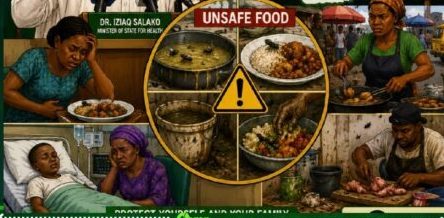
The Federal Government has raised fresh alarm over the growing burden of food-borne diseases in the country. The government also disclosed that unsafe food has caused more than 53,000 deaths and about 50 million illnesses across the country yearly. According to the Minister of State for Health and Social Welfare, Dr Iziaq Salako, “together these illnesses and deaths result in a staggering 4.26 million years of healthy life lost to illness, disability or early death.” The minister further said that most of this burden falls heavily on children under five, who account for more than 80 per cent of all foodborne disease burden in Nigeria.”
The minister stated this in Abuja as part of activities to mark this year’s World Food Safety Day organised by the ministry in collaboration with the National Food Safety Management Committee (NFSMC). The 2026 World Food Safety Day theme, “From Burden to Solutions—Safe Food Everywhere,” underscores the importance of food safety to good health and national development. Recent data from the World Health Organisation (WHO) say that unsafe food causes approximately 866 million illnesses and 1.52 million deaths globally each year. The UN agency explains that children under five bear a disproportionate burden, accounting for 29 per cent of this public health crisis and around 143,000 fatalities annually.
It further says that one in nine people worldwide falls ill annually after consuming food contaminated with bacteria, viruses, parasites, or harmful chemicals. The global health agency reiterates that unsafe food results in an estimated loss of US$310 billion each year in medical expenses and lost productivity. Most of the food-borne illnesses are traceable to biological hazards, such as Salmonella, E. coli, and Norovirus, while chemical contaminants, like lead and arsenic, cause a disproportionate share of total deaths.
According to experts, unsafe food is any food or beverage containing harmful bacteria, viruses, parasites, or toxic chemicals that make it injurious to health or unfit for human consumption. They also point out that eating contaminated food is the primary cause of foodborne illnesses or food poison.
Overall, the burden of food-borne illness is reportedly highest in low-and middle-income regions, with the African and South-East Asian regions accounting for nearly 75 per cent of all cases and 60 per cent of deaths.
The minister equally pointed out that most of the disease burden is driven by diarrhoeal pathogens, with over 40 million diarrhoeal illnesses in Nigeria linked to food-borne pathogens, including Salmonella, E.coli, Campylobacter, Shigella and rotavirus. He added that these infections are major cause of hospitalisation, malnutrition and mortality among Nigeria’s youngest citizens.
Other News
We laud the Federal Government for raising the alarm over food-borne diseases and the dangers of consuming unsafe food. Beyond raising the alarm, the government should move a step further to ensure that food is available to the masses at affordable prices. The economic hardship in the country caused by some of the economic reforms of this administration can even make some Nigerians to buy and consume unsafe food. Let government subsidise the cost of certain food items and make them accessible to the poor masses.
Government can open the grain silos and make the food items available to many Nigerians as a way of saving them from consuming unsafe food. The government should encourage large-scale mechanised farming as a way of boosting food production. The emphasis now should be on all seasons farming. For this to work, government must curb the growing insecurity and kidnapping for ransom across the country. The kidnapping industry must be eliminated.
Some unscrupulous business owners contribute to the consumption of unsafe food by changing the expiry date of some of their products, including medicines. Some food vendors use unclean water to prepare food, while some traders use chemicals to ripen fruits. This is why the National Agency for Food, Drug Administration and Control (NAFDAC) should be vigilant and routinely check the super markets, warehouses of food companies and open drug markets to ensure that what they sell to Nigerians are safe for consumption.
Apart from NAFDAC, the government should reintroduce sanitary inspectors or environment health officers who are responsible for monitoring hygiene compliance in residential, commercial and public spaces to prevent disease outbreak. They can play a vital role in food safety by checking the hygiene standards of markets, slaughterhouses and restaurants.
Government should do a lot of public education on food-borne diseases and dangers of consuming unsafe food in the country. There is also need for consumer education now that unsafe food leads to millions of deaths in the country. State and local governments should enlighten their citizens about food-borne diseases and the effects of consuming unsafe food.