Follow Us on Google

United States of America-based professor of history and eminent academic, Toyin Falola, has reiterated the need for Nigeria to ensure that it arrests the growing unrest in the country as a result of the worsening food insecurity, cautioning that such was enough to destabilize citizenship and the nation at large.
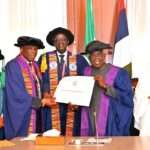
Falola made this known in his address on citizenships during the just-concluded African Humanities Research and Development Conference (AHRDC 2024) put together by the African Humanities Research and Development Circle in partnership with the University of Nigeria, Nsukka, and Alex Ekwueme Federal University, Ndufu-Alike, Ebonyi State. The programme had Professor Egodi Uchendu and Dr Chukwuemeka Agbo as conveners. The event, held between February 19 to 21, 2024, at the Alex Ekwueme Federal University, Ndufu-Alike, Ebonyi State, Nigeria, was done in honor of Professor Falola.
Professor Toyin Falola is a distinguished Professor of African Studies whose scholarship transcends the boundaries of Africa, especially in the areas of African epistemologies and African History. He holds the Jacob and Frances Sanger Mossiker Chair in the Humanities, is a Professor of History, and is a Distinguished Teaching Professor at the University of Texas at Austin. In addition, he holds three Distinguished Professorships in South Africa, and an Emeritus Professorship in a Nigerian University.
Speaking, Falola stated that “The context of citizenship is very depressing for the Nigerian situation. It is citizenship crucifixion without resurrection, in which the state is crucifying its citizens. This concept is different from that of persecution. Political persecution refers to the cases of Nnamdi Kanu, Omoyele Sowore, and other political prisoners. This is about how in your land, you can be hungry; you can starve to death. How can a minimum income be N35,000 and a bag of rice is N75,000? Do you want the person to claim citizenship? Or if there is hunger in the land, would that food insecurity not destroy citizenship and the state itself? You cannot be a citizen and some people will be in Abuja and begin to do IMF and World Bank and say your life is not important to them. They say ‘If you like go and die’. But this death is not defined; it is not a mission of divinity, which is why I said that you are not going to resurrect after your crucifixion.”
He also lashed out at the nation’s ruling elite’s growing intolerance to alternative voices. “There is also banishment without crime in the Nigerian context. If you have read Chinua Achebe’s Things Fall Apart, you will see how Achebe closed the Okonkwo story. Also, take note of how the Yoruba and other nations in Nigeria banish an offender; they state very clearly the offenses that will lead to your banishment: adultery, criminality, or theft. They won’t kill you; they would say ‘Can you pack your luggage and leave and never come back?” That is banishment. Even if you read the history of Ibadan in the 19th century, they even banished their kings and chiefs. They banished one of them and instructed him to go and live among the Ijebu people and that he should not return,” he stated.
On geopolitics, he warned the world was at a critical stage, saying that “this is defined in terms of new wars, new competition, and emerging financial transactions. The Ukraine war is still ongoing; we don’t know its resolution. But if they want to resolve the war very quickly, they have to remove some portion in the South of Ukraine and give it to Russia. That will just solve the problem right away. Russia is not going to give up the Vulcan even if it means the last soldier standing. If they give part of Ukraine to Russia, you will find changing citizenship, and that is a subject that we need to talk about. Not far away from where this conference is holding is Cameroon, and the people have been saying that Cameroon should be broken into two. The Ambazonians as they call themselves are at the forefront of this. You all remember that if Biafra had succeeded, it would have been a republic with a new form of citizenship. This geopolitics is always with us. Sudan became two countries: Southern and Northern Sudan. Eritrea left Ethiopia. The point is about how wars and geopolitics can reshape what we call citizenship. You can be a Cameroonian today and wake up becoming an Ambazonian.”
He noted that the concept of difference “in which we use color, genotype, and others is of crucial significance. If I were to put in the same room a Hutu and Tutsi (because I have been to Rwanda, unless they tell you, you won’t know the difference. If they tell you the difference, they will weave it around color and the nose. And you ask yourself: what is going on here? Why are you characterizing a white skin and black one as two different kinds of identity? Many of you may know that if you see a Palestinian and a Jewish person, you won’t know the difference. It is the same color. There are Arabs in Israel; there are Christians in Israel; there are Muslims in Israel. On the other side of Gaza where they are fighting, they look alike; and there are Christians and Muslims there; there is also Judaism there. You can see how complicated this notion of citizenship is. If I go to an American store, if I don’t talk thereby revealing my accent, they won’t know where I am from. They could say that I am an African American. This is so that even an accent can be part of this conversation. It is also significant because historically, many have been excluded from citizenship.”