Follow Us on Google
• Govt, SEITAC unveil project to save lives when flooding, waterways accidents occur
From Obinna Odogwu, Awka
No fewer than 241 people lost their lives in different parts of the country when floodwaters swept through communities, local council areas and states this year.
A total of 144,790 people were displaced; 839 others sustained varying degrees of injury, even as 115 persons went missing.

This was according to the 2025 Flood Dashboard released by the National Emergency Management Agency (NEMA) which went further to reveal that a total of 433,578 people were affected by the flooding across 27 states and 123 Local Government Areas of the country as of November 4 this year.
According to the report, the disaster damaged 52,509 houses and destroyed 74,767 hectares of cultivated farmlands, leaving thousands of people without shelter and livelihoods.

In 2024, about 5,264,097 people were affected by that year’s flooding which swept through different parts of the country. About 1,237 lives were also lost to the floodwaters, according to NEMA.
The 2022 flood disaster appeared to be the worst Nigeria has ever recorded. More than 600 people died in it; about 1.3 million people displaced, and more than 200,000 homes destroyed, according to the humanitarian affairs’ ministry.
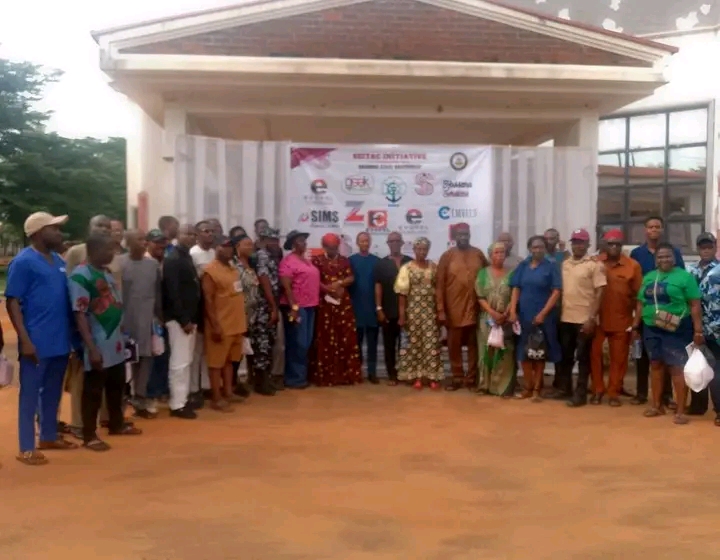
Worried by these sad developments, SEITAC Initiative, in collaboration with the Anambra State Government, last Saturday launched ACQUARESCUE project, a cutting-edge, people-focused intervention with the mission of predicting, preventing, responding, and rescuing people from flood disasters.
The event, with the theme, ‘Saving Lives, Building Resilience – Technology and Community at the Heart of Water Disaster Response’ was held at Prof. Dora Akunyili Women’s Development Centre, Awka.
Founder of the organisation, Uzo Okoye, during the official unveiling of the project, said that the initiative was a visionary project born from necessity, and driven by a deep commitment to saving lives and securing communities against water-related disasters.
Okoye, an engineer, explained that the project was an African-built solution and ideas designed to solve the targeted problems and protect the African people during unfavourable weather events.
“Across Africa, floods, coastal surges, dam failures, erosion, and water-transport accidents have increased at an alarming rate”, he lamented.
“Communities are displaced, economies ruptured, and far too many precious lives are lost – often not due to the disaster itself, but because help arrived too late, or warnings never arrived at all.”
He said that with timely information, innovative technology, and a coordinated response system, many lives could be saved in the event of water related challenges.
He revealed that long before the project was conceived, the organisation had built structures, supported churches, trained volunteers, and provided help where needed.
“But the scale of water-related challenges we witnessed demanded a bigger, more intelligent, more data-driven solution”, he stated.
“That is why we built InfraBantu – our proprietary Infrastructure Data Management Software.
“InfraBantu allows governments, institutions, and responders to visualise, analyse, and manage critical infrastructure data with precision.
“It maps vulnerabilities, predicts risks, and supports evidence-based decision-making. And today, it forms one of the foundational digital engines powering the intelligence behind the ACQUARESCUE Project.”
Okoye said that ACQUARESCUE mobile app was the organisation’s second major innovation which is currently being developed but would be completed very soon, explaining that the app was designed to be Africa’s premier early warning and emergency response platform for water-related disasters.
“Through real-time alerts, community reporting tools, geo-tagged SOS features, and rapid coordination with responders, the app will ensure that no call for help goes unheard and no disaster strikes without a warning”, he explained.
Speaking further, he said that with the project in place and running, a future where a farmer receives a flood alert before the river overflows; a community is evacuated hours before a dam breaches; a family stranded in a boat accident is located and rescued within minutes, and a future where governments can predict risk zones using satellite-linked data and community intelligence, is very possible.
“The reason why this matters is because disasters do not wait for preparation; because communities deserve a lifeline, because Africa cannot continue losing billions in assets and thousands of lives every year, and because innovation is the new frontier for humanitarian leadership”, he said.
Going forward, Okoye said that the organisation would, in the coming months, roll out Africa-wide volunteer rescue networks, high-speed water emergency response units, data-driven community risk assessments, disaster education programmes and others to promote safety during flooding.
Commissioner for Women’s Affairs and Social Development in the state, Hon Ify Obinabo, in her keynote address, said that the government was pleased to unveil the project aimed at confronting one of the most critical challenges shaping Africa’s future – the rising tide of water-related disasters that threaten lives, livelihoods, infrastructure, and national development.
Delivering the address titled: ‘Responding to Africa’s Rising Water Disasters: A Call for Innovation’, Obinabo said that across the African continent, from Nigeria to Mozambique, South Sudan to Sierra Leone, floods, tidal surges, boat mishaps, riverbank collapses, and coastal erosions have destroyed communities that once flourished.
“These disasters are no longer occasional; they are becoming the new reality — intensified by climate change, rapid urbanisation, unplanned settlements, and gaps in emergency preparedness”, she added.
Other News
“This is the context that gave birth to AcquaRescue, a vision proudly championed by the SEITAC Initiative and embraced by the Anambra State Government.
“It is a vision driven by compassion, informed by science, and sustained by the belief that Africa can do more than react to disasters – Africa can innovate its way to safety, resilience, and sustainable development”, she stated.
The commissioner lamented “the growing crisis” across Africa, saying that the continent loses thousands of lives every year to avoidable water disasters.
“In Nigeria alone, floods in 2022 displaced over two million people and claimed more than 600 lives. Boat accidents in riverine communities occur with alarming regularity.
“Entire farmlands are washed away; children are forced out of school; economic progress is reversed in a single rainy season”, she lamented.
The commissioner argued that the human and economic losses should spur the continent to explore opportunities in the information and communication technology (ICT) with a view to rethinking how to prepare, respond and protect its people.
“Innovation is no longer optional; it is essential. The world is evolving, and Africa must evolve with it”, she declared.
Obinabo said that innovation meant using data to predict floods before they strike; using technology to map vulnerable communities; designing safer waterways transportation systems; building smarter evacuation and response networks; training responders, boat operators, and citizens to save lives and creating partnerships that multiply impact and reduce costs.
“This is exactly what the AcquaRescue Project represents – a new model for protecting communities through integrated innovation”, she added.
The commissioner explained that the project introduces a comprehensive, scalable, and tech-enabled approach to water disaster management which includes early warning and flood monitoring systems that would alert communities about impending dangers using sensors, satellite data, and digital platforms.
She said that with the project, a fleet of modern rescue boats and trained responders would be provided and that the equipped team would be on standby, ready to deploy in minutes.
“This project will support the state in regulating boat operations, improving compliance, and reducing accidents.
“Villages, markets, schools, and transport hubs will be educated on evacuation plans, safety tools, and survival techniques”, she explained.
The commissioner said that the programme would support water transport development in the state, and that through a public-private partnership model, AcquaRescue aims to create safe, revenue-generating waterways systems for the state.
“It is not just a project, it is a living ecosystem for safety, preparedness, and resilience. It is a model for the rest of Africa. And our goal is simple: Let Anambra become the blueprint for Africa.
“A blueprint for reducing preventable deaths, digitising waterway operations, strengthening emergency response capabilities, and creating a culture of safety.
“If we succeed here – and we will – this model can be replicated in Delta, Bayelsa, Rivers, Benue, Kogi, and across the entire continent”, she stated.
Obinabo, however, made it clear that the government must create enabling policies, provide institutional support, and integrate innovation into planning to ensure that the objectives of the rescue program are actualised.
“The private sector must bring technology, and operational expertise. Communities must embrace safety culture, participate in training, and ensure compliance”, she said.
The commissioner emphasised the need for collaboration, saying that in unity, the waters that once threatened the people would become channels of opportunity.
“Imagine an Anambra where no boat leaves the shore without a safety check; where children in flood-prone villages sleep without fear; where responders arrive instantly; where waterways become safe for trade, tourism, and transportation; and where innovation becomes our shield against natural disasters.
“This is the future AcquaRescue envisions. A future where Africa rises above its water challenges with courage, creativity, and collaboration.
“With AcquaRescue, with government partnership, with community ownership and with the unwavering spirit of innovation, we can transform disaster from a threat into an opportunity – an opportunity to build resilient communities, protect our water users, and save countless lives.
“Let today mark the beginning of a new chapter; a chapter where Africa responds to water disasters not with fear, but with innovation, preparedness, and collective strength”, she concluded.
Meanwhile, a resource person at the event, Mr. Ukonu Ukonu, spoke on snail value chain, reeling out the many economic benefits of snail farming as well as its nutritional value.
He encouraged the participants to venture into snail farming, disclosing that its demand is high, both in the local and international markets