Follow Us on Google
By Chukwuma Umeorah
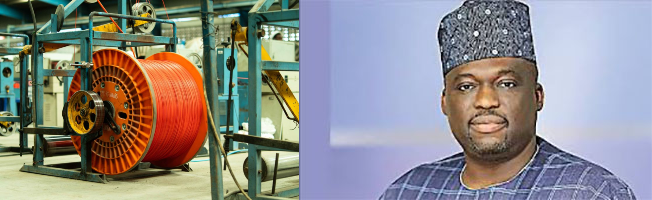
The Federal Government has said that the newly commissioned Coleman Fibre Optic Cable Factory II will serve as a national asset that will accelerate Nigeria’s digital transformation, reduce import dependence, and strengthen local industrial capacity.
President Bola Tinubu, made this known during the commissioning of the factory and the celebration of Coleman Technical Industries Limited’s 50th anniversary in Ogun State on Wednesday. The factory is Africa’s largest Fibre Optic Cables and Africa first reinforced plastic production factory.
Tinubu who was represented by the Special Adviser to the President on Ease of Doing Business, Dr. Jumoke Oduwole, said the factory will boost strategic Nigerian economy’s competitiveness, fast-track digital transformation, support job creation, and improve national infrastructure.
“Every kilometer of fibre made here strengthens the backbone of our digital economy, accelerating broadband for homes and businesses, enabling secure e-commerce, powering smart factories, and modernizing public services,” she said.
Oduwole emphasized that the expansion will help reduce foreign exchange outflows. According to her, “Having this scale of production here in Nigeria conserves foreign exchange, creates quality jobs, and positions us as a regional supplier into the rest of Africa under the African Continental Free Trade Area.
“With this new facility, our country has greater capacity to expand digital infrastructure, reduce the cost of Internet access, and deepen broadband penetration. Local fibre allows faster, more affordable rollouts of 5G, last-mile connectivity and resilient networks for security-critical operations.”
She added that President Tinubu has directed regulatory and financial institutions to sustain an enabling environment for manufacturers. “I charge our regulators to make compliance predictable, digital, cost-effective, and swift. Quality and speed are not opposites, they are the twin rails of competitiveness,” she said.
Minister of Communications, Innovation and Digital Economy, Dr. Bosun Tijani, said the new plant is critical to Nigeria’s plan to deploy 90,000 kilometers of fibre optic network across the country. “The President decided as a nation, we will invest in 90,000 kilometers of fibre optic network across this country. Every corner of our nation will be covered with fibre optic cables,” Tijani said.
He disclosed that the World Bank has approved $500 million for the broadband project, describing it as the largest in the bank’s portfolio. “There’s no project as big as that project in the portfolio of the World Bank,” he said.
Tijani revealed plans to train 5,000 young Nigerians on fibre technology, splicing, and deployment in partnership with Coleman. “This is something that will be starting in about two to three months,” he said.
The minister noted that improved connectivity would enhance productivity across key sectors. “In Brazil, farmers use internet and satellite technology for precision farming. They end up saving 95 percent on the cost. That would be impossible for me to achieve without connectivity,” he said.
Ogun State Governor, Dapo Abiodun, described the project as a milestone that reinforces the state’s position as the country’s industrial hub and a major driver of the digital economy. “For us in Ogun State, today’s commissioning marks a defining moment in our state and in Nigeria’s digital revolution. In an age powered by data and connectivity, fibre optics has become the lifeblood of modern communication.”
Abiodun disclosed that the state is laying 3,000 kilometers of fibre cables under its Digital Economy Project, with Coleman as a key supplier. “Those cables we will be buying from Coleman,” he said.
He added that local fibre production will support national economic growth. “According to the World Bank, a 10 per cent increase in broadband penetration can raise GDP by up to 1.4 percent in developing economies. By producing these cables locally, Nigeria is not only reducing its dependence on imports but also creating thousands of direct and indirect jobs.”
The MD/CEO of Coleman, George Onafowokan while recounting the growth and impact of the company, pledged that Coleman “would continue to deliver products of high quality. Our progress today is as a result of years of strategy and relentless pursuit of efficiency and excellence. We have invested in technology and built capacity ensuring that Coleman not only meets demands, but define the standards of quality and reliability in our industry.”