Follow Us on Google

• NEC orders fresh funding for NEMA, ministries to tackle floods
• Local emergency management committees to be established in LGAs
From Juliana Taiwo-Obalonye, Abuja
The Federal Government and state governors have launched the Renewed Hope Ward Development Programme, aiming to deliver the benefits of recent economic reforms to Nigeria’s 8,809 wards through job creation, improved food security, and poverty reduction.
Unveiled during Thursday’s National Economic Council (NEC) meeting on July 31, 2025, chaired by Vice President Kashim Shettima, the programme targets at least 1,000 economically active individuals in each ward for direct support to invigorate grassroots economic activities.
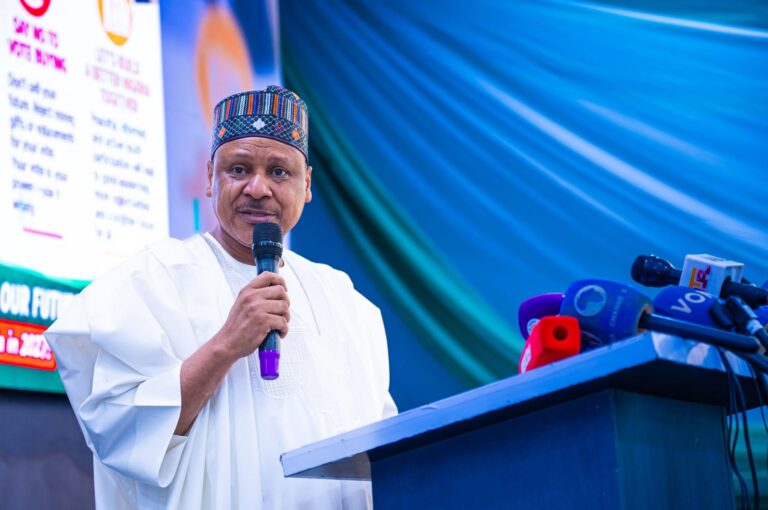
Addressing State House Correspondents after the meeting, the Minister of Budget and Economic Planning, Atiku Bagudu, said President Bola Tinubu, who attended the session, praised governors for their collaboration and described the initiative as a “historic next step” in the government’s reform efforts.
“Having stabilised the macro-economy, the next step is to drill development down to the lowest levels so that, in all 8,809 wards, we can stimulate economic activity that will generate employment, reduce poverty, enhance food security, and strengthen social protection,” Bagudu stressed.
He explained that the programme will be funded collaboratively by federal, state, and local governments using increased Federation Account revenues and will complement other ongoing development projects.
Bagudu noted that the plan is rooted in Chapter Two of the Nigerian Constitution, which charges all levels of government with the responsibility to “harness the resources of the nation and promote a dynamic, self-reliant economy.”
Describing the initiative as “a Federation project,” the minister revealed that NEC approved making his ministry the programme’s secretariat.
He further referenced the latest IMF Article IV report praising Tinubu’s bold economic reforms—such as fuel subsidy removal, foreign exchange market liberalisation, and improved revenue administration—that have bolstered Nigeria’s economic resilience.
“Mr President believes that to reduce poverty and food insecurity, we must invest collaboratively in the creative energy of Nigerians in every ward. Having achieved macroeconomic stability, this programme is the natural next step,” Bagudu said.
At the briefing, Imo State Governor Hope Uzodinma highlighted the council’s unanimous support for the programme, calling it a means to ensure reform benefits reach “the common man on the street.”
“The country is earning more money now, and so are subnational governments,” Uzodinma noted. “The president brought a programme that will fast-track the process of this additional money making a bigger impact by trickling down to the grassroots. This is how Nigerians will begin to feel the Renewed Hope agenda at their level.”
Uzodinma added that NEC discussed environmental impact assessments for major infrastructure projects, including the Lagos-Calabar Coastal Road and the Sokoto-Badagry Road, and plans to establish a committee to coordinate federal and state efforts to accelerate these projects.
With NEC’s endorsement, the Renewed Hope Ward Development Programme is set to bridge Tinubu’s macroeconomic reforms with direct, grassroots benefits, unlocking small-scale economic opportunities and helping advance the administration’s goal of a $1 trillion economy.
“The reform policies are beginning to yield fruits,” Uzodinma concluded, “and now the focus is on making sure those fruits are felt all the way down to the grassroots.”
The Council also directed the release of fresh funding to strengthen Nigeria’s flood preparedness and disaster management efforts, mandating support for key federal ministries, agencies, and state governments ahead of the looming rainy season.
Other News
The resolution follows forecasts predicting heavier-than-usual rainfall in 2025, to ensure a coordinated push to prevent the devastating impact of past floods and ensure resources flow to frontline agencies and states best positioned to protect lives and property.
The Minister of Finance and Coordinating Minister of the Economy, Wale Edun, confirmed that resources will be channelled to the National Emergency Management Agency (NEMA) and other critical ministries, including Water Resources, Budget and Economic Planning, and Environment.
“Last year, funding was provided to support NEMA and related ministries. This year, we have once again been mandated to put together an intervention programme that will provide tangible and meaningful support for flood prevention and relief efforts,” Edun told State House correspondents after the meeting.
Edun explained that the intervention will extend beyond federal agencies, covering state emergency management agencies (SEMAs) and the 36 states, along with the Federal Capital Territory.
The NEC also agreed that local emergency management committees should be established and activated across all local government areas, with emergency coordination forums to be convened regularly.
The finance minister said the plan will ensure improved coordination among federal, state, and local actors, building on last year’s groundwork to deliver a more robust response to flooding.
Earlier in the meeting, NEMA’s Director General presented a detailed briefing on the agency’s 2025 preparedness, outlining progress made, including:
– A multi-year disaster relief and response strategy (2024–2027) developed with UNDP support;
– A nationwide hazard risk analysis in collaboration with UNICEF;
– Signed MOUs with disaster relief units of the police, civil defence, and Nigerian Red Cross;
– Partnerships with six universities offering disaster risk management programmes.
Despite these strides, NEMA identified gaps such as poor drainage systems, delays in data collection from insecure, flood-prone areas, and weak enforcement of urban planning and building codes.
In response, NEC issued a call to action to governors, urging them to:
– Strengthen state emergency agencies,
– Set up local emergency management committees,
– Enforce building codes and physical planning laws,
– Institutionalise monthly environmental sanitation,
– Prioritise funding for disaster preparedness.
“Flooding is a shared challenge and requires a whole-of-society approach,” Edun said. “All tiers of government must be fully involved, from enforcement of planning laws to equipping emergency response teams.”
Edun revealed that emergency operation centres had already been activated nationally and zonally since May 29, with equipment deployed to high-risk states.
He said NEC’s renewed funding directive would ensure the momentum is sustained.