Follow Us on Google
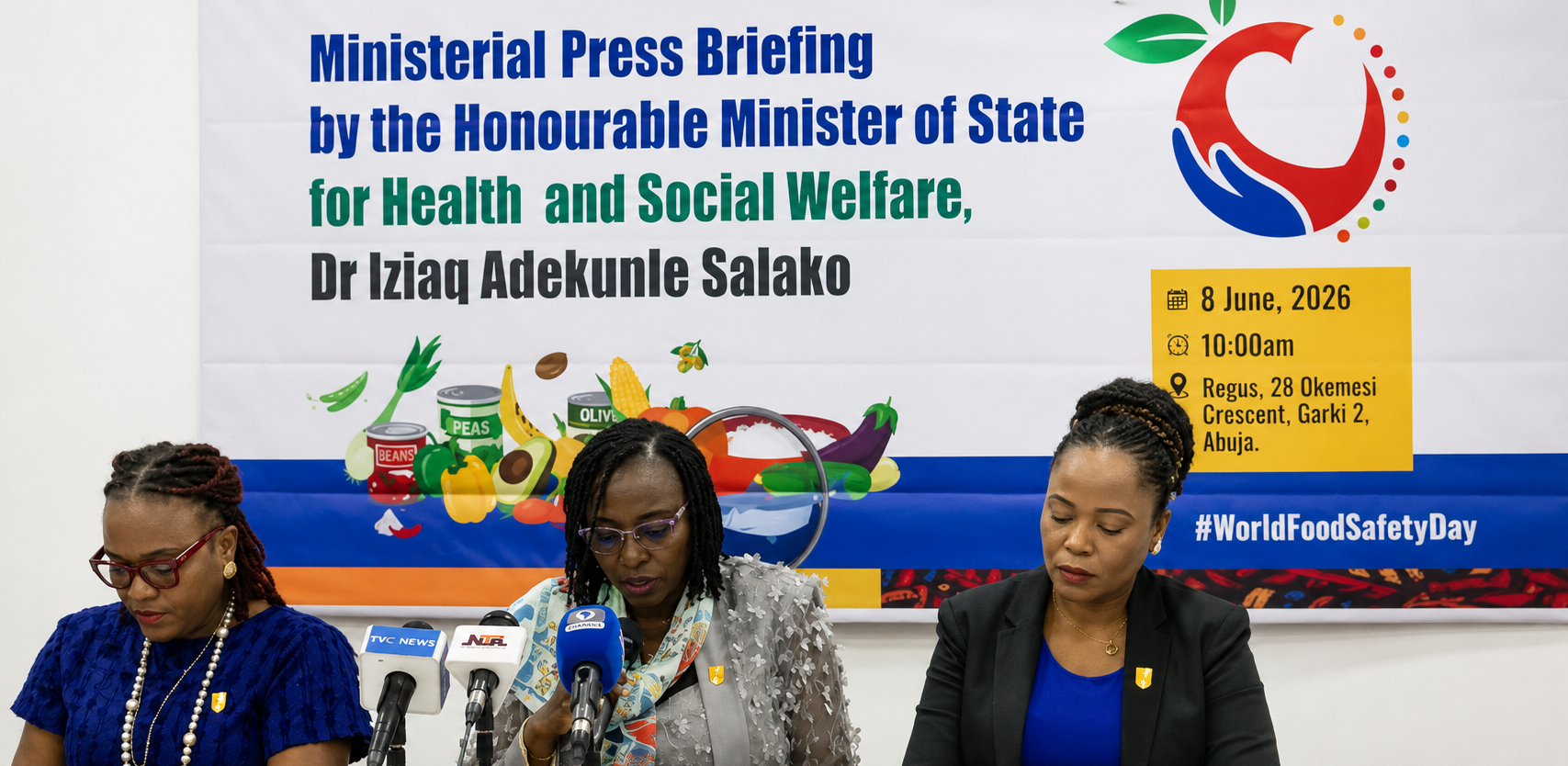
From Idu Jude, Abuja
The Federal Government of Nigeria, in partnership with the World Health Organisation (WHO) and other stakeholders, says it is ready to end health challenges associated with cases of unsafe food in the country.
The Minister of State for Health, Dr Iziaq Adekunle Salako, made the remark on Monday in Abuja while addressing the media in commemoration of the 2026 World Food Safety Day.
He stated that millions of lives in Nigeria are endangered, with updated modelling showing that 1.5 million lives are lost annually owing to food-related diseases.
Consequently, he said that Africa continues to carry the highest per-capita burden, and children under five bear a disproportionate share of the impact of unsafe food.
“For Nigeria, the new estimates confirm the scale of the challenge. Our national data show that Nigeria records nearly 50 million foodborne illnesses every year, and unsafe food causes more than 53,000 deaths annually in our country. Together, these illnesses and deaths result in a staggering 4.26 million years of healthy life lost to illness, disability, or early death.”
The Minister said that Nigeria joins the global community in commemorating the 2026 World Food Safety Day under the theme, “From Burden to Solutions: Safe Food Everywhere”. This theme is a powerful reminder that food safety is not merely a technical issue; it is a national development priority that affects the health, productivity and wellbeing of every Nigerian.
Just days ago, the World Health Organisation (WHO) released updated global estimates of the burden of foodborne diseases for the period 2000–2021. These new figures reveal a far greater burden than previously understood.
Globally, records also indicate that the updated modelling of unsafe food now causes an estimated 866 million cases annually.
“Together, these illnesses and deaths result in a staggering 4.26 million years of healthy life lost to illness, disability, or early death. Most of this burden falls heavily on children under five, who account for more than 80% of all foodborne disease burden in Nigeria.
“In practical terms, this means the true cost of unsafe food in Nigeria is not only measured in sickness and death, but also in the lost cognitive, physical, and developmental potential of our children.
The minister observed that analyses have also shown that in most African countries, including Nigeria, the burden is so heavily concentrated among children that greater emphasis must be placed on preventing long-term human capital loss rather than focusing solely on adult productivity.
“The majority of this burden is driven by diarrhoeal pathogens. Over 40 million diarrhoeal illnesses in Nigeria are linked to foodborne pathogens, including Salmonella, E. coli, Campylobacter, Shigella, and rotavirus. These infections continue to be a major cause of hospitalisation, malnutrition, and mortality among our youngest citizens. Chemical hazards are also emerging as a serious concern, with lead exposure responsible for tens of thousands of healthy lives lost to illness, disability, or early death, especially through contaminated grains, spices, and water sources.”
He said these numbers underscore the urgency of strengthening food safety systems across the entire value chain.
“Yet, even as we confront these realities, we must also acknowledge the significant progress Nigeria has made. Our 2023 Joint External Evaluation (JEE) demonstrated measurable improvements in all indicators of food safety capacity, and our current 2025 State Party Annual Report (SPAR) score of level 3 places Nigeria ahead of the WHO food safety target for low‑ and middle‑income countries and Sub‑Saharan Africa. This means Nigeria is now one of the leading countries in the region in establishing functional systems for detecting, reporting, and responding to foodborne disease events.
Other News
“Through the National Food Safety Management Committee, we have strengthened collaboration across all relevant sectors. The 2023 National Integrated Guidelines for Foodborne Disease Surveillance and Response have given Nigeria a unified national system for foodborne disease surveillance, laboratory confirmation, outbreak investigation, traceback, food recall, and risk communication.”
However, he stated that these achievements must not lead to complacency. The new WHO estimates are a call to action. “We must intensify surveillance for heavy metals and chemical contaminants. We must improve food safety practices in traditional and informal markets, where most Nigerians buy their food. We must strengthen hygiene, water, and sanitation infrastructure and ensure that food business operators and vendors comply with national standards. We must also continue to build laboratory capacity, strengthen risk communication, and improve coordination across all sectors.”
Meanwhile, the minister has warned that food safety is not only about preventing infections; “it is also about ensuring that the food we eat does not contribute to the growing burden of noncommunicable diseases. Nigeria faces a rising epidemic of hypertension, stroke, heart disease, diabetes, and obesity, driven by unhealthy diets high in sodium, sugar, and trans fatty acids. We are responding decisively.”
Nigeria has developed the National Guidelines for Sodium Reduction aligned with WHO benchmarks. NAFDAC has finalised the draft Sodium Reduction Regulation, which will ensure sodium limits in processed foods. Nigeria is implementing the transfat elimination regulation, making us one of the first African countries to adopt WHO-recommended limits for industrial trans fats.
We are also working to strengthen the sugar-sweetened beverage tax, which is a proven tool for reducing sugar consumption; we appreciate the effort of the National Assembly on this. We are also developing front-of-pack labelling (FOPL) to help consumers make more informed food choices.
These actions demonstrate our commitment to ensuring that food in Nigeria is not only safe but also healthy. But to truly move from burden to solutions, every sector must play its part. We must ensure the full implementation of the foodborne disease surveillance and response system, enforce sodium and TFA regulations, and invest in safer traditional markets. Industry must reformulate products to reduce salt, sugar, and unhealthy fats, improve hygiene and traceability, and provide honest labelling. Academia must generate evidence on emerging hazards and food consumption patterns. Development partners must continue to support capacity building, disease surveillance, and One Health collaboration. And the public must adopt safer food handling practices, reduce reliance on salty and sugary foods, and make healthier choices.
Also speaking, the Director-General of NAFDAC, Professor Christianah Adeyeye, who was represented by Eva Edwards, Director of the Food Safety and Applied Nutrition Directorate, stated that the theme for the 2026 World Food Safety Day, “From Burden to Solutions, Safe Food Everywhere,” reminds us that food safety is not merely a technical issue; it is a public health, socioeconomic, and development imperative.
She informed the gathering that behind every statistic on foodborne disease is a child, a family, a community, or a business affected by preventable illness and loss.
“At NAFDAC, we remain firmly committed to contributing to reducing the burden of foodborne disease through science-based regulation, effective surveillance, a strengthened food control system, and robust stakeholder engagement.
“Our efforts continue to focus on ensuring that foods manufactured, imported, exported, distributed, advertised, sold and consumed in Nigeria meet the acceptable standards of safety and quality.”
The year 2026 marks the eighth edition of World Food Safety Day, and NAFDAC joins the Federal Ministry of Health and Social Welfare, the National Food Safety Management Committee (NFSMC) and the rest of the world in the commemoration.
“We reaffirm our commitment to working collaboratively with all stakeholders to strengthen Nigeria’s food safety system and ensure that safe, wholesome, nutritious, and quality food remains accessible to all.
“We recognise World Food Safety Day as an added opportunity to situate food safety as a significant issue of public health concern, especially in the light of safe, wholesome food being important for boosting immunity and improving the body’s natural defence in fighting diseases.
“Where food is unsafe, our nutritional goals cannot be achieved.”
The Country Representative of the World Health Organisation (WHO), Dr Parel Ursu, who was represented at the occasion by Dr Ponder Wakawa, Technical Officer for Nutrition and Food Safety, noted that Nigeria is on the right track to eliminate foodborne diseases, using various agencies to achieve maximum results. He said the country must match words with action, adding that most foodborne diseases are preventable with the collaborative efforts of all stakeholders. He stated that the WHO is always ready to partner with the country on its quest to fight foodborne diseases.