Follow Us on Google

From Noah Ebije, Kaduna
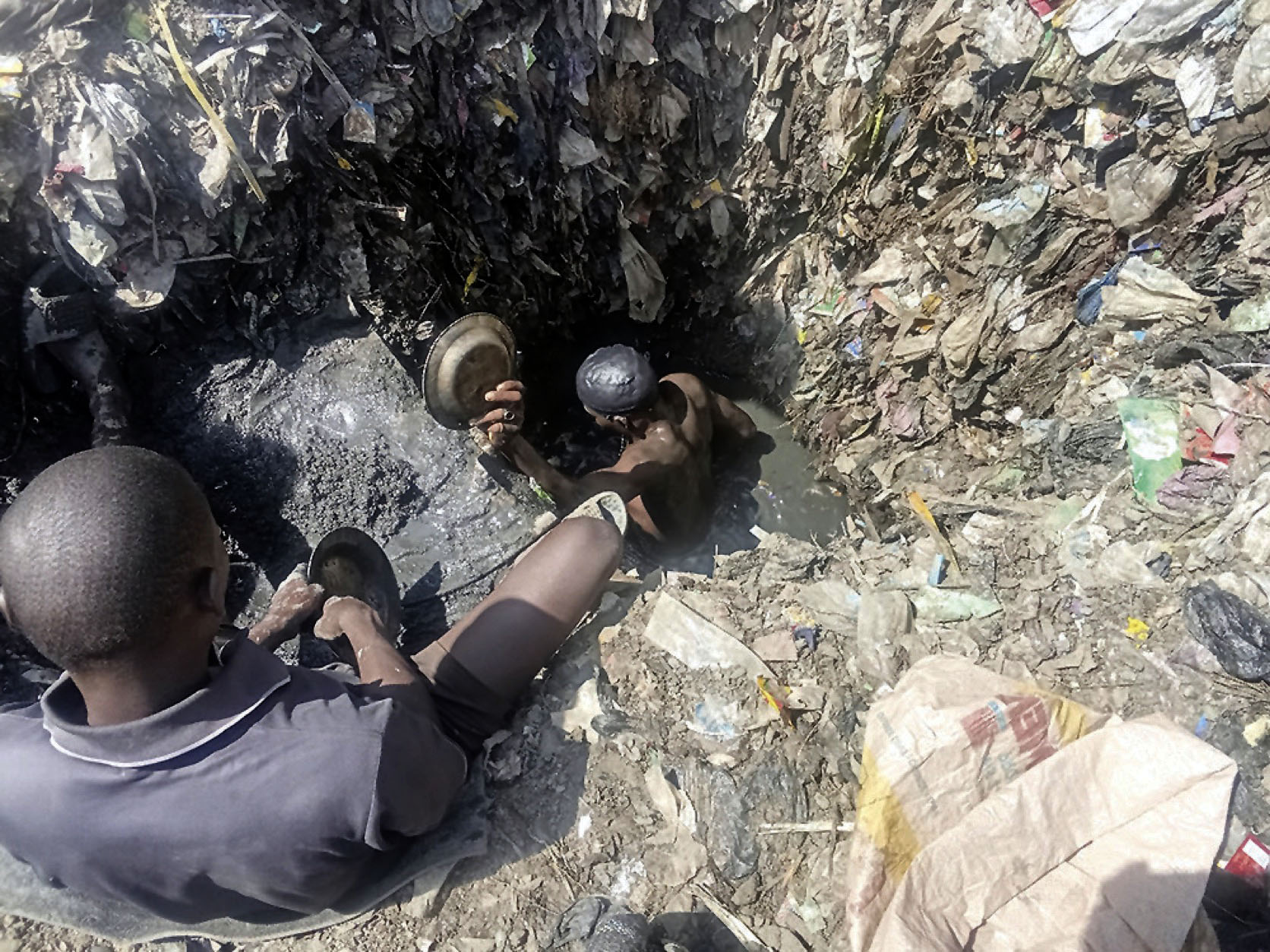
The environment is filthy, and the stench of decomposing refuse hangs heavily in the air along Ibrahim Taiwo Road, off Abeokuta Street, Kaduna. But none of this seems to bother Aliyu Kabir, who is submerged in a pool of muddy water inside a refuse dump, searching for something many people would hardly imagine could be found beneath such filth: iron and copper.
For Aliyu, who leads a team of five other boys, the refuse dump is a workplace, the muddy water is part of his mining field, while the iron and copper buried beneath the earth are his daily bread.
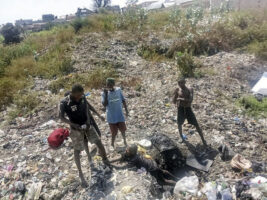
While many people see only heaps of discarded waste, these young men see wealth. Every day, they dig deeper, venture further beneath the murky water and expose themselves to health hazards in pursuit of the metals they can sell for money.
For them, the refuse dump is more than a mountain of rubbish. Beneath its dirt, waste and stagnant water lies what has become an unlikely source of livelihood.
Deep inside the dump, the boys have carved out an unusual workplace. They dig through layers of accumulated refuse, mud and sharp sand, sometimes going deep enough to encounter large pools of water. Without sophisticated mining equipment, they venture into the murky ponds in search of particles of iron and copper buried beneath the earth.
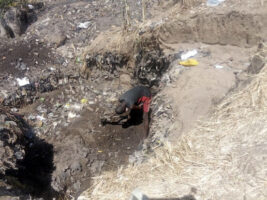
Their activities bear some resemblance to conventional mining, except that their mineral deposits are hidden beneath heaps of refuse rather than in established mining fields.
The work is physically demanding. They scoop out large quantities of mud and sharp sand, transfer the materials into containers and painstakingly separate the valuable metals from unwanted debris. Using magnetic objects, they extract iron, while copper is recovered through the sorting process. The remaining materials are discarded as they concentrate on gathering enough metal to make their efforts worthwhile.
For Aliyu, however, the activity is neither an adventure nor a temporary pastime. It is work, and he makes no attempt to disguise that fact.
Asked what he was doing inside the water, his response was simple: “This is work, oga.”
When asked what could possibly be valuable in such an unpleasant environment, he replied confidently: “It’s money.”
He then identified the materials they recover as iron and copper.
The boys, whose ages range from 15 to 25, reportedly engage in the activity almost every day. Depending on what they find, they recover between five and 15 kilogrammes of metal, although the quantities vary.
There is no fixed salary, guaranteed daily income or formal employment arrangement. Their earnings depend entirely on how much usable metal they can extract and sell.
Their destination is the popular Panteka Market in Kaduna, where buyers purchase the recovered metals for recycling and other commercial purposes. The materials are sold by weight, with the boys quoting a price of about N5,000 per kilogramme. They say their daily proceeds depend on the quantity recovered and the prevailing rates.
For the young miners, the money helps meet immediate needs and support their families.
Other News
Yet, behind the apparent commercial value of the recovered metals lies a story of economic vulnerability.
Asked how much he earns as a salary, Aliyu appeared puzzled by the question. He explained that he does not work for a fixed wage. Rather, he gathers whatever quantity of metal he can find, takes it to the market and sells it.
There is no certainty about what the next day will bring, but there is also little room for him to abandon the only means of livelihood he appears to have.
For another young worker, Khalifa Sani, the motivation is equally straightforward: survival.
He explained that the work provides some money whenever they are fortunate enough to recover sufficient quantities of metal. Sometimes they get five kilogrammes; on other occasions, seven, 10 or even 15 kilogrammes.
They subsequently transport their collections to the market for sale. Asked about his monthly earnings, he indicated that there was no fixed amount, describing the activity as a means of meeting expenses and supporting his family.
The interaction with the young men also revealed another dimension of their circumstances: limited access to formal education and opportunities.
During the conversation, some struggled to communicate in English, with one openly admitting: “I don’t know English.”
Although the inability to speak English does not establish whether someone has attended school, their difficulties with formal communication raise questions about their educational opportunities and the economic circumstances that may have pushed them into such demanding work at this young age.
For the youngest among them, the reality is particularly troubling. At an age when many children should be in school, acquiring knowledge and preparing for the future, some are already spending their days digging through contaminated soil and entering stagnant water in search of valuable scraps.
Their circumstances raise serious questions about child labour, access to education and the economic pressures that force vulnerable children into hazardous occupations.
The dangers associated with their activities cannot be overlooked. Working inside refuse dumps exposes them to sharp objects, contaminated materials, unstable ground and potentially harmful substances. Entering stagnant water further exposes them to infections and other water-related health risks.
The use of improvised tools instead of appropriate protective equipment makes their situation even more precarious. For boys who depend on the work to survive, however, the immediate need to earn money appears to outweigh concerns about the dangers surrounding them.
There is also no indication that the boys operate under any organised mining arrangement or enjoy the protections expected in regulated industries. They work with whatever materials and equipment are available, determine their own working hours and depend on buyers at the market to convert their discoveries into cash.
Their occupation exists within the informal economy, where daily survival often takes precedence over safety regulations, social protection and long-term financial security.
Interestingly, the boys are not searching for gold, despite the resemblance between their activities and conventional mining operations. When asked whether they also look for gold beneath the refuse dump, Aliyu was categorical.
“No gold. No gold,” he said.
Iron and copper are the metals they seek, and these are the materials that give economic value to their otherwise unpleasant working environment.
For Aliyu and his colleagues, the refuse dump has become an unlikely economic resource. What households, businesses and other waste generators discard eventually becomes a source of income for young people with limited alternatives.
Their activities also offer a glimpse into the informal recycling economy, where discarded materials are recovered, sorted and returned to commercial use. However, while the business provides an immediate source of income, it offers no assurance of stable earnings, improved living conditions or a secure future.
As the boys return to digging, separating and sorting, their story goes beyond the iron and copper they hope to sell at Panteka Market. It is a story of young lives caught between the urgency of survival and the opportunities they deserve but may never have had.
Their determination to earn a living is evident, but so is their vulnerability. For the children among them, the situation is particularly disturbing: instead of being in classrooms, they are exposed to hazardous conditions in the desperate search for daily bread.