Follow Us on Google
From Juliana Taiwo-Obalonye, Ndubusi Orji and Sola Ojo, Abuja
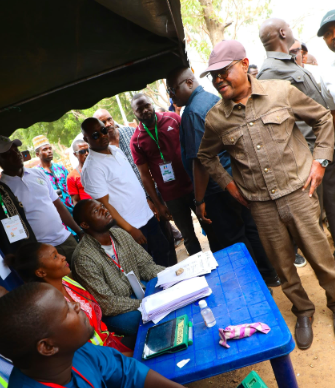
Minister of Federal Capital Territory (FCT), Nyesom Wike, who monitored polling units in the Abuja Municipal Area Council (AMAC), praised the hitch-free atmosphere after visiting sites in the city and satellite towns.
His commendation came despite low voter turnout, late commencement of voting, Bimodal Voter Accreditation System (BVAS) malfunctions, polling unit relocations, and allegations of vote buying.
Speaking to journalists, the minister said:
“First of all, we thank God that everywhere is peaceful. The only issue we have observed is low voter turnout, particularly within the city, and that has always been the case. However, when you go to some of the satellite towns, the turnout is quite impressive,” he said.
He praised security personnel for their role in maintaining order. “As I said, the election is peaceful, which means security has done very well. In the past, we used to have incidents of violence in some polling units, but in this case, we have not recorded any such violence.” Wike noted minor protests at one unit as he arrived but stressed no ballot papers or boxes were destroyed.
On INEC’s use of Bimodal Voter Accreditation System (BVAS) and Result Viewing Portal (IReV), Wike said: “First of all, they have not started counting votes. It is only after the votes are counted that issues of transmission will arise. But from what we are seeing now, everything appears to be moving smoothly in terms of the use of BVAS. We will continue to monitor the situation and comment based on what we observe.”
Wike rejected claims by FCT Senator Ireti Kingibe that his movement restriction amounted to a curfew. “It is unfortunate. I never imposed a curfew. In my statement, I said – with the approval of Mr. President – that there would be a restriction of movement from 8 p.m. to 6 a.m. This is not the first time such a measure has been taken during elections. I clearly stated that it was with the approval of Mr. President. People should take time to read statements properly and understand what was said before reacting. I do not want to join issues. At the end of the election, when the results come out, we will all know.”
As voting ended by 2:30 p.m. and collation began, Wike urged residents to stay calm. “The way people have been peaceful and orderly during the voting period, they should also remain peaceful and orderly during collation. That is usually the period when those who feel they may lose might want to cause problems. I urge everyone to remain calm and allow the process to be concluded peacefully. Voting is expected to end by 2:30 p.m., after which collation will begin. The way people have been peaceful and orderly during the voting period, they should also remain peaceful and orderly during collation. You know, it is that period where those who feel or have some feeling that they may lose may want to cause one problem or the other. And I think that’s a good way to approach it.”
Despite Wike’s positive assessment, reports from Bwari Area Council’s Kubwa, Usuma, and Byazhin wards highlighted late starts. INEC scheduled voting for 8:30 a.m., but at LEA Primary School Phase 3, Kubwa, units set up until 8:50 a.m. Junior Secondary School PW waited until 9:23 a.m., Government Secondary School Kubwa until 9:45 a.m., and Byazhin until 10:10 a.m. due to BVAS failures.
Zenith Labour Party supervisor Ojukwu Hyacinth, at Kubwa since 6:30 a.m., said: “I am supervisor for Zenith Labour Party. I have been here since 6.30. INEC told us that their officials will be here by 7.30 and voting will commence by 8.30. This polling unit 056, (Government Secondary School, Kubwa) they arrived by 9.15.” ADC agent Iliya Abdullahi added: “I came here by 7.30. But nothing is happening here up till this time (9.45am).”
Other News
PDP agent Samuel Eluwa at Byazhin noted: “We have been here since morning, but the BVAS is not picking up. That is what they (INEC officials) are battling. They (INEC officials) came by 8.0am. This is 10.04.am. We have not done anything yet. No communication from INEC. Nothing. The voters are coming and going back.”
Voter Emeka Nze criticised apathy at Byazhin: “I am voter in this unit. My observation is that when I came earlier the officials were not out. I had to go back home and return. We were told that the BVAS was having issues. But they are almost through with resolving it. Another observation I have is that there is general low turn out of voters. We have about 257 registered, with name clearly displayed. But we are not up to 30 here, if you can. For Nigerians, we can’t be clamouring for change and we don’t want to active participants in the process. I think that for me, is a major issue.
You can see young men playing football around. If they can come out to play football, they should have as well come out to be part of the civic process. You can’t after this election, start shouting they didn’t do election well, when you did not play your role.”
In Nyanya and Asokoro, vote-buying surfaced. At Nyanya’s Polling Unit 041, an ADC agent alleged campaigning inside but recanted. A PDP agent at Unit 042 claimed inducements. Sources described “coded” vote buying via POS operators in Asokoro’s Kundurma village, with voters directed for payments post-voting. Security was robust, with no violence.
Monitoring in Karu, near the Presidential Villa, Areas 11, 10, and 2 showed polling unit shifts causing confusion. Lanre Lasisi of ChannelsTV in his reported monitored by our correspondent said: “I’ve been to Karu, I’ve been to the area around the presidential villa, I’ve been to Area 11, Area 10, and at Area 2 monitoring the process. It’s been a very hard, long day, and people have tried to a large extent to exercise their franchise. What was the missing link had be the issue of the voters themselves and some of the voters we spoke to were complaining that the polling units were moved and they were not notified. Someone said he’s been to like 15 polling units trying to search for his name and at the point we were speaking, he still had not found his name and others were still going around as we were driving around. To a large extent it’s been peaceful.”
Lasisi added on relocations: “For some people, what happened was that they traditionally went to where their polling units are situated, where they’ve always gone when it’s election time, only to be told that their names and numbers were not there. Now in some places, the INEC staff were able to help. They would direct them to where they should go. In other times, they would just have to keep checking. They would just tell them, ‘go and check there.’ But interestingly, I heard from some voters that they got text messages. Someone even mentioned the issue of an email that alerted him where his polling unit had been moved to. So he said that was how he was able to easily find his way there. People said it was when they got to the polling unit that they got a text that now told them go to this place. But for others, there was no text. There was no one able to help them. The ad hoc staff at the polling unit where they went to could only advise them go and check there or go and check there. And they keep walking up and down.”