Follow Us on Google
• Doctors, survivors recall harrowing experiences during
By Cosmas Omegoh

At last, the world can rejoice. Now, COVID-19 is no longer a global health emergency. That scourge, pandemic and monster, which ravaged the globe, sending many to untimely death, is receding and recessing to where it emanated from.
Here in Nigeria, some COVID-19 survivors and medical practitioners are also rejoicing. They are people who saw COVID-19 deaths at close range, and miraculously escaped its vice grip.
For the health professionals, what a trauma to see their colleagues agonise and die. Some for months unending were unable to see their families for fear of infecting them. They slept inside their cars, placed their lives on the line in order to save others. Now, here they are telling their stories.
When, therefore, the World Health Organisation (WHO) in its latest update declared that “COVID-19 is no longer a global health emergency,” it called for rejoicing.
WHO had taken its time to make the latest declaration in the same way it hesitated before pronouncing COVID-19 a pandemic in 2020.
WHO’s International Health Regulations Emergency Committee at its recent 15th meeting on COVID-19 said the pandemic no longer constitute a global concern.
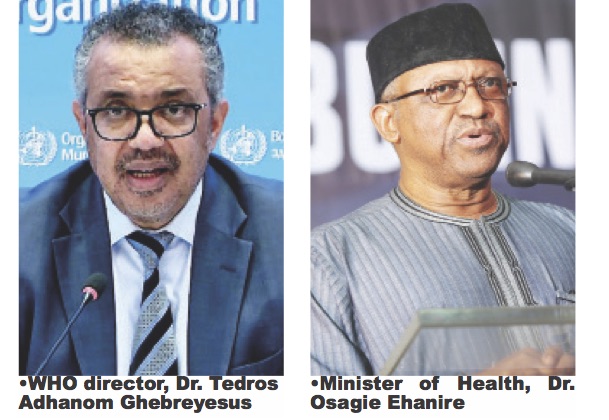
WHO Director-General, Tedros Adhanom Ghebreyesus, at a follow-up press conference in Geneva, Switzerland, affirmed that: “For more than a year, the pandemic has been on a downward trend. This trend has allowed most countries to return to life as we knew it before COVID-19.”
But don’t be complacent
However, health experts are still warning against complacency, empasising that COVID-19 still looms.
“Do not lay down your guards yet,” Dr Iorhen Akase, warned.
Indeed, Dr Akase needs to be taken seriously. He is in pole position to know, and say what he said.
He coordinated frontal attacks on COVID-19 as the Team Lead, COVID-19 Response Team at Lagos University Teaching Hospital (LUTH).
“WHO’s declaration that COVID-19 is no longer a global health emergency is welcome.
“As far as the world is concerned, the impact of COVID-19 on economic activities and the livelihood of the people, global travel and all of that was huge. But now, it is no longer a health emergency; so everybody is celebrating.
“But for us as medical practitioners, COVID-19 still remains. People will once in a while come down with COVID-19 especially the most vulnerable people.
“Those of us who are practising should look out for sporadic outbreaks of COVID-19. It has not gone away, except that it is no longer disruptive. It might no longer cause the kind of disruption we saw across communities. If it causes death from time to time, it might be in one or two instances,” he told Sunday Sun.
Dr Akase affirmed that “the WHO declaration is good as far as the disruption to public enterprise is concerned. But as clinicians and doctors, we always know that COVID-19 is still here, and we have to watch out for that.”
In like manner, a consultant family physician and public health expert with the Jos University Teaching Hospital (JUTH), Dr Daniel Meshak, warned that “there are still pockets of COVID-19 cases especially in Plateau State.”
He reasoned that the reduction in the number of infection might be as a result of the community vaccination, which was carried out before now.
Dr Meshak added, “that could be because we might have attained 70 per cent health immunity. But there is what is now called long-COVID-19 which is being studied in the Western world.”
Similarly, an expert in veterinary public health and preventive medicine, Prof. Pwaveno H. Bamaiyi, who is also the Dean, Faculty of Veterinary Medicine, University of Jos, warned against the return of COVID-19.
“COVID-19 has not disappeared,” he emphasised, adding that “its outbreak came with serious trauma; people are avoiding the safety measures now because COVID-19 has subsided, but it hasn’t left completely.”
Our COVID-19 experience
Ask those who saw COVID-19 at close quarters, their stories are not good music. Some health professionals placed their lives on the line each day; imagine them watching their infected colleagues dying. What a trauma that was!
Recalling his experiences, Dr Akase said: “First, I had issues with the availability of information on COVID-19 in the social media which were mostly not true. That compounded things.
“At the beginning of COVID-19 when we had to do enlightenment campaigns and all of that, we heard people saying because our environment is hot, COVID-19 could not do anything especially at a time Donald Trump, the immediate past president of USA kept saying that COVID-19 was just a mere flu.
“That encouraged some people to throw caution to the wind. Thank goodness many people didn’t die in their numbers especially in our hospital.
“At LUTH, we did not have a whole hospital dedicated to COVID-19. We had fewer bed spaces for COVID-19 patients. But at a time, we had about 100 people admitted for COVID-19 at the same time.
“At some point, clearly the healthcare workers became overwhelmed by the number of infections, not that it was difficult to treat, but because of the facilities available.
“We had people die when the oxygen they were using finished. It was traumatic learning that so, so number of people had died when the oxygen they were using finished. Some hospitals did not have the capacity to produce oxygen. Some were using oxygen for commercial uses; some were using domestic oxygen too.
“So, there were a lot of issues that were so traumatic simply because the capacity to respond was not sufficient.”
Then, he recalled that “before the vaccines arrived, there were not just days but months I spent without going to see my family. When we started the response in March of 2020, I never went home freely until May. I had to stay away for months; when I went home, I simply saw my family from a distance and went back.
“As a doctor, who worked in a tertiary hospital with many other doctors, one of the impactful things I experienced was having to be doctor to doctors.
“I had professors who contracted COVID-19 and had to be admitted under me, likewise many other high-profile persons in the healthcare sector.
“It was such a trauma having to lose some colleagues I knew personally.
“And one thing in the medical profession is that you don’t treat individuals you know personally. You try to avoid such scenario. “But unfortunately, there was no way I could avoid that. I was in a situation I could not avoid treating my colleagues – people I knew personally. So, managing them, treating them and going into a stage some of them were dying was not just traumatic, but heart rendering.”
Dr Meshak decried people’s high-level resistance to the COVID-19 vaccine, recalling how he lost a friend to the virus.
“When I heard about COVID-19 outbreak, I was curious as a health practitioner to know what the symptoms could be and how to treat it.
“Later, I was involved in the management of the COVID-19; I saw a lot of resistance by some members of the public who did not believe the virus was real.
“As a doctor, I saw people go down with COVID-19.
“I lost a friend who unfriended me on the social media because I kept posting updates on COVID-19, and the need to adhere to safety measures as part of my public enlightenment on the virus,” he said.
He also recalled that “we were a team comprising doctors, nurses, public health experts, and pharmacists at an isolation centre at JUTH.
“But because of limited resources, and the rising number of persons infected with the virus, we had to change our approach by adopting home-care for those with mild cases, while the isolation centres were for those battling with severe cases.”
He admitted that he later got infected with mild COVID-19, but had to handle it carefully.
“I think mine was mild because I was vaccinated. If I were not vaccinated, my case could have been different.
“Those who were not vaccinated and the elderly ones struggling with one ailment or the other were badly hit.”
He expressed concern about the low intake of vaccine in Plateau State declaring that “all vaccines are safe; for a few, it caused only reactions,” lamenting that resistance to vaccines was still very high.
While also recalling his ordeal during the period, Prof Bamaiyi said: “The outbreak of COVID-19 came with serious trauma.
“I recall losing quite a number of colleague professors here at the University of Jos.
“It was a nightmare; nobody knew that it was going to happen; it just came as a shock to all of us, and we didn’t know how to escape it; we were locked up in our homes, some in their laboratories trying to carry out some research.
“It was very trying period when we saw people we knew very closely – people who were our colleagues – seniors colleagues dying.
“We had leaders of various committees at the national level; we lost all of them at the peak of COVID-19. And that is why we will be having a memorial lecture in their honour.”
He too admitted that “I had symptoms that were COVID-related, but I did not go into the laboratory to confirm that; but when I recalled that I had contact with a colleague friend who was infected by the virus, I went into self isolation.”
A survivor and resident of Lagos, Tony, (not his real name) recalled how he and his family nearly got killed by COVID-19.
“I was having fever and occasional bouts of cough, but never knew I had COVID-19.
“Then at some point, a friend persuaded me to visit the testing centre at the Nigerian Institute for Medical Research (NIMR) in Yaba, Lagos.
“Getting tested and obtaining the result were quite an ordeal. But I gave it a trial.
“The next day, the result of the test was posted to my email address – it was positive.”
He recalled that “when I informed my friend about the result, he earnestly urged my family and I to hurry to NIMR for more test. There, we all tested positive the next day.
“That was how we began treatment after taking our test results to Gbagada General Hospital COVID-19 centre.
“We had expected the worse, but we were told our cases were mild; so we were handed drugs and asked to buy the rest and asked to go home and isolate.”
Thanks to vaccine
For Dr AKase, the coming of vaccines changed the COVID-19 narrative. He reasoned that “at the point it came out, people had started developing health immunity. They were getting ill and recovering; there was some form of community immunity.
“But when you consider that those who were mostly vulnerable took the vaccines and were protected, that showed that they helped.
“Then the fact that those who took the vaccines were allowed to travel remarkably showed that they downgraded COVID-19 to something we could live with. So, it was a game changer.”
Prof Bamaiyi corroborated his words, saying “the series of vaccinations deployed by the government were helpful.
“Some have received up to five doses in some countries; but here in Nigeria, we are still struggling to convince people to accept the vaccines; however, most people have taken the first, second and even third doses.
“If we’re able to cover 70 per cent of our population, then we can say there’s health immunity that can protect the entire country; we are not there yet; but I think about 50 per cent of the population has taken the vaccine.”
He discloed that experts in the country were trying to develop a COVID-19 vaccine. According to him, “we have the candidate vaccine developed by Usman Danfodio University; we have that candidate vaccine now in University of Jos for pre-clinical trial by the Vaccine and Biomedical Research Laboratory at the Veterinary Teaching Hospital Polo.
“That lab was specially built for that purpose; we have to do the pre-clinical trials on animals before we begin to do it on humans.”
What next with COVID-19
With COVID-19 believed to be lurking at the corner still, what is the next step to stop the virus from staging a return? Here, Dr Akase’s answer is apt. He said: “Now, efforts have to be made by the government to integrate COVID-19 services into the health care delivery system. We need to move away from that emergency response mode. We need to integrate COVID-19 into routine care.”
It is his considered view that “when a patient shows signs, we need to test them for malaria, for urinary track infection, hypertension or diabetes. It is like integrating COVID-19 care into routine health services so that it will no longer be an issue for frontline workers. It should be integrated into our primary health care and secondary health care services,” adding “in all, we are happy COVID-19 is no longer a public health disruptor.”