Follow Us on Google
• Ibadan communities where residents drink urine, eat faeces from shallow wells
• Open defecation, lack of access to safe water, toilet facilities keep residents on the verge of an epidemic
By Oluseye Ojo
The city of Ibadan is the picturesque capital of Oyo State. It is renowned for its rich cultural heritage, hospitality, prestigious educational institutions, vibrant community system, civil disturbance, war-like character, and high sense of pride.

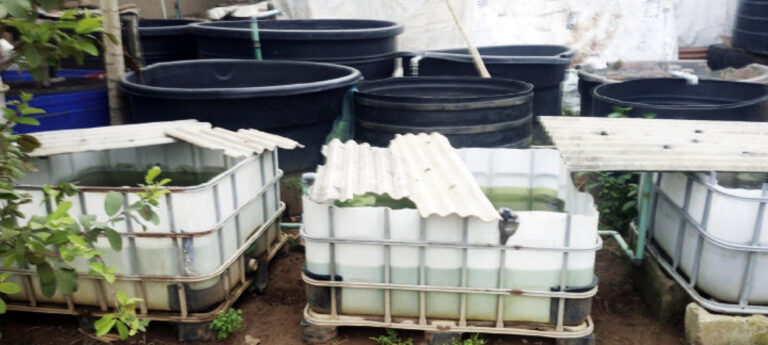
•Falende community water treatment (Insect: Water test result at Iyana Igburo, Aderogba area)
However, behind its facade of beauty lies a concerning reality, with a significant number of residents living perilously close to rivers without proper sanitation facilities and access to safe water for drinking.
The people, living very close to rivers and streams in the heart of Ibadan, told Saturday Sun that they are the forgotten ones in Ibadan, because they have not been enjoying social amenities from the government. “The government has neglected us. They don’t care if we die,” they chorused in interviews with this newspaper.

•Part of Aderogba where flood sacked residents
Majority of people inhabiting the affected communities on river banks have been drinking and eating their own and other people’s faeces. But they have not been collecting the faeces for the purpose of drinking and eating for ritual purposes, like a number of ritualistic internet fraudsters.
The people in the affected communities have been compelled to drink and eat their own excreta because they lack access to good toilet facilities, which has led to open defecation on the river banks and throwing of faeces into the rivers. Ironically, the faeces found its way back to the communities through contamination of their wells.
Many residents of the community drink the raw water from the well. They bathe and cook with the water. A high percentage of the residents said they were not financially buoyant to buy sachet water for drinking.

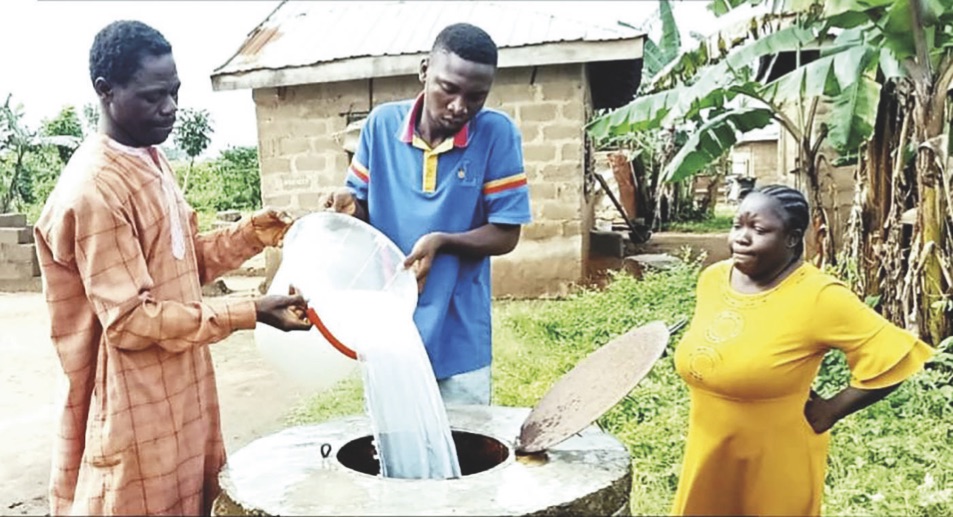
• Sensitisation by OYORUWASSA at Janmero
In 2018, the Federal Government of Nigeria unveiled a National Action Plan to provide safe, sustainable sanitation and hygiene services to Nigerians by 2030, with a view to ending open defecation in the country by 2025.
But Oyo State Government has set a target of 2028 to end open defecation in the state, because the efforts to end open defecation in the state started in 2021, which was about three years after the implementation of the National Action Plan was unveiled in the country.

•General Manager, OYORUWASSA, Adeniyi Adeduntan (2nd left); Goke Ayodele, Director, Community Mobilisation and Hygiene Education (left), Nafisat Salau, Water Quality Officer (2nd right); and Oluseye Ojo of The Sun after a strategic meeting on the project in Ibadan
In a bid to achieve Open Defecation Free (ODF) status in Oyo State, the United Nations Children’s Fund (UNICEF), has gone into partnership with the Oyo State Rural Water Supply and Sanitation Agency (OYORUWASSA), an agency of the Oyo State Government.
The partnership is working assiduously towards ending open defecation in the rural communities in the state. The UNICEF has adopted two rural local governments – Egbeda and Ona Ara – as its pilot project, as part of efforts to end open defecation in the state.
But for the majority of Ibadan residents in communities that are on the banks of rivers and streams, Saturday Sun can exclusively report that they do not have toilet facilities. Those that have the toilet facilities channelled their sewage pipes directly into the rivers and streams, and a few of them that have wells in their houses are not happy that they now have contaminated water in their wells, which poses major health issues to them and the society.
The discovery was made during a tour of communities that are besides rivers in Ibadan. They include Oke-Ofa, Oluyege, Oje, Aderogba, Alafara, Kudeti, and Ogunpa in Ibadan North East Local Government with its headquarters at Iwo Road; Ibadan South East with its headquarters at Mapo, and Ibadan North West with its headquarters at Onireke.
The Sun, RUWASSA, and UNICEF
The reporter had attended a two-day media workshop on ‘Ending Open-Defection (ODF) in Nigeria’, organised by the tripartite of Oyo State Ministry of Information and Orientation, and OYORUWASSA in collaboration with UNICEF, at Kakanfo Hotel, Ring Road, Ibadan, from Wednesday October 18 to Thursday October 19, 2023. It was attended by journalists from the six South West states of Lagos, Ogun, Oyo, Osun, Ondo and Ekiti.
The first day of the workshop featured training sessions on water sanitation, access to safe water, importance of good toilet facilities and hand-washing with running water and soap after using the toilet.
The second day of the workshop came with a visit to Jago village in Ona Ara Local Government. It is one of the villages adopted by UNICEF in collaboration with the state government in ending open defecation. The tour of the village revealed that open defecation has become a thing of the past in the village, which was established in 1840, according to the Baale of Jago, Chief Olusegun Oparinde. The road that leads to Jago village from Badeku was like the road to hell.
Oparinde said the intervention of the government and UNICEF has made defecating in open places gone forever in Jago. The intervention has resulted in the construction of about 150 toilets in the village. The villagers have also been enlightened and encouraged to wash their hands with soap and running water every time they used toilets.
His words: “We have more than 1,000 people living in this village. But only my house used to have a functional toilet in this community. Most villagers defecate in the open, especially by roadsides, backyards and in the bush.
“When they were using the bush and roadsides, the faeces get washed into the Osun River in the community. So, we could not drink from it.
“The toilet project has saved the community from open defecation. Before now, we used bushes around us to defecate. We perceived the odour, and you could not trek a distance without stepping on faeces. So, the construction of these toilets came as a huge relief, not just to parents and children, also to the entire community.
“But this village – Jago, experienced a low rate of cholera in the past. But some of my people that used to defecate in bush fell inside wells and some suffered snakebite. Now, we have toilets everywhere in the village. We are happy. I thank Governor Seyi Makinde, Oyo State Government, RUWASSA and UNICEF for making this happen in my community. I also thank my people for their support and cooperation in accepting and adopting the new lifestyle. Now, we have two public boreholes in the village, apart from the one that I dug by myself.
The reporter observed that everywhere in Jago was very neat, and there was no stench of faeces from any part during the tour of the village.
The reporter wondered that if this feat could be achieved in a village, what about communities in the urban centre of Ibadan that do not have toilet facilities and access to safe water?
He remembered his growing up years at Labiran, his family compound in Ibadan. He recalled how he used to trek with his uncles from Labiran to Beyerunka, and to Alarafa. He did not forget the makeshift plank bridge for pedestrians on Alafara River that connects Alafara community with Oja’gbo. Still fresh in his mind was how people would defecate on the river bank, dump wastes in the river, how pigs used to soak themselves in the dirty water in the river, as well as how an unbearable stench usually pervaded the area.
So, he decided to do a story on some urban communities that line the river banks in Ibadan, especially Alafara, Ogunpa, and Kudeti.
Visits to urban communities on river banks
A preliminary visit was paid to the communities to know the situation of things in the affected communities. But it showed that the river that passes through Aderogba is the same that passes through Alafara and Kudeti, though joined by other streams and rivers along the way. The river gets different names in different communities. The open defecation has continued in the communities because majority of the houses there did not have toilet facilities and access to safe water.
The Oyo State Rural Water Supply and Sanitation Agency (OYORUWASSA) was contacted to help in testing of well water in some of the urban communities to have an empirical support for this report on how the communities are being affected by open defecation and indiscriminate dumping of solid wastes in the river.
The Director of Community Mobilisation and Hygiene Education at the agency, Mr. Adegoke Ayodele, who was at the media workshop in October, was contacted. He linked the reporter with the agency’s General Manager, Mr. Adeniyi Adeduntan, for the project. After extensive deliberations, the agency decided to do the water testing, and provided test kits free of charge.
The agency also assigned its Water Quality Officer and Higher Laboratory Technologist, Mrs. Nafisat Salau, to work with the reporter. The Chairman of Nigeria Union of Journalists (NUJ), Oyo State Council, Chief Ademola Babalola, approved the use of a branded bus of the union to convey the reporter and the official of RUWASSA to the places.
Discoveries in the visited urban communities in Ibadan North East LGA
In the communities visited, shocking revelations were made. The first port of call was Oke-Ofa, where a landlord was met sitting down in front of his house that is very close to Oke-Ofa River. After much enlightenment and persuasion, he agreed to talk without mentioning his name. He stated that the one-storey building did not have any toilet or well. He added that he was in the process of constructing a toilet, which would have its sewage pipe channelled to the Oke-Ofa River.
But the Water Quality Officer of RUWASSA, Mrs. Nafisat Salau, prevailed on him not to do so because of the risk factors involved. She advised him to ensure digging of the ground that could take two rings with affordable toilet facilities, such as Satopan. She asked him to come to the head office of RUWASSA at Oyo State Government Secretariat at Agodi in Ibadan if he needed financial assistance to build the toilet. She spoke of a single-digit interest loan provided for construction of toilets by the state government. The loan, she said, could be accessed through selected microfinance institutions. The man said he did not know that it was bad to channel sewage pipes into the river. He promised to do the needful on the toilet and the well.
About one kilometre stretch of Oke Ofa River that this reporter assessed, the stench from the area would no doubt lead to a reduced life span. A roadside mechanic workshop, opposite I.M.G E8 Oke Ofa Primary School, Ogungangan, was at the centre of the stench. When approached one of the technicians in the workshop said the stench has been unbearable to them. He said the same discomfort was being experienced by the pupils of the primary school. But at the time of the visit, the schools in the state had proceeded on their first term holidays.
The team proceeded to Oloro Compound at Janmero, Oluyege. The Chairman of the landlord association, Alhaji Waheed Olagunju, said the community has 78 houses, out of which about 10 were equipped with toilet facilities. He added that a few houses have wells.
He stated that it might be difficult to persuade the residents of the community that have no access to toilets not to engage in open defecation whenever nature calls. He then appealed to Governor Seyi Makinde, the state government, political office holders, organisations and individuals to help the community with 10 public toilets to eradicate open defecation in the community. He also requested boreholes for the community.
“I can confirm to you that we have two rivers in this area. The first one is at Oke Ofa E8. The second one is E6 Atipe at Ageelu. Majority of the houses close to the two rivers don’t have toilets. Some passed their sewage pipes into the rivers. I have good toilet in my houses as well a well. I am leading by example. I will continue to talk to my people to change,” he said.
Alhaji Hadi Lagunju, who is the treasurer of the community, said: “My well was constructed in December 2022. But it is now sour in the mouth when we drink it. So, I went to the market to buy chlorine and alum to treat the water.”
Also, Mr. Abdulkareem Adebayo, said majority of residents of the community do not have any other way to dispose their solid waste than to dump them in two river in the community. He appealed to the government to allow the personnel of Oyo State Solid Waste Management Agency to come to the community regularly to evacuate wastes.
Water test was carried out in two of the wells in the community.
The team also proceeded to Aderogba community, where there is Temidire River. The colour of the water in the river and in some wells at Oniwata Compound of Aderogba was the same. The residents said they have been drinking the water for years, even as they shrugged off any fear of an epidemic or deaths.
Alhaji Ganiyu Shittu of Ile Oniwata, said he was born in the community more than 90 years ago. He stated that the community had access to tap water from the water corporation in the past. The last time the tap water worked in the community, according to him, was 50 years ago. He made it known that residents of the community used to fetch water from Temidire River, which was a stream some 50 years ago. He explained that the stream became a river after many houses were built the community an its environs.
“We used to cross the streams on foot. Now, it is a big river that has made nonsense of our community. During the rainy season, the flood from the river has sacked many residents of this community. Everywhere would just be flooded. In fact, many people have abandoned their houses and relocated to other places.
“The effect of pollution of the river is what we see in our well. This is happening because the government has neglected us. If the government will assist us, they should dredge the Temidire River for us. Our problem in this community will be solved if it can be doing what Ibadan Urban Flood Management Programme (IUFMP) does in other notable rivers at the urban centres.
“This river, which comes from Omolewa side to Yejide, passes through Aderogba as well as Alafara, Oranyan, Labo, Eleegun, Kobomoje, Agbogbon, Kudeti and Bode. The river is supposed to be an extension of Ogunpa Channelisation. What happened in government, I don’t know.
“You cannot dig the ground up to eight feet before you get water in this community. The pollution from the river is affecting our well. It will surprise you that some unknown people have been dumping dead bodies in the river in order to implicate us. We are very poor in this community. We cannot afford sachet water. We drink the water like this. It is the same water our children and grandchildren have been drinking.
“We don’t have the luxury of resources and time to boil the water before drinking and cooking or bathing. We are used to it, and it does not do us any harm. But during rainy season, the water from our well would be white, but it will have brownish or greenish colour in the dry season.
“We have more than 100 houses in this community. But none of us has a toilet. But some houses in the other neighbouring communities, like Isale Alfa, have toilets. Majority of the houses have wells. We all drink from the wells. If you fetch water from the well into a bucket, within three hours, the sediments would settle at the bottom of the bucket. We would just collect the clean water at the top and drink. The only borehole dug for this community by the Ibadan North East Local Government is not useful. The water from it is not drinkable for us.
“Our community is between Temidire River and Isale Alfa River. During the rainy season, the two rivers would flood this community from both sides. You can only imagine the level of faeces and other pollution that we would have to battle with whenever the community is flooded.
“I am tired of appealing to the government to help us. They will not answer us. The government does not know that we exist. If we die, it does not concern them.”
Elder Matthew Akinbode is the Chairman, Landlord Association of the community. He has his house at Iyana Igburo in the area. He corroborated what Alhaji Ganiyu Shittu, the oldest man in the community, said. He pleaded with government to provide potable water to solve the water problem, build about 10 public toilets to stop open defecation, and dredge the Temidire River.
The Water Quality Officer of RUWASSA, Mrs. Nafisat Salau, also did a water test for two wells in the community; one at Oniwata Compound, and the other at Iyana Igburo.
Results of water test
The water test was carried out to have empirical support on whether faecal disposal practices in open defecation was actually contaminating wells in the affected communities.
Four test kits were used for each well, with each kit for each of the four levels of the test. The levels are the source of the water, transportation of the water, storage of the water at household level, and control that has to do with boiling of the water.
Water Quality Officer of RUWASSA, Mrs. Nafisat Salau, in carrying out the tests, ensured that the households in the community were involved. She asked them to wash their hands to perform the three stages and also the boiling stage. The water was collected into small bottles made for the tests in each category. The chemical in the bottles gave the water in each of the bottles a yellowish colour.
She told the community people to keep the bottles in safe places and within 24 to 48 hours, the yellowish colour of the water would either remain the same or turn to black. She explained that if it remained yellowish, there was no contaminant in the water. But if it changed to black, there are contaminants in the water in their wells.
At the end, the results revealed that the well at Alhaji Hadi Lagunju’s compound had contaminants from the source, which is the well, to the transportation stage, that is the bucket used to convey the water, and the big bucket used to store the water. The water was contaminated at the three stages as the water in the bottles for the first three stages changed to black. But the water in the fourth bottle remained yellowish because it was boiled.
The results of the test conducted on the well of Alhaji Waheed Olagunju of Oloro Compound, Janmero, Oluyege, showed that the first two stages were contaminated because they changed to black, while the storage stage and control level remained amber. The households were asked if they have been using water treatment, like water guard or aquatab, to treat the water at the storage level. But they said they had not been treating the water.
The results of the tests at Oniwata Compound in Aderogba showed that all the first three stages were contaminated, while the control stage remained amber. The results were the same for the well at Mr. Matthew Akinbode’s house in Aderogba.
The Water Quality Officer of RUWASSA said the results of the tests showed that pathogenic organisms were present in the water in the communities. She advised that if they could cultivate the habit of boiling their water before usage, it would be safe for them.
In his assessment of the results from the field, the General Manager of OYORUWASSA, Mr. Adeniyi Adeduntan, said the findings have to do with environment, health, and infrastructure. He promised that he would meet with strategic stakeholders for necessary steps.
“The OYORUWASSA, as established in 1992, is only responsible for the rural communities. Unfortunately, we found out that what is happening in the rural communities is also happening in the metropolis of Ibadan city. I know that the administration of Governor Seyi Makinde is trying its best, with the Commissioner for Environment, Hon Mojeed Mogbonjubola. The administration is responsible and responsive. It will tackle the issue.”
When asked for his opinion on whether the government should establish an agency that would take care of the urban communities, or the scope of RUWASSA should be expanded, he stated that expansion of the scope or establishment of an agency for urban communities would require funding and going through legislative process. He added that the power is beyond RUWASSA.
He noted though that a Small Town Water Agency can take care of the urban communities and large local governments in the state that are becoming cosmopolitan. He said: “It would be good if the governor can approve of this.”
The Ogunpa Channelisation might have made communities living on its bank probably save, but many people around Ogunpa, Labaowo, and Dugbe axis of the channelization, where there are big markets, as gathered, have abandoned the public toilet facilities in the areas, and preferred to dispose their faeces in the Ogunpa water channel.
Many believe that the communities visited might just be a sample of how open defecation, lack of access to safe water and good toilet facilities are stalling the plan to end open defecation in the state by 2028. Many people, especially women and children might have been facing a myriad of waterborne diseases, such as cholera, typhoid fever, and dysentery.
The grave danger faced by Ibadan residents in the affected communities is not confined to their health alone. Their actions, such as channelling sewage pipes directly into rivers, might negatively impact the environment and the ecosystem.
Sewage pollution, according to experts, disrupts the ecological balance of rivers and adjacent lands, leading to the extermination of aquatic organisms, decline in biodiversity, and even the release of toxic gases.
It is believed that flagrant disregard for environmental concerns has severe consequences, not only for the immediate population but also for future generations who will inherit the degraded ecosystem.
To address this issue, experts said collaborative efforts between the government, non-governmental organisations, and the community might be essential. The implementation of sustainable solutions, such as providing access to proper sanitation facilities, ensuring clean water sources, and raising awareness about environmentally friendly practices, can contribute to a healthier and more prosperous Ibadan.
In the two local governments – Egbeda and Ona Ara, adopted by UNICEF to achieve open-defecation free in the state, water tests were carried out in 40 communities in each of the two councils, totalling 80 communities. One of the communities is Falende in Egbeda. The tests were done by the Environmental Health Officers in collaboration with RUWASSA. It was preceded by mobilisation and sensitisation of the villagers. Many of the results also came out positive, while a few came outnegative.
Open Defecation in Oyo
The UNICEF Lagos Field Officer, WASH Specialist, Mr Monday Johnson, has said 4.5million residents of Oyo State practise open defecation, while 5.6million people in the state lack access to decent toilets.
The revelation came as the state government has developed a roadmap to ending open defecation by 2028 in the state. Wife of Oyo State governor, Mrs. Tamunominini Makinde, has also stepped in through the Office of the First Lady in the state for Oyo to become open defecation free by 2028.
The UNICEF noted that 83 per cent of motor parks and markets in the state also lacked toilet facilities, which have been exacerbating poverty, and also have effects on health, education, and nutrition, calling on the Oyo State Government to fast-track its effort to meet its target within the next five years.
Johnson stated that UNICEF is supporting the two local governments in the state – Egbeda and Ona Ara, in ending open defecation, saying: “UNICEF has only supported starting the programme in two local government areas out of the 33 local government areas on Oyo State, which means that 31 local government areas are still there with nothing happening. .
“Now, it is time for Oyo State to pick up. Oyo State Rural Water Supply and Sanitation Agency has worked with UNICEF for the past two years; they now have the capacity.”
He noted that the Ministry of Environment in the state has joined the campaign to end open defecation. “Everyone that is related to hygiene and sanitation should now come in to do something that will change the situation in Oyo State.
“The open defection roadmap was to start in 2022 and end in 2028; Oyo State has not started, and almost two years are lost now. Oyo State only has between now and 2028 to meet its target. So, we need to work almost six times faster than we are now to be able to meet the target.”
Johnson declared that one in four Nigerians still defecate in the open and that Nigeria is off track in meeting the Sustainable Development Goals, requiring that something be done to change the narrative.
Wife of Oyo State governor, Mrs. Tamunominoni Makinde, said all and sundry must join hands together in reaffirming “our commitment to breaking the barriers that impede progress toward universal access to toilet facilities.
“By fostering awareness, advocating policy changes, and engaging in grassroots initiatives, we can contribute to a world, where toilet is not a privilege but a universal right.
“Provision of toilet facilities with proper usage by all and sundry will help our state and nation to eradicate open defecation. This will be in line with Sustainable Development Goal (SDG) Target 6.2, Presidential Executive Order 009 and Oyo State Target to make the State open-defecation free by 2028.”
In the same vein, the Commissioner for Environment and Natural Resources, Mr Mojeed Mogbanjubola, noted that inadequate sanitation practices have severe consequences on environment, contaminate water sources, cause soil degradation, and release pollutants.
“So, collaboration is key to changing the sanitation landscape. By working together, we can harness our collective strengths to implement sustainable solutions, share best practices, and drive positive changes within our communities.”
Meanwhile, Commissioner for Information and Orientation in the state, Prince Dotun Oyelade, has also said individuals who engage in the unhygienic practice would face severe penalties.
He emphasised the urgency of addressing the issue, noting that Governor Seyi Makinde has instructed the Ministry of Justice to ensure the prosecution of anyone caught dumping refuse or defecating in public areas.
He explained that the imposition of penalties for open defecation and indiscriminate refuse dumping is intended to promote behavioural change and hygiene among citizens, adding that by enforcing consequences, the Oyo State Government is aiming to eradicate open defecation before 2028, in a bid to ensure much improvement in the social menaces and all other diseases plaguing the state.
Oyelade stressed the importance of collaboration between the government and UNICEF’s WASH (Water, Sanitation, and Hygiene) action plan. He added that the government is open to enacting legislation to support the effort if necessary.
Highlighting the gravity of the open defecation crisis, he assured residents that the government is committed to tackling this issue and improving the well-being of the state.
Oyelade stated further that billboards would be placed at major junctions and entry points throughout the state, to raise awareness about the penalties and discourage environmental infractions.
His words: “Oyo State Government is willing to effect the necessary behavioural change in open defecation, working with UNICEF’s WASH (Water, Sanitation, and Hygiene) action plan. In Oyo State, we have adopted the WASH action plan, and if need be, we will back it up with legislation.”