Follow Us on Google
By Seun Emmanuel
Fashion, at its most compelling, has always been a form of mythology-making. For SS26, The Five steps unapologetically into that lineage, offering a collection that does not merely reference Yoruba deities but reimagines them as living, breathing presences and figures whose authority, contradictions, and moral complexity are translated into cloth, metal, and silhouette.
This is not costume. It is cultural authorship.
Curated after the Yoruba gods, The Five positions Esu, Obatala, Ogun and Orunmila as both narrative anchors and stylistic provocateurs. The designer’s ambition is clear: to reconstruct how these gods might have dressed in the past while unapologetically filtering that imagination through a modern fashion lens.
The result is a collection that feels grounded in history yet unmistakably contemporary, an exercise in reverence without rigidity.
Esu, often misunderstood as mere chaos, is given one of the most nuanced treatments. The black cotton two-piece, punctuated by a red satin pocket flap, is sharp, deliberate, and quietly mischievous. Balloon sleeves mirrored in the trousers create a silhouette that feels unstable in the best way. It resists easy categorisation, much like Esu himself, the god of confusion and crossroads.
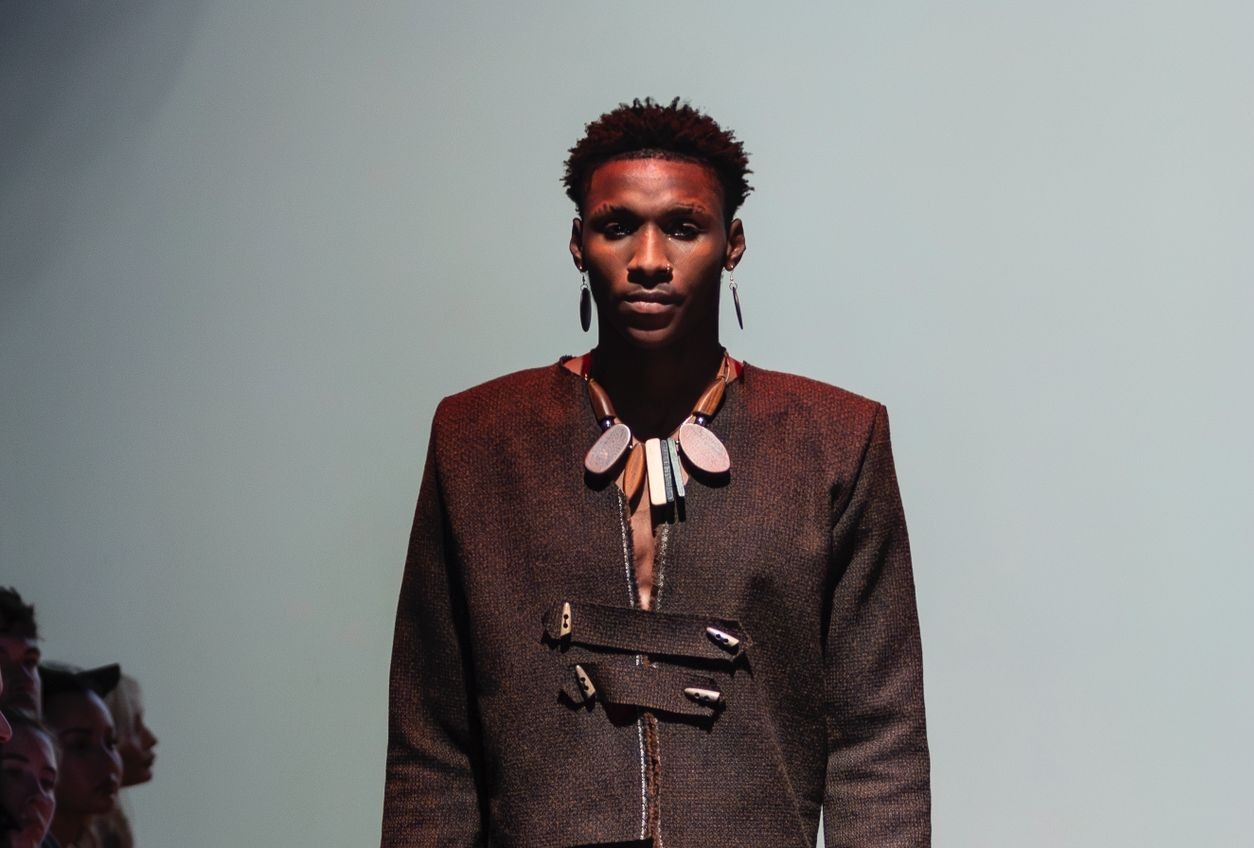
Obatala’s look pivots the narrative from conflict to authority. Known for purity and power, Obatala’s cropped jacket with its exaggerated, high-set shoulders projects command with almost architectural clarity. The horns used as buttons are not decorative flourishes; they function as signifiers of dominance and hierarchy, grounding the garment in ritual symbolism. Paired with checkered wide-leg trousers in British wool, the look balances weight and drape, tradition and tailoring. The giant pleats and oversized cut feel ceremonial, yet wearable, a recurring strength of the collection.
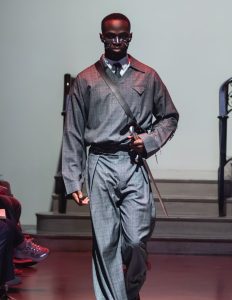
Ogun, the god of war and iron, is the most immediately tactile expression of this ethos. His grey wool jacket, cut into a resolutely boxy silhouette, carries miniature metal swords cascading down the left sleeve, an explicit and almost confrontational gesture. Yet it is precisely this restraint in placement that makes the embellishment feel intelligent rather than excessive. The V-neck with half collar softens the severity, while the elasticated waist and free hanging cuffs introduce movement, allowing the garment to live beyond symbolism. The trousers, anchored by a metal waist adjuster and exaggerated forward pleats are quietly revolutionary. With elastic at the back enabling size flexibility, they acknowledge the realities of modern bodies without sacrificing structure.
Orunmila’s presence introduces softness without diminishing gravitas. The off-white kimono two-piece speaks of abundance and fluidity, its unforced elegance reinforcing Orunmila’s role as a major deity of divination and wisdom. Cowries are symbols of wealth and peace, adorn the sleeve splits, running from wrist to elbow, creating moments of movement that feel almost meditative. This is spirituality rendered tactile, purity expressed through volume rather than austerity.
In an era where “heritage” is often flattened into aesthetic shorthand, The Five offers something richer: a living dialogue between past and present. It reminds us that fashion, like mythology, gains its power not from nostalgia, but from reinvention.
Across the collection, the disciplined use of wool and cotton ensures coherence. These fabrics give weight where needed, flow where desired and crucially allow the silhouettes to speak louder than surface decoration. The Five does not dilute Yoruba cosmology for palatability; instead, it trusts the intelligence of its audience.