Follow Us on Google
…Patients abandoned in federal hospitals
• X-raying the nagging recurrent problems
From Fred Ezeh, Abuja
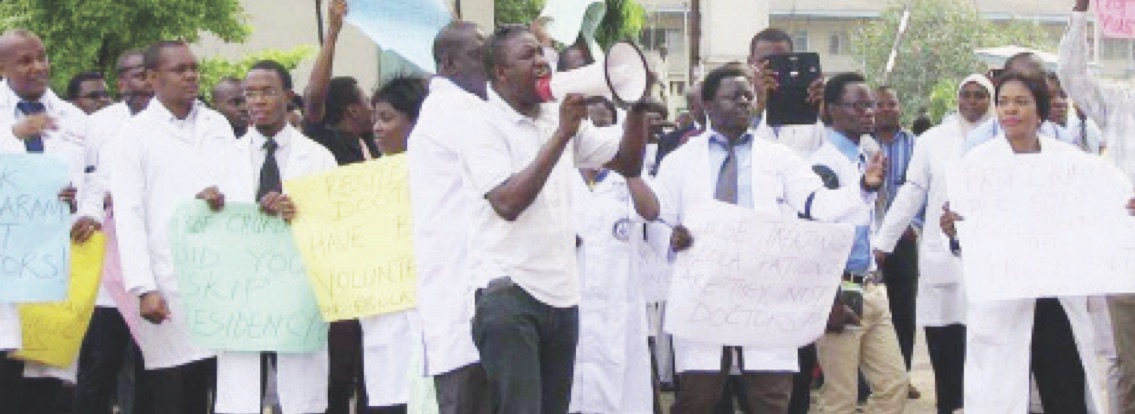
Medical doctors under the umbrella of National Association of Resident Doctors (NARD), on Wednesday, announced an indefinite nationwide strike. They directed their members to immediately withdraw their services from public health facilities nationwide.
This means that healthcare-seeking Nigerians would witness skeletal or no services in public hospitals across the country, and being that it’s an indefinite nationwide strike, the pains and frustrations of these sick Nigerians might last longer than expected.
Regrettably, strike seems to have become recurring decimal in the health care sector over the years, just as it has been in the education sector, particularly the university lecturers under the umbrella of Academic Staff Union of Universities (ASUU).
Over the past years, doctors and other labour unions, notably, ASUU, PENGASSAN, NUPENG, NMA, ASUP, among others, have chosen strike as the only way to urgently get government’s attention, hence they often capitalized on that to get what they wanted, and they often succeeded.
Evidently, the demands of these unions are neither new nor fresh items added to the previous demands. It’s simply the inability of the government to implement the signed agreements, perhaps, months or years after they were willingly signed by both parties.
In May this year, the doctors embarked on five-day warning strike, to probably alert the government on unfriendly action that was ahead, industrial disharmony. The warning strike was, perhaps, an opportunity to reawaken the consciousness of the government on the urgent need to attend to the demands of the doctors as enumerated in their several meetings with government representatives.
The five-day warning strike was, undoubtedly, hellish for healthcare-seeking Nigerians, particularly those who solely rely on public healthcare facilities for healthcare services. Surprisingly, most of the industrial actions are essentially on the same issues that had lingered for very long time with little or no success in terms of the reason(s) for the industrial disharmony.
THE ISSUES
At the centre of the doctors’ anger are the issues of welfare (salary and other packages) and over-labour, apparently due to shortage of manpower.
Members of NARD National Executive Council (NEC), in their last meeting that preceded the nationwide strike, said that the government has been “insensitive” to their plight, hence the decision to withdraw their services nationwide which was the last option available to them.
They said that the government failed to release circular on one-for-one replacement of clinical staff despite the unexpected hardship the brain drain had caused the doctors and other clinical staff in public health facilities.
They equally queried the delay in payment of the 2023 Medical Residency Training Fund (MRTF), despite several engagements with the government, even as members observed that the first phase of the updated courses and examinations for which the fund was intended had been concluded and the second phase about closing too.
They accused the government of refusal to pay the salary arrears of 2014, 2015, and 2016 of its members, in addition to hazard allowance arrears, as well as the arrears of the consequential adjustment of minimum wage. They also accused some state governors of not implementing the Consolidated Medical Salary Structure (CONMESS), domesticate the Medical Residency Training Act (MRTA)/pay the Medical Residency Training Fund nor improved on the hazard allowance, while some owed backlog of salary arrears.
The doctors also accused some state governments of deliberately overseeing the progressive collapse of the health sector in their states, thereby endangering the lives of their citizens; and also questioned the rational behind the decision to downgrade the membership certificate of the postgraduate medical colleges by the Medical and Dental Council of Nigeria (MDCN) without any cogent reason.
They insisted that CONMESS salary structure must be reviewed upward using the principle of full salary restoration as captured in the various communications with the government before
and after the removal of fuel subsidy.
Specifically, they asked for 550 per cent salary increase because of the recent decision of the Federal Government to remove fuel subsidy which resulted in significant rise in cost of movement and general cost of living.
PREVIOUS PEACE EFFORTS
Evidently, the issues in contention dated back eight to 10 years ago. There are indications that several efforts were made by both the Goodluck Jonathan and Muhammadu Buhari administrations to ensure that durable industrial peace was restored in the health sector, but that didn’t work as planned. Their efforts seemed not good enough to guarantee the needed industrial peace in the sector.
Dr Chris Ngige, the immediate-past Minister of Labour and Employment, being the representative of the government in the meetings was reported to have had “confrontations” with the doctors on the contentious issues during several of their meetings.
But despite his efforts, he could not solve the issue of industrial disharmony in the health sector despite using the National Industrial Court whenever notice of strike was issued. It was also reported that Dr Ngige had used the instruments of the court to weaken the strength of the doctors and other labour unions to avoid periodic disruption of services in the hospitals through strikes.
An official of the Federal Ministry of Health, who pleaded anonymity told Sunday Sun that the Ministry had argued in several occasions with the doctors on some of the demands they presented, with reference to the fact that some of the requests of the doctors are unrealistic.
“There can’t be uniformity in some of their requests because the majority of the doctors are on the employment of the state governments. So, the Federal Government cannot be responsible for the wellbeing and welfare of the workforce of the state governments irrespective of the sector,” the official said.
Femi Gbajabiamila, as the Speaker of the House of Representatives, also intervened at different occasions, some of which yielded the desired result of halting nationwide strike or calling off an ongoing strike in the health sector.
TINUBU’S INTERVENTION
Due to absence of minsters, it has been a little bit difficult for the present administration to engage in meaningful negotiation with the aggrieved doctors.
Meanwhile, Speaker of House of Representatives, Tajudeen Abbas, seems to have taken the steps of his predecessor, Gbajabiamila, to mediate between the government and the striking doctors.
Few hours into the strike on Wednesday, he led a delegation to the Presidential Villa to update the President on the progress made as regards negotiations with the striking doctors.
But, according to him, the president was yet to be updated with the issues, hence he requested more time from the striking medical officers, who had already commenced their strike.
“The president reminded the aggrieved doctors that he was just two months in office, and that the doctors should please give him a little more time. Obviously, the president was completely unaware of most of the things they mentioned because he was yet to be briefed about all that issues.
“The president also suggested that the issues be channeled to the office of the Chief of Staff for necessary action. I believe that within the next coming days, something will be done about the strike.
“On the other hand, we have had engagements with the doctors on the matter. There were series of conditions that they gave that we felt that we need to share with Mr. President, and we have intimated him on what we have discussed and the agreements so far reached with the striking doctors, and issues that they have raised that need his attention,” Abbas said.
Meanwhile, it was reported on Friday, that President Tinubu has approved the payment of N25,000 peculiar allowance for medical and dental doctors in hospitals which is expected to be paid from the overhead budget.
It was also reported that National Salaries, Income and Wages Commission, has issued a circular to that effect. The circular indicated 25 per cent for CONMESS 1-6 and 35 per cent for CONMESS 7. Another circular also noted a review of CONHESS, 25 per cent for CONHESS 1-14 and 35 per cent for CONHESS 15. Also included was the circular on hazard allowance for doctors working outside the hospitals.
STAKEHOLDERS’ REACTION
There has been mixed reactions from various stakeholders in the health sector on the unending doctors strike.
Dr Ken Ozoilo, former President of Medical and Dental Consultants of Nigeria (MDCAN), blamed the government for the periodic disruption of industrial peace and harmony in the health sector by not honouring several agreements.
“How can government not honour agreements it willingly entered with its labour unions? That’s the height of unseriousness from the government. The contentious issues had lingered for long, administration after administration, and that was because of insincerity on the part of the government,” he said.
He insisted that the doctors are right in their demands, but was skeptical about the chances of the doctors winning the fight considering the kind of people in leadership responsibilities.
He, however, suggested that government should encourage more private sector investment in the health sector, and this could come through establishment of health care facilities that can employ doctors and pay them whatever amount they agreed.
“For instance, the government suggested one-for-one replacement for exited doctors and other clinical staff, but they are foot-dragging in releasing a circular to that effect. That’s part of the unseriousness in the part of the government,” he said.
President, World Medical Association (WMA), Dr Osahon Enabulele, said that the WMA don’t intervene in such cases except on a very extreme conditions. “WMA does not intervene in such local and national issues except upon the invitation of the national body, in this case, the NMA. Otherwise, such an intervention may be seen as meddlesome. As at today, I have nothing of such before me or the WMA.
PATIENTS SPEAK
Expectedly, patients are always at the receiving end of the fight. In Abuja, many patients who had visited the various public health care facilities in the past few days were turned back, and asked to visit private health care facilities for whatever medical attention they need.
At the National Hospital Abuja, the absence of the doctors were conspicuous and the effects were being felt greatly by the patients, both old and new. Frustrations and hopelessness were boldly written in the faces of patients who were in the hospital for medical attention, but were not given attention because of the strike.
A patient in the hospital who pleaded anonymity told Sunday Sun that when he got a hint of what was about to happen, he made necessary arrangement to move out of the hospital, perhaps, to private health care facilities for closer attention. “I am not returning to the hospital. I hope to stay in the private facilities till I am done with the treatment,” he said.
Zainab Abbas, a patient at the Maitama District Hospital, Abuja, appealed to the doctors to shield their swords, and give some time to the government.
She said: “The strike came at the wrong time if you ask me. I can bet you that these striking doctors won’t get the needed attention from the government because the officials are new and would claim ignorance of the issues, or better still, they would request for more time to study the books and understand the problems.”
She suggested that they shelve the strike and allow for some time, and that will be after the government, particularly the new ministers might have settled down to work.
Another patient identified as Catherine Opara, registered her frustrations with the situation: “We have been on admission at National Hospital, Abuja. But we have been asked to seek alternative because doctors have down tools. The alternative is private clinics. It’s not an easy one for us. We have exhausted all the money we have on drugs and transportation considering the cost of transportation and general cost living in Nigeria today.”
Another patient, Mariam, said she had appointment with one of the doctors at Federal Medical Centre (FMC), Jabi, Abuja, but was later cancelled because of the strike.
She said: “The doctor suggested that I wait till the strike is called off if it’s not urgent. However, he asked me not to hesitate to call him if the situation change for bad. So, I returned home as suggested and kept close check on my health situation.”