Follow Us on Google
Tinubu, Akpabio, Abbas, govs, others hail Uzodimma for his unique book, impactful projects in Imo
By Henry Umahi
If you want to see money well spent, come to Emmanuel Iwuanyanwu International Conference Centre (EIICC) in Owerri, the capital of Imo State. The multi-purpose facility is a sight to behold.
From a wretched and forsaken facility, the Hope Uzodimma administration transformed it to a world class edifice. It is an architectural masterpiece that every Imo indigene should be proud of.
Before the coming of Uzodimma, a former administration had erected a miserable structure in the name of an international conference centre in 2014. But in 2021, the elements blew away the shack. Uzodimma removed the debris and changed the story.
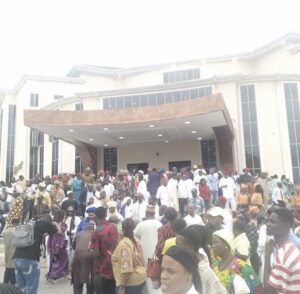
Stepping into EIICC premises, you are welcomed by a magnificent structure with modern auditoriums, superb interior decor and state-of-the-art cooling system. The facility has a 6,000 sitting-capacity main auditorium and two smaller ones. It is designed to host a variety of national and international events, even as it stimulates the economy of the state.
Former Speaker, Imo State House of Assembly, Dr. Acho Ihim, said: “The Emmanuel Iwuanyanwu International Conference Centre is a testament to Gov. Hope Uzodimma’s focus on delivering quality infrastructure across the state. The EIICC is just one of such.”
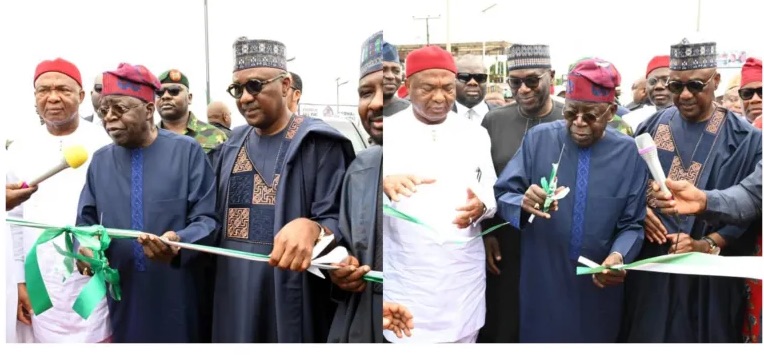
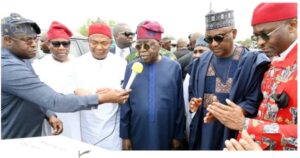
On September 30, the EIICC was inaugurated with fanfare by President Bola Ahmed Tinubu. Before coming to the EIICC, Tinubu had inaugurated the dualized 120km Owerri – Umuahia Road, as well as the Assumpta Twin Flyover. These events brought the crème de la crème of society to Owerri.
Indeed, if ever there was any doubt about Uzodimma’s place in Nigeria’s political space, such was dispelled that day. That day, Uzodimma literally moved the country to his state.
To put it differently, the country collapsed into Imo State as many of those that mattered in the running of the country converged on the capital of the Eastern Heartland. From the fringe of the Sahara to the Atlantic coastline, men and women of timbre and calibre, the movers and shakers of society, came to town. President Tinubu topped the long list of important personalities.
They included the Senate president, Mr. Godswill Akpabio; deputy president of the Senate, Barau Jibrin; Speaker of the House of Representatives, Hon. Tajudeen Abbas; deputy speaker, House of Representatives, Hon. Benjamin Kalu; governors elected on the platform of the All Progressives Congress (APC) and national chairman of the party, Prof. Nentawe Yilwatda, among other chieftains.
Others who graced the events were first class traditional rulers, including the Obi of Onitsha, His Majesty, Igwe Nnaemeka Alfred Ugochukwu Achebe; Ooni of Ife, Oba Adeyeye Enitan Ogunwusi, Ojaja II; Obong of Calabar, Edidem Ekpo Okon Abasi Otu V, as well as captains of industry, religious leaders, academics, members of the diplomatic corps and other dignitaries from across the country. Indeed, it was a full house.
Apart from inauguration of Uzodimma’s legacy projects, Tinubu also unveiled a book on APC authored by the governor, who is also the chairman of the Progressive Governors Forum (PGF). Speaking at the launch of Uzodimma’s book – A Decade of Impactful Progressive Governance in Nigeria – Tinubu reflected on the formation of APC as a pivotal move that altered Nigeria’s political trajectory.
He remarked: “The old ways weren’t viable, leading Nigeria close to collapse. Breaking with the past was not an option; it was the only way forward.
“With this book, Gov. Uzodimma has given Nigeria a gift. No nation will forget its own journey and no leader will forget the beauty of stewardship.”
He commended Uzodimma for executing impactful projects in Imo and for authoring a book that chronicles the achievements of the party in the past 10 years.
Expressing optimism about Nigeria’s future, Tinubu pointed out that the nation has recorded great improvement since the leadership of APC. According to him, “Nigeria is no longer where it was 10 years ago.”
Tinubu volunteered that his administration has, in the second quarter of 2025, grown the Nigeria economy by 4.23% with inflation rate falling to 20.12% this year, indicating a relief to the people. He appealed to Nigerians to remain patient, resilient and assured that the nation is changing for the better with the external reserve standing at 42.03%, the highest since 2019.
In his remarks, Akpabio lauded Uzodimma for transforming Imo State with critical infrastructure. He was particularly impressed by the world class air-conditioning system in the auditorium.
The Senate president also commended Uzodimma’s efforts in putting together a book that chronicled APC’s achievement and generally, for his vision for Imo State. He commended Tinubu for his leadership sagacity, adding that more progressive-minded opposition party governors will soon join the APC.
Reviewing the book, Prof. Bennett C. Nwanguma said it fits into the genre of political science or politics. Explaining the organization and structure of book, he said that it consists of 373 pages organised into 10 chapters.
Chapter one talks about early progressive movements. Here, the author traces the history of progressive politics in the country, starting from the years before independence until the present time, culminating in the formation of the All Progressives Congress (APC) in 2013.
Chapter two offers a clear and concise exploration of the term, progressive. According to Nwanguma, this “chapter is further enriched by a section on the evolution and impact of progressive governance in Europe, Latin America, Asia and, to a less extent, Africa.”
In chapter three of 26 pages, the APC manifesto and its core policies were discussed. Chapters four talked about ‘a decade of progressive governance: sectoral achievements’ and chapter five discusses ‘progressive governance in action’.
Chapter six unveiled a comparative analysis of Pre-APC era vs APC era. He said: “The author used five major parameters, namely economic performance, social development, infrastructure and global perception of Nigeria for the comparison.
“The verdict is summed up in this sentence, quote: In the last decade of APC governance, we have begun to transform Nigeria. Economically, Nigeria is more resilient and self – reliant today than we were ten years ago. Nigeria is also reclaiming respect globally. This is the decade that Nigeria turned the corner from years of promise to years of achievement. The Nigeria of 2025 is far better than the Nigeria of 2015, judging by such indicators as the economy, health, education, infrastructure and all other indices by which development is assessed.”
Chapter seven talked about APC’S approach to inclusive governance while chapter eight focused on Nigeria at the global stage. Chapter nine x-rayed the common criticisms of the APC governance in the last decade and chapter 10 discussed the way forward for democratic governance in Nigeria.
According to the reviewer, the strength of the book is that “the author set out to articulate, chronicle and document the impact of progressive governance in Nigeria as delivered by the All Progressives Party in the last decade. Without an iota of doubt, the author has achieved this. The book is brilliantly written and the timing of the publication is also apt, more like a book whose time has come. The book deserves credit first for its originality, the uniqueness and the rigour that went into it. The coverage is extensive and the analysisis deep. The true value of the book lies not only in the rigour and dept of research, but also in the presentation.”
Nwanguma noted that the book’s coverage is extensive and analysis quite deep, “creating opportunity for others to contribute to the progress of the progressive movement, and a viable reference for a long time.”
In his address at the book launch, Uzodimma reflected on Nigeria’s journey under the APC from 2015 to 2025, highlighting milestones, challenges, and lessons learned. He emphasised that the book is not just a personal achievement but belongs to the APC family and the Nigerian people.
Uzodimma stated that the book is a product of deep reflection and explained “progressivism” in the Nigerian context, focusing on community solidarity, inclusion, and service.
He praised President Tinubu’s visionary leadership and role in forming the APC, and commended the President for economic progress, especially for recording trade surpluses for six consecutive quarters with non-oil export contributing significantly.
Uzodimma noted that Imo State has seen rapid infrastructural growth, including roads, bridges, and urban renewal projects as well as other social investment initiatives.
Prof. Yilawatda described the book as a compass, pointing out that the author reminded the party of its journey since 2013 when it was formed. He stressed that history has recognised the party as visionary and a conviction that Nigeria deserved a change, and an urgent one at that, to plant the seed of reforms.
He honoured Uzodimma’s visionary intellect, describing him as a man “with deep thought, and the book, a guiding light.”
The APC national chairman described Tinubu as a master strategist and a leader who understands transformation and what it requires.
Igwe Nnaemeka Achebe, traditional ruler of Onitsha, in his goodwill remarks on behalf of his colleagues who came from across the regions of the nation, commended Governor Uzodimma’s effort in authoring the book and described the book as a “road map to the nation’s economic development.”
Alhaji Addulsamad Ishaku Rabiu, a business mogul and chief launcher, also commended the author and his party, emphasising leadership that is focused, pragmatic and willing to serve the people.
The masters of ceremony, Eugenia Abu, Okey Bakassi and Cyril Stober, navigated through the programme skillfully.
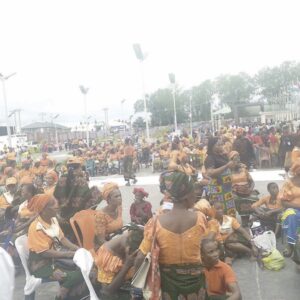
Outside the EIICC, excited Imo residents danced to their hearts content, singing praises to the governor who has given them hope of better days to come.