Follow Us on Google
From Sola Ojo, Abuja
President Bola Tinubu has urged the Economic Community of West African States (ECOWAS) to classify resource theft, illegal mining and mineral smuggling as international crimes, warning that the scourge threatens the region’s peace, stability and economic prosperity.
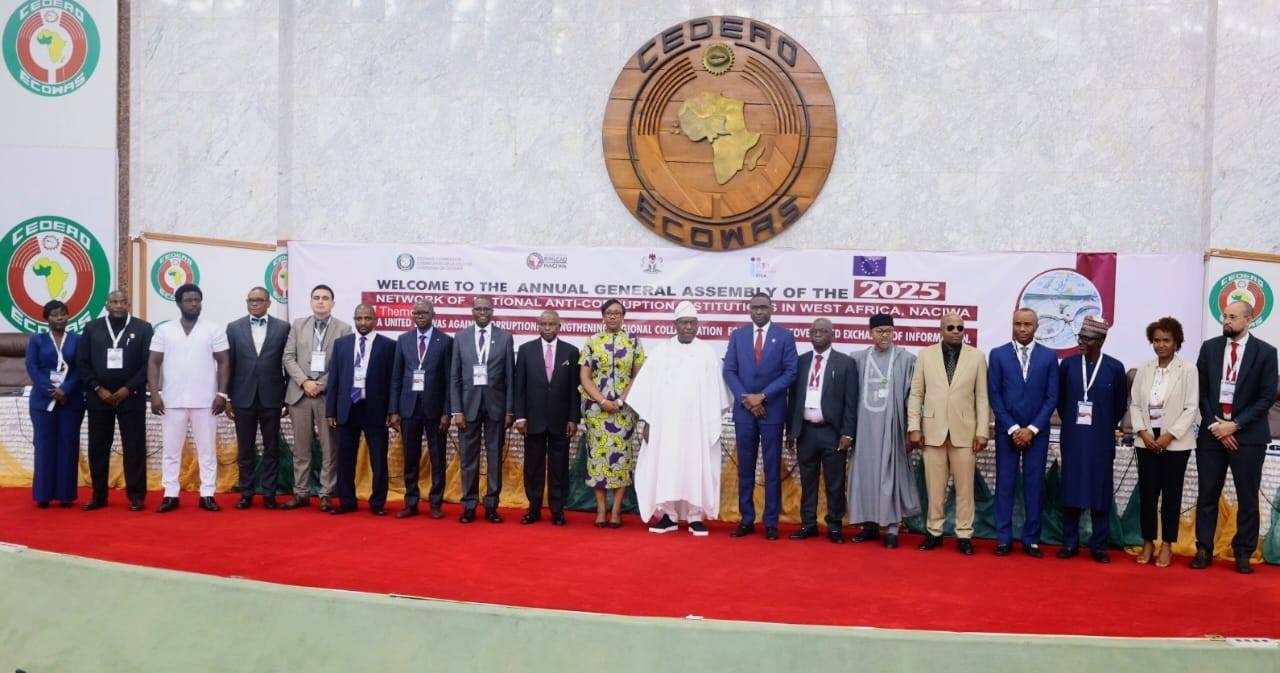
Speaking through the Secretary to the Government of the Federation (SGF), George Akume, at the opening of the 7th Annual General Assembly of the Network of National Anti-Corruption Institutions in West Africa (NACIWA) in Abuja, yesterday, the President said the time had come for the regional economic body to walk its talk.
He specifically wanted ECOWAS to designate resource theft, illegal mining and stealing of minerals as international crimes that threaten the stability of the region, and galvanise the world against trade in stolen minerals from West Africa.
He lamented that despite decades of economic reforms, the menace of illicit financial flows and mineral theft continues to weaken development efforts across the subregion.
“Even now, illicit outflows remain an odious miasma. Stealing of mineral resources is on the rise in the region, fuelling the proliferation of small arms, light weapons and other violent crimes, such as kidnapping and banditry.
“These have exacerbated our security challenges and worsened the development outlook of the region,” he said.
The President emphasised that no country could win the battle against corruption alone, urging member states to embrace collective action.
“No country can single-handedly win the battle against illicit flows. It requires collaboration and NACIWA offers ECOWAS a multi-state and multi-stakeholder platform to harness regional efforts against corruption and its manifestations,” he added.
Highlighting his administration’s commitment to accountability and asset recovery, Tinubu said Nigeria had made significant progress through the Economic and Financial Crimes Commission (EFCC) under Ola Olukoyede, who also serves as the current President of NACIWA.
He said: “Under my administration, we have prioritised asset tracing and recovery, backed by a new legal framework for asset management.
“The vision has translated into the recovery of humongous sums by the anti-corruption agencies. One of the agencies, the EFCC, has been prolific in recovering stolen assets.”
He revealed that recovered assets are now being put to productive use.
“Our commitment is to ensure that recovered stolen assets become enablers of growth and instruments for social inclusion.
“Two legacy programmes of my administration, the Students Loan Scheme and the Consumer Credit Scheme, commenced operation with the injection of N100 billion in recovered proceeds of crime by the EFCC.”
Earlier, Olukoyede, who is the EFCC Chairman and President of NACIWA, reaffirmed the network’s renewed vision as a unifying force for anti-corruption collaboration in the region.
Other News
“Since assuming office in 2022, our goal has been to reposition NACIWA into a dynamic and credible platform for regional collaboration,” he said.
He listed the network’s achievements, including enhanced regional visibility, formal recognition by ECOWAS, the establishment of a permanent secretariat in Nigeria and the designation of the EFCC Academy as NACIWA’s Centre of Excellence for capacity development.
To him, “We have deepened partnerships with ECOWAS, United Nations Office for Drugs and Crimes (UNODC), the African Union (AU) Anti-Corruption Board, and other development partners.
“We now enjoy observer status at the GlobE Network, linking NACIWA to global anti-corruption bodies.”
He further disclosed that the network had proposed its recognition as a Technical Commission under ECOWAS Protocol Article 19, a move he said would “institutionalise coordination on investigations, asset recovery and anti-corruption policies across the subregion.
“We must acknowledge the evolving landscape in which our institutions operate. Political transitions, security concerns and governance challenges across member states underscore that our fight against corruption cannot be divorced from broader considerations of political stability and social justice.”
On his part, the Attorney-General of the Federation and Minister of Justice, Lateef Fagbemi, commended Olukoyede’s leadership, describing it as distinguished and exemplary.
“Let me commend the leadership of the EFCC chairman, who, as NACIWA President, has strengthened the network not only in integrity but also in transparency and accountability,” he said.
Similarly, Senator Emmanuel Udende, Chairman of the Senate Committee on Anti-Corruption and Financial Crimes, stressed that corruption’s trans-border nature demands strong regional synergy.
“Its trans-border nature demands that we go beyond national efforts to embrace strong regional cooperation, intelligence sharing and joint asset recovery,” Udende said, pledging the National Assembly’s support for legal frameworks that enhance international cooperation.
Chairman of the House Committee on Anti-Corruption and Financial Crimes, Ginger Onwusibe represented by Nnamdi Ezechukwu, emphasised that corruption knows no borders.
“Corruption does not respect borders; it moves through our systems, our banks, our pockets and our politics,” he said. “That is why our efforts must also transcend borders.”
The President of the ECOWAS Commission, Dr. Omar Alieu Touray, represented by Vice President Damtien L. Tchintchibidja, also praised the EFCC for strengthening NACIWA’s visibility and impact.
“NACIWA has made significant strides in promoting collaboration, though there is a need to further intensify cooperation,” she said.
Other dignitaries present included the Chairman of the Independent Corrupt Practices and Other Related Offences Commission (ICPC), Dr. Musa Adamu Aliyu; Ambassador Gautier Mignot, Head of the EU delegation to Nigeria and ECOWAS and representatives of UNODC, International IDEA, Code of Conduct Bureau and civil society organisations.