Follow Us on Google
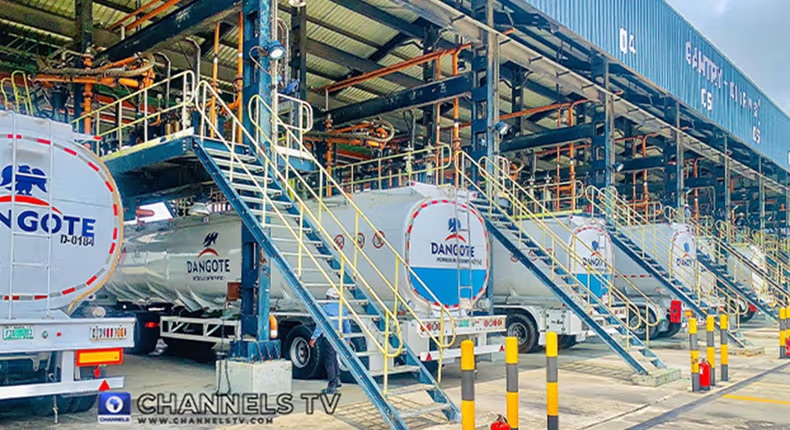
As the N2.15 trillion initial public offering (IPO) of Dangote Petroleum Refinery opens today, the refinery’s dominance of Nigeria’s petrol market is putting the question of competition in the downstream sector under fresh scrutiny.
Concerns previously raised by petroleum marketers and the Federal Competition and Consumer Protection Commission (FCCPC) are resurfacing, especially as the refinery’s IPO prospectus revealed that Dangote accounted for approximately 87.6 per cent of Nigeria’s total Premium Motor Spirit (PMS) supply as of May 31, 2026, including imported volumes, while accounting for 100 per cent of domestic produced PMS.
The disclosure provides the latest indication of how quickly the refinery has become the dominant supplier in Nigeria’s petrol market.
But concerns about excessive market concentration are not new.
Indeed, months before the IPO,Petroleum Products Retail Outlets Owners Association of Nigeria (PETROAN), Independent Petroleum Products Marketers Association of Nigeria(IPMAN) and the FCCPC had separately raised questions about the implications of Dangote Refinery’s growing influence over refining, distribution and supply in the downstream petroleum market.
President of PETROAN, Billy Gillis-Harry, warned in September 2025 that the concentration of refining, storage, distribution and retailing under one corporate entity could pose a risk to Nigeria’s energy security.
“There is an attempt by a corporate organisation to consolidate the power of refining, storing, distributing, and eventually owning retail outlets. That will be so much power concentrated in the hands of one company that will now even answer the question of energy security. And energy is a major issue, even in times of war”, he said.
Gillis-Harry’s warning, made in an interview on ARISE News, was not directed at domestic refining itself but at the possibility of excessive concentration across the petroleum value chain.
The PETROAN President had argued that while the emergence of Dangote Refinery was positive for Nigeria, the market needed to retain sufficient competition to protect energy security and other businesses.
The Independent Petroleum Marketers Association of Nigeria (IPMAN) had similarly raised concerns over Dangote Refinery’s proposed direct distribution arrangements and their possible implications for existing marketers.
IPMAN Publicity Secretary, Chukwudi Akadike, had cautioned that the concerns of marketers and other stakeholders needed to be addressed before the distribution scheme could achieve its intended objectives.
“Until concerns of marketers and stakeholders are addressed, the scheme may not achieve its purpose.”
Akadike’s intervention came amid discussions over Dangote’s plan to distribute petroleum products directly across the country, a model that marketers feared could bypass established distribution structures and alter the competitive balance in the downstream market.
The competition question also reached the FCCPC during the earlier legal dispute over petroleum product import licences.
When Dangote Refinery challenged the import licences issued by the Nigerian Midstream and Downstream Petroleum Regulatory Authority (NMDPRA) to NNPCL and other marketers, the FCCPC sought to join the case, arguing that the matter had significant implications for competition in the petroleum industry.
The Commission stated that the case raised the question of whether preventing other oil companies from operating their import licences could lead to anti-competition or a monopoly in favour of Dangote Refinery.
In its application, the FCCPC put the issue more directly:
“The main thrust of Dangote Refinery’s suit borders on anti-competition and monopoly in the petroleum industry.”
The Commission said its interest in the case arose from its statutory mandate to protect competition and eliminate anti-competitive practices.
Although the court subsequently dismissed the FCCPC’s application to join the case, and the refinery later discontinued the suit, the competition issue did not disappear.
Indeed, the controversy resurfaced in 2026 when NNPC opposed another legal challenge by Dangote over fuel import licences, accusing the refinery of seeking to monopolise Nigeria’s fuel market.
NNPC argued that restricting competing imports could undermine competition, expose the country to supply disruptions and create price instability.
Against that background, the latest disclosure in Dangote Refinery’s prospectus is significant.
With the refinery already accounting for 87.6 per cent of total PMS supply, including imports, the downstream market has become substantially dependent on one domestic producer.
The prospectus itself acknowledges the refinery’s dominant supply position but maintains that the refining and petrochemical industries remain highly competitive, with Dangote competing against regional and international refiners and other suppliers into West Africa.
It also states that competition in refining is determined by factors including crude-oil sourcing, refining efficiency, logistics, distribution infrastructure, product quality and pricing.
But the document contains another disclosure that could concern consumers and marketers expecting domestic refining to automatically translate into cheaper petrol.
Dangote Refinery says its domestic product pricing is based on import parity, with refined-product prices referenced to international benchmarks.
“In relation to domestic sales, the Issuer adopts an import-parity pricing approach to maintain competitiveness with imported products.”
The prospectus further states that changes in international crude prices and refined-product prices directly affect the refinery’s gross refining margin, revenue and profitability.
This means that although the petrol is refined domestically, its pricing remains linked to international market dynamics.
For downstream marketers, the implication is significant.
The emergence of Dangote Refinery has reduced Nigeria’s dependence on imported petrol, but it has not insulated the domestic market from global crude prices, international product benchmarks or foreign-exchange movements.
The prospectus acknowledges that the refinery’s results are significantly affected by fluctuations in crude oil prices, exchange-rate movements, inflation and regulatory and fiscal policies affecting the Nigerian oil and gas industry.
The refinery is also preparing for a much larger role in the market.
According to the prospectus, Dangote intends to expand its refining capacity to approximately 1.4 million barrels per day by 2029, subject to regulatory approvals, financing and successful execution of the expansion programme.
That expansion could further deepen its position in Nigeria and the wider West African petroleum-products market.
For the downstream industry, therefore, the issue is not whether Dangote Refinery has transformed Nigeria’s petroleum sector. It clearly has.
The refinery has helped reduce import dependence, created domestic refining capacity on an unprecedented scale and supplied the overwhelming majority of Nigeria’s PMS market.
The bigger question is whether the emergence of such a dominant supplier can coexist with a sufficiently competitive downstream market.
That question was raised by PETROAN and IPMAN long before the IPO, especially in the context of marketers’ access to products and distribution.
And it was equally raised by the FCCPC from the standpoint of competition and monopoly.