Follow Us on Google
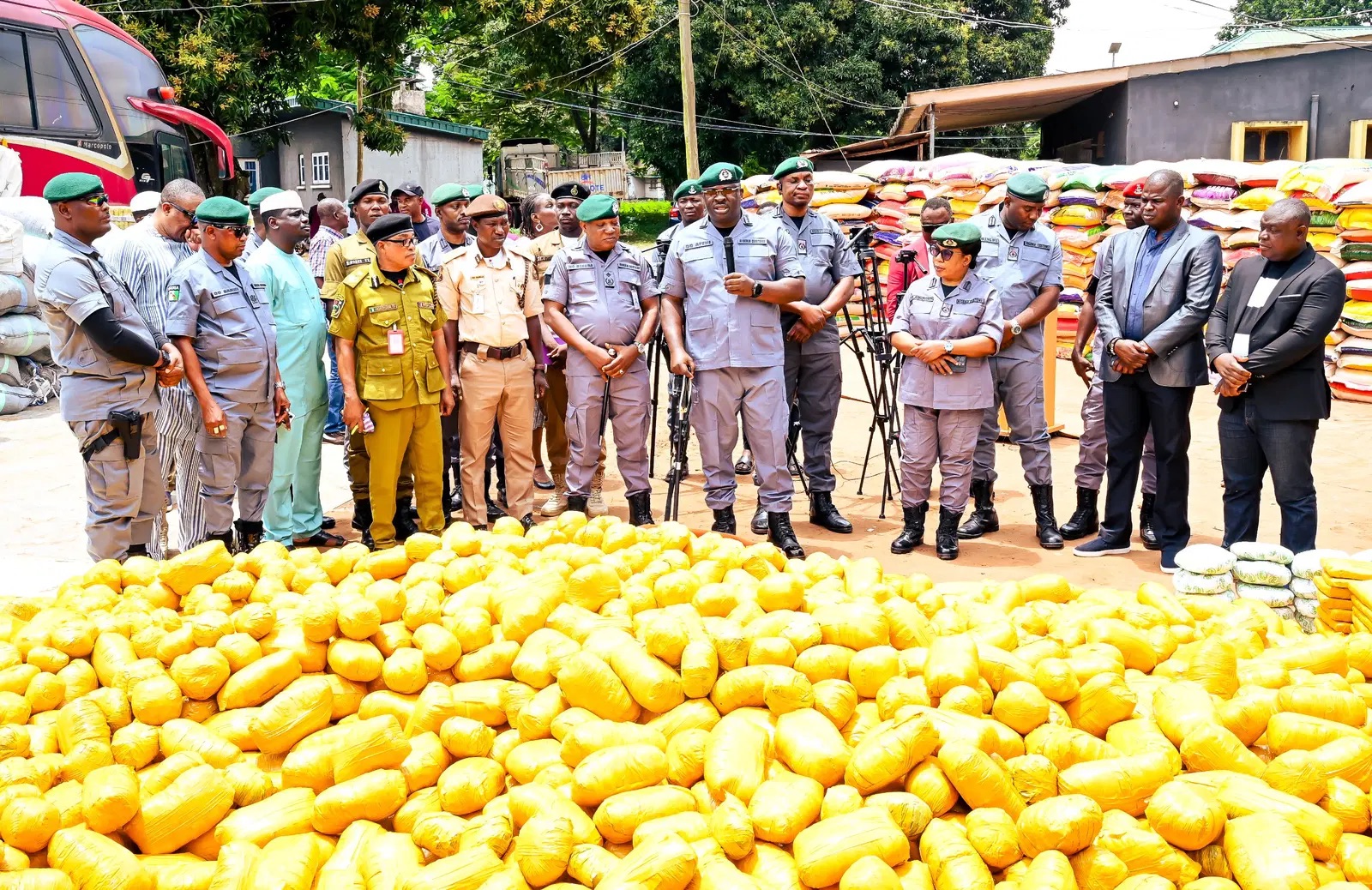
The Nigeria Customs Service (NCS), Ogun I Area Command, Idiroko, has stepped up its crackdown on smuggling along the Nigeria-Benin Republic border and intercepted prohibited goods worth more than N9.5 billion in Duty Paid Value (DPV) between February and August 2026.
The sustained enforcement campaign, according to the Command, is aimed not only at curbing smuggling but also at protecting local industries, safeguarding food security, preventing the circulation of illicit drugs and pharmaceuticals, boosting government revenue and creating a safer environment for legitimate trade.
At the centre of the operation is the Acting Customs Area Controller of Ogun I Area Command, Deputy Comptroller Olukayode Oladapo Afeni, under whose leadership the Command has recorded seizures involving foreign rice, petroleum products, narcotics, tyres, pharmaceuticals, clothing, sugar, fertiliser, wildlife and other prohibited goods.
Between June 24 and August 13, 2026, the Command intercepted prohibited consignments with a combined DPV of N3,574,435,248.08.
The seizures included 6,035 parcels of Ghana Loud/Indica, 2,339 bags of foreign parboiled rice, 70 cartons of basmati rice, 30 bags of foreign sugar, 11,450 litres of Premium Motor Spirit, PMS, in kegs, another 1,750 litres of PMS in drums and 30 kegs of diesel.
Also seized were 100 bags of fertiliser, 67 bales of second-hand clothing, 2,674 pieces of new shorts and trousers, 3,760 pieces of new tops, 85 fire extinguishers, 480 cartons of Pure Haven drinks, cosmetics, oats, hair accessories, surgical shoes and 127 new purses.
The 6,035 parcels of Ghana Loud/Indica were subsequently handed over to the National Drug Law Enforcement Agency (NDLEA), Idiroko Special Command, for further investigation and necessary action.
Afeni disclosed that between January and August 2026, the Command had handed over 32,412 parcels of hard drugs and 92 sacks of raw Cannabis Sativa to the NDLEA.
The latest seizures followed another major enforcement operation conducted between April 1 and June 23, 2026, during which the Command recorded 146 seizures totalling N4,628,591,970.16 in DPV.
During the same period, the Command generated N259,777,346.89 in revenue, representing a 238 per cent increase over the N76.81 million generated during the corresponding period of 2025.
The second-quarter seizures included 2,807 bags of foreign parboiled rice, 9,482 parcels of Cannabis Sativa, 62 sacks of raw marijuana, 16,525 litres of PMS, 475 litres of diesel, 7,642 pieces of footwear, 2,427 pneumatic tyres, 63 sacks of foreign sugar, 73 bales of second-hand clothing, fertiliser, imported flour, frozen products and pharmaceuticals.
The Command also handed over 6,981 parcels of Cannabis Indica/Ghanaian Loud and 62 sacks of raw marijuana to the NDLEA, while illicit pharmaceutical products, including 77 cartons of Analgin injections containing 138,600 tubes, were transferred to the National Agency for Food and Drug Administration and Control (NAFDAC).
Earlier between February and March 2026, the Command intercepted prohibited goods valued at approximately N1.35 billion.
Those seizures included 2,539 kegs of vegetable oil, 4,325 cartons of foreign spaghetti, 1,204 bags of foreign parboiled rice, 2,547 parcels of Cannabis Sativa and 13,625 litres of PMS.
Four live pangolins and two antique artefacts believed to date back to the 19th century were also intercepted.
The Command said the seizure of vegetable oil formed part of its efforts to protect domestic producers from unfair competition arising from the illegal importation of foreign products.
The recurring seizure of foreign rice has also emerged as a major feature of the anti-smuggling campaign, with Customs maintaining that the illegal inflow of foreign rice undermines Nigerian farmers, local rice mills and agricultural investors.
In the April-June period alone, 2,807 bags of foreign parboiled rice were intercepted, while another 2,339 bags, alongside 70 cartons of basmati rice, were seized between June 24 and August 13.
Beyond economic concerns, the Command has also faced resistance from smugglers during enforcement operations.
Other News
In one June operation, Customs officers intercepted a truck carrying 113 bags of foreign parboiled rice along the Itori-Wasimi-Abeokuta corridor. The driver, according to the Command, ignored the officers’ signal to stop and attempted to ram the patrol vehicle before he was apprehended.
In another operation, 630 bags of foreign rice were intercepted along the Afamin-Igbogila axis.
The Command said its operations were increasingly being driven by intelligence, technology and collaboration with sister security agencies as smugglers continued to adopt more sophisticated methods, including concealment, the use of bush paths and waterways, night movements and multiple routes.
Afeni’s enforcement strategy, therefore, appears to be moving beyond routine patrols to intelligence-led operations designed to identify smuggling networks, track their routes and intercept consignments before they reach the Nigerian market.
Despite the aggressive enforcement campaign, however, the Ogun I Command has continued to record progress in legitimate trade.
Between April and June 2026, the Command facilitated 20,972 metric tonnes of exports with a Free-On-Board value of ₦1.049 billion, compared with no recorded export activity during the corresponding period of 2025.
By the August briefing, the Command had reported another 10,110 metric tonnes of exports valued at ₦2.594 billion FOB, with white talc, crushed thermal coal and Compressed Natural Gas, CNG, among the major commodities exported.
The development suggests that the Command is attempting to balance enforcement with trade facilitation by blocking illicit commerce while creating room for legitimate businesses to operate.
For the Customs Service, the wider objective is to ensure that the border does not become a conduit for smuggling at the expense of Nigerian manufacturers, farmers, legitimate traders and government revenue.
However, the persistence of large-scale seizures also highlights the scale of the economic incentives sustaining smuggling activities.
The continued interception of rice, petroleum products, narcotics, clothing and other prohibited goods indicates that enforcement alone may not eliminate the problem.
Border communities, traders and legitimate businesses would also require predictable procedures, viable economic alternatives and efficient trade processes, while security agencies would need sustained cooperation to tackle criminal networks operating across the border.
The Ogun I experience consequently presents a broader test of the Federal Government’s Renewed Hope economic agenda.
The objective is not merely to increase the volume of seized goods but to create an environment where Nigerian farmers and manufacturers can compete, legitimate traders can operate profitably, government can collect lawful revenue and criminal networks can no longer exploit the border as an avenue for illicit commerce.
From the approximately ₦1.35 billion seizure recorded between February and March, to the ₦4.63 billion recorded between April and June, and the ₦3.57 billion seizure window between June 24 and August 13, the operational tempo of the Ogun I Command has remained high.
The diversified seizure profile also shows that the border challenge extends beyond food products to narcotics, petroleum products, pharmaceuticals, tyres, clothing, sugar, fertiliser, wildlife and antiquities.
At the same time, the Command’s collaboration with the NDLEA and NAFDAC, revenue generation and facilitation of legitimate exports indicate an attempt to make border enforcement serve both economic and security objectives.
For now, the message from Idiroko appears clear: while Customs is tightening the space available for smugglers, it is also seeking to position the border as a gateway for legitimate Nigerian trade.
The ultimate measure of success, however, will not be the size of Customs’ seizure warehouses but whether the pressure on illicit trade translates into a stronger legitimate economy, greater protection for local producers, increased revenue and a safer border environment.