Follow Us on Google
By Damiete Braide
The Cross River State Government is taking bold steps to boost its health security framework with the drafting of two landmark pieces of legislation, the Public Health Security Bill and the Animal Health Bill.
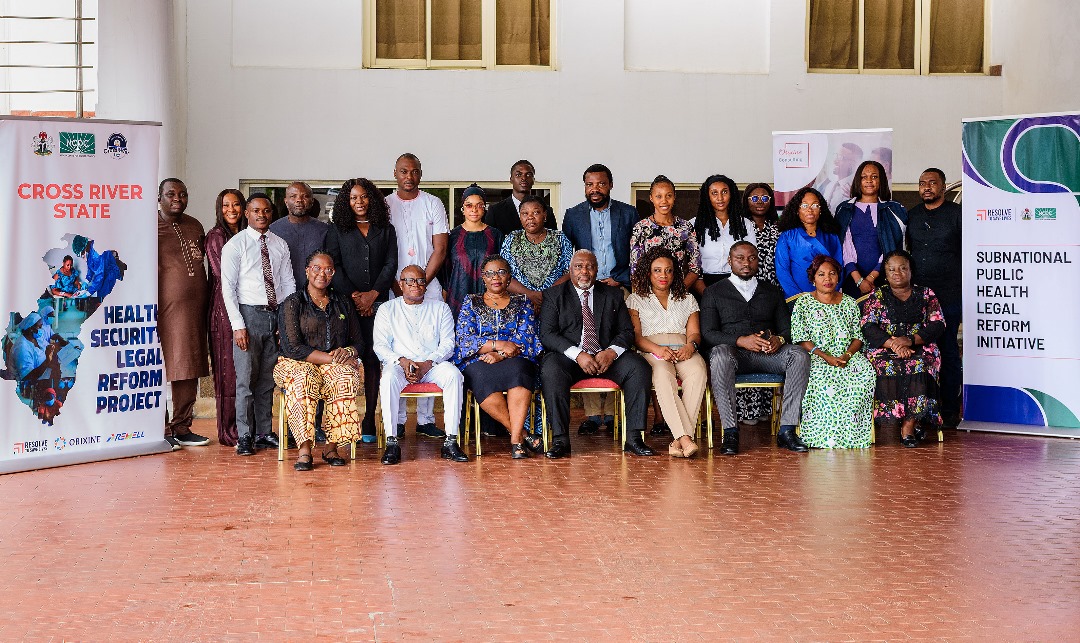
Through the collaborative efforts of the State Ministries of Health and Justice, in partnership with the Nigeria Centre for Disease Control and Prevention (NCDC) and the global health initiative Resolve to Save Lives (RTSL), a legal drafting workshop was convened to advance the development of both bills.
This initiative aims to strengthen the state’s legislative capacity to prevent, detect, and respond to public health threats, including zoonotic diseases that can spread between animals and humans.
The drafting process draws heavily from Nigeria’s broader health security law reform agenda. At its core, the goal is to ensure that legal instruments are aligned with international best practices, provide clarity on the roles and responsibilities of different health actors, and incorporate gender-responsive and inclusive approaches into public health governance.
Chibuzo Eneh, Director of Subnational Support at NCDC, stressed the importance of state-level legal frameworks in safeguarding public health. He pointed to recommendations from the Joint External Evaluation conducted in Nigeria, which underscored the need for subnational public health security laws in line with the International Health Regulations (2005).
“Many state laws are moribund and outdated, according to the assessment conducted by the NCDC, hence the need for a review,” Eneh explained.
The two bills are designed to establish a strong legal foundation for a One Health approach, a strategy that integrates human, animal, and environmental health to improve disease prevention and response. They will address critical gaps revealed in both national and state assessments, such as deficiencies in emergency preparedness, weak surveillance systems, insufficient attention to gender equity, and outdated animal health regulations.
Anthony Effiom, Solicitor General of the Cross River State Ministry of Justice, noted that legal clarity is essential for effective emergency response.
“A strong legal framework with clearly defined roles is essential for building a resilient and coordinated system capable of protecting citizens during health emergencies. These bills will enhance our capacity and ensure that no sector is left behind in the fight against public health threats,” he said.
Other News
To ensure that the proposed laws are not just well-written but also actionable and enforceable, NCDC and RTSL are providing technical expertise. This support is helping to ensure the bills reflect evidence-based standards, clearly outline responsibilities, and foster collaboration across the public health, veterinary, and environmental sectors.
According to RTSL’s Senior Legal and Policy Advisor, Barr. Emem Udoh, robust legal frameworks can be lifesaving.
“Robust public health laws are essential to saving lives. These bills will equip Cross River State to act swiftly, coordinate effectively, and protect its most vulnerable during public health emergencies, while safeguarding economic and social stability,” Udoh said.
Among the key elements of the proposed legislation are the establishment of a legal framework for integrated disease surveillance, early warning systems, and rapid emergency response; the creation of a state public health laboratory to improve diagnostic capacity; stronger regulation and monitoring of animal health to reduce the risk of zoonotic outbreaks; clear definition of the roles of Ministries, Departments, and Agencies (MDAs) in preparedness and response operations; provision for sustainable financing and accountability mechanisms to ensure long-term health security.
The outcome of the legal drafting workshop will directly inform the provisions of both bills, ensuring they are practical, enforceable, and aligned with state and national health security priorities. Once the drafting process is complete and the bills are approved by Governor Bassey Otu, they will be presented to the Cross River State House of Assembly for consideration and passage.
If enacted, the Public Health Security Bill 2025 and the Animal Health Bill 2025 will not only modernise the state’s health governance framework but also bring it in line with international standards. Cross River State will join a growing list of states, including Kaduna, Kano, and Jigawa, that have recently updated their legal frameworks to meet the evolving demands of public health and animal disease control.
By embedding preventive measures, rapid response capabilities, and intersectoral collaboration into law, Cross River State is positioning itself to handle both current and future public health emergencies more effectively. The integration of a One Health approach ensures that human, animal, and environmental health are addressed in a unified manner, reducing the risk of outbreaks and ensuring a more resilient health system for all residents.
As global health threats continue to evolve, the state’s proactive legislative action signals its readiness to protect lives, safeguard livelihoods, and build a health system capable of withstanding the challenges of the future.