Follow Us on Google
By Lukman Olabiyi
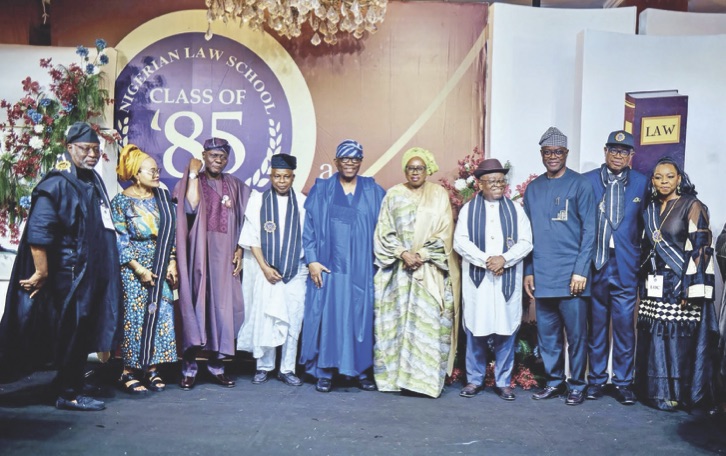
The 2025 annual reunion of the Nigerian Law School Class of 1985 was not merely a celebration of four decades at the Bar; it was a historic convergence of men and women whose collective imprint has shaped Nigeria’s legal system, governance, academia and corporate life for 40 remarkable years.
Described by dignitaries as one of the most prestigious, influential and illustrious sets ever produced by the Nigerian Law School, the Class of 1985 returned in grand style, reunited by shared memories, professional triumphs and a legacy of service that cuts across every stratum of national life.
From the pinnacle of the judiciary to the corridors of executive power, the class stands as a testament to what disciplined training, intellectual rigour and professional camaraderie can produce.
At the apex of the judiciary alone, the set boasts three serving Justices of the Supreme Court of Nigeria: Justice John Inyang Okoro, Justice Moore Abraham Aseimo Adumein and Justice Habeeb Adewale Abiru, an extraordinary distinction that underscored the pedigree of the cohort.
Their influence is equally profound at the Court of Appeal, where at least seven Justices trace their professional roots to the 1985 set, while the Federal and State High Courts currently count eight Chief Judges from the class.
In all, more than 100 serving and retired judges, alongside countless magistrates across the federation, are products of the same cohort, making it one of the most judicially represented classes in the history of the Law School.
Yet, the reach of the Class of 1985 extends far beyond the courtroom. Members of the set have distinguished themselves as permanent secretaries, heads of service, chief executives of key government parastatals and leaders in the private sector.
In the academia, the class has produced vice chancellors, deputy vice chancellors and over 20 professors, including renowned scholars such as Prof. Wahab Egbewole, SAN; Prof. Enefiok Essien, SAN; Prof. Nierum Okogbule; and Prof. Ayo Atsenuwa.
The immediate past Chairman of the ICPC, Prof. Bolaji Owasanoye, SAN, is also a proud member of the class.
At the Bar, the leadership credentials of the set are formidable. The leader of the class is also the leader of the Nigerian Bar, the Attorney-General of the Federation and Minister of Justice, Prince Lateef Olasukanmi Fagbemi, SAN.
The class further counts 46 Senior Advocates of Nigeria (SANs), over 22 Benchers and a rare dual-qualified legal luminary, Prof. Fidelis Hillary Izuka Oditah, KC, SAN.
The Lagos grand finale of the anniversary celebrations drew an array of high-profile guests, including the Chief Justice of Nigeria, Justice Kudirat Kekere-Ekun; Lagos State Governor, Babajide Sanwo-Olu; Oyo State Governor, Seyi Makinde; and other eminent personalities from across the country.
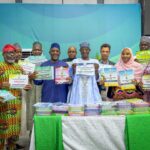
Welcoming guests, the Class Chairman, Chief Emeka Ngige, SAN, expressed profound gratitude to the law teachers who moulded the set at the Nigerian Law School, Victoria Island, and paid special tribute to the outgoing Director-General of the Nigerian Law School, Prof. Isa Hayatu Chiroma, SAN, for his consistent support of the class since assuming office in 2018.
He recalled that the anniversary celebrations had spanned continents from a mini-reunion in Enugu during the NBA Annual General Conference in August 2025, to another gathering in Toronto on the sidelines of the International Bar Association conference, culminating in the Lagos event as a thanksgiving for life, service and professional elevation.
A major highlight of the evening was the dinner lecture delivered by Prof. Fidelis Oditah, KC, SAN, titled “The Increasing Demand on Judicial Time for Political and Electoral Matters: Implications for Socio-Economic Development of Nigeria.”
In a thought-provoking address, Oditah lamented what he described as decades of judicial gridlock, excessive technicality and an unhealthy prioritisation of political litigation over all other forms of justice.
“The problem in Nigeria is not access to justice,” he declared. “It is exit from justice.”
He criticised the culture of endless interlocutory appeals, procedural ambushes and cases that drag on for decades, citing disputes lasting as long as 70 years and collapsing on avoidable technical grounds.
According to him, the over-concentration on electoral disputes driven by constitutional timelines has left commercial, labour, land and human rights cases languishing, with severe consequences for investment, social stability and economic growth.
In their goodwill messages, the Chief Justice of Nigeria, Governors Sanwo-Olu and Makinde commended the Class of 1985 for its enduring contributions to nation-building and urged members to continue to deploy their wealth of experience, influence and intellect in the service of humanity and Nigeria.
As the evening drew to a close, the reunion stood not just as a celebration of longevity at the Bar, but as a powerful reminder of what a generation of lawyers, united by purpose and sustained by excellence can achieve in shaping a nation’s destiny.