Follow Us on Google

The federal government has warned that 14,118 communities across 266 Local Government Areas (LGAs) in 33 states and the Federal Capital Territory (FCT) will be at high risk of flooding this year. The Minister of Water Resources and Sanitation, Joseph Utsev, disclosed this during the public presentation of the 2026 Annual Flood Outlook (AFO) by the Nigeria Hydrological Services Agency (NIHSA) in Abuja.
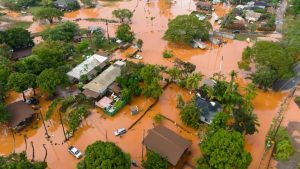
The states are Abia, Adamawa, Anambra, Bauchi, Bayelsa, Benue, Borno, Cross River, Delta, Ebonyi, Edo, Enugu, Gombe, Imo, Jigawa, Kaduna, Kano, Kebbi, Kwara, Lagos, Nasarawa, Niger, Ogun, Ondo, Osun, Oyo, Plateau, Rivers, Sokoto, Taraba, Yobe, Zamfara and the FCT.
Also, additional 15,597 communities in 405 LGAs in 35 states, excluding Ekiti State, will experience moderate flood risk, while 923 communities in 77 LGAs in 24 states will be affected by low flood risk incidents during the year. The listed states include Adamawa, Anambra, Bauchi, Bayelsa, Benue, Borno, Cross River, Delta, Ebonyi, Edo, Jigawa, Kaduna, Kano, Kebbi, Kogi, Nasarawa, Niger, Ogun, Ondo, Osun, Oyo, Sokoto, Taraba, Zamfara and the FCT.
Utsev warned that major cities in the country that will experience flash and urban flooding due to the high rainfall intensities, low attention to management of water facilities such as drainage systems and waterways and lack of flood resilience structures include Abakaliki, Abeokuta, Abuja, Benin City, Birnin-Kebbi, Calabar, Ibadan, Kaduna, Kano, Lagos, Makurdi, Nguru, Onitsha, Oshogbo, Port Harcourt, Sokoto, Warri and Yola, among others.
At the same time, Bayelsa, Cross River, Delta, Lagos, Ogun, Rivers and Ondo will experience coastal flooding due to rise in sea level and tidal surge. This will impact fishing, wildlife habitation and river navigation.
The minister described the AFO as a critical planning tool for disaster preparedness, stressing that early warning remained key to reducing the impact of floods on lives, infrastructure and the economy. According to him, “the Annual Flood Outlook is not just a scientific report but a call to action. Early information saves lives, protects livelihoods and reduces economic losses.”
Other News
The Director-General of NIHSA, Umar Ibrahim Mohammed, had earlier explained that the 2026 AFO was driven by improved technology and data systems. He also stated that the agency had upgraded its flood forecasting framework to a hybrid AI-integrated modeling system to enhance accuracy, reduce false alarms and improve early warning timelines.
President Bola Tinubu, who was represented at the event, said the outlook underscored the need for proactive flood management and economic diversification. He also noted that recurrent flooding had remained a major national challenge, recalling the devastating 2024 flood in Maiduguri, Borno State, which prompted a shift towards anticipatory disaster management.
Apart from stating that the AFO had become a foundational document for planning early response, mitigation and evacuation strategies nationwide, the President enjoined relevant ministries to develop frameworks for harnessing Nigeria’s water resources as part of efforts to move from an oil-dependent economy to water-based economy.
Some studies have shown that between 1985 and 2014, floods affected over 11million Nigerians, claimed more than 1,100 lives and caused economic losses exceeding $17billion. In the same vein, no fewer than 5.2million people were affected by the 2024 flood. According to the National Emergency Management Agency (NEMA), the 2024 floods led to the loss of 1,237 lives; displacement of 1.2million people, while 16,469 individuals were injured, 116,172 houses were destroyed and 1,439,296 hectares of farmlands were affected.
The annual flood alarm is, indeed, a call for action to mitigate the impact of floods in the affected communities, LGAs, states and the FCT. With 33 states, 266 LGAs and 14,118 communities to be affected by the flood, there is need for proactive measures to reduce its impact in those areas. The governors and chairmen of the affected states and LGAs must begin to put measures in place to check the impact of the impending floods. They must ensure that farming communities are not adversely affected by the flood.
Temporary homes can be provided in safe areas for those who will be displaced by the flood. In fact, the state governments should relocate people in flood-prone communities to upland areas.
The early flood warning calls for action and the clearing of water drainage systems and waterways. For proper waste management, Nigerians are enjoined to desist from dumping refuge in drains and waterways. They must ensure regular clearing and maintenance of drainage channels.
Those enforcing building regulations should prohibit and remove structures on waterways, as well as protect natural drainage areas. They should provide proper water channels around buildings. The state governments should also expand and modernise infrastructure to meet the needs of growing urban population. Let government plant more trees, protect wetlands and restore green spaces to absorb excess water. Building of dams in high flood-prone areas will mitigate the effects of floods and save farms, crops, animals and other livelihoods.