Follow Us on Google
• Farmers lament losses, as lack of processors push manufacturers to imports
• Garri may be N30,000 next year, farmers warn
• Experts urge ‘Nigeria First’ policy to save cassava industry, farmers
By Ngozi Nwoke
Nigeria is the largest producer of cassava in the world. Yet in 2026, cassava farmers bitterly complain of facing an economic disaster with little national attention or support.
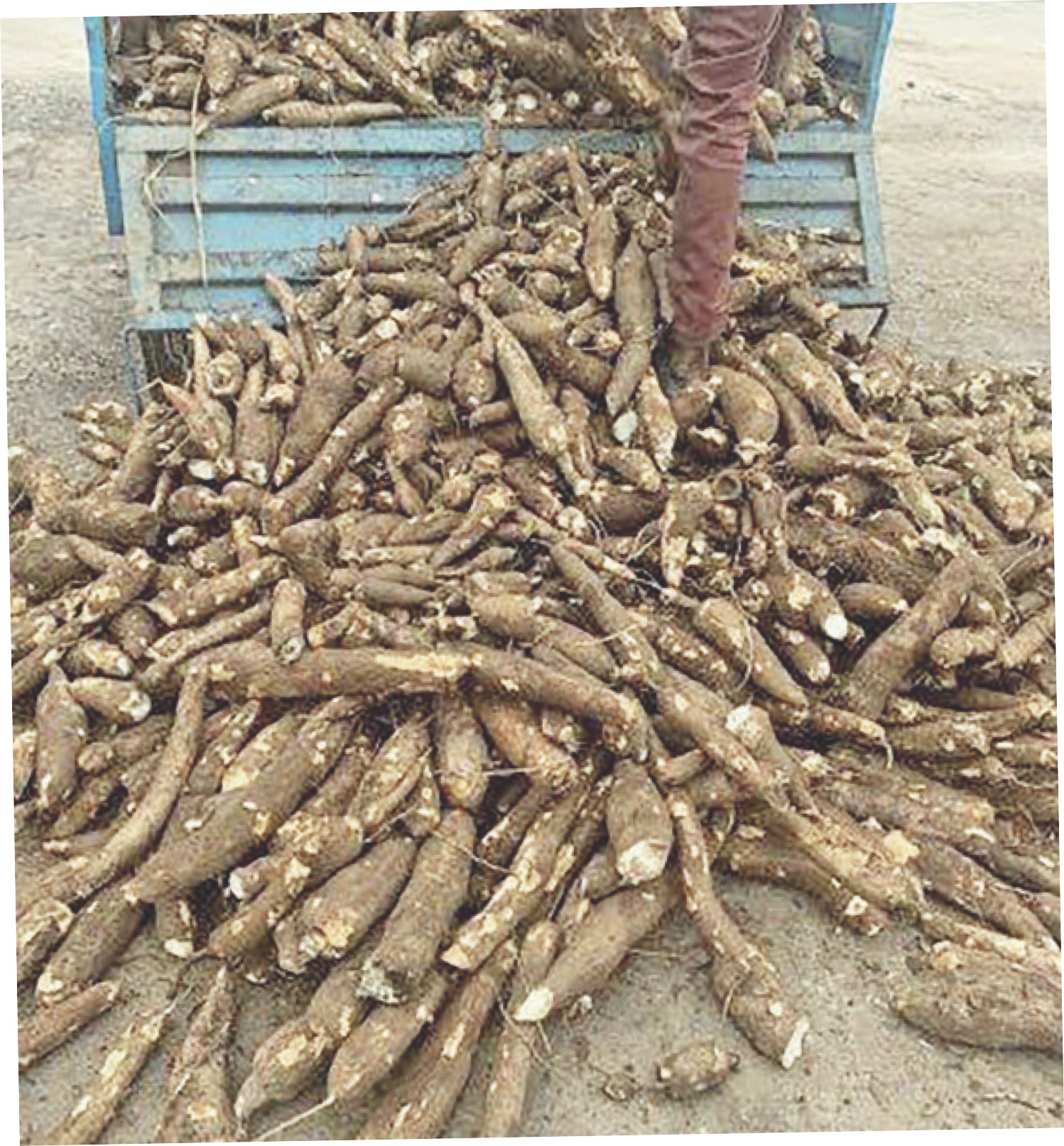
They stressed that cassava prices have crashed by over 80 per cent, and many farmers cannot recover production costs, adding that a truckload of cassava that sold for ₦180,000–₦200,000 now goes for ₦40,000–₦50,000.
Some cassava farmers abandon mature cassava on their farms because harvesting and transporting them cost more than the selling price. Cassava is a major industrial crop used for high-quality flour in bread, noodles, and starch for pharmaceuticals, paper and textiles, ethanol for sanitisers and fuel, sweeteners and adhesives.
Some cassava farmers lamented that even as they suffer, big production companies such as breweries, pharmaceuticals, and flour mills that use cassava starch in their production have continued to import starch and ethanol that can be processed locally from Nigerian cassava.
That disconnect has turned a bumper harvest into a crisis. Oversupply at the farms, weak processing capacity, and an industrial sector that still prefers imported products have collided. The result is that a crop that feeds millions and powers industries is now a liability to the people who grow it.
In Nigeria’s cassava value chain, most manufacturers do not buy raw tubers directly from farmers. Instead, they rely on middleman processors, SMEs and aggregators who buy cassava from farmers, process it into starch flour, High-Quality Cassava Flour, HQCF, or ethanol, and then sell to breweries, pharmaceuticals, and food companies.
The problem, however, is that this middle layer is weak. Many cassava processing companies that are meant to buy from farmers and convert the tubers into industrial inputs have collapsed due to inadequate, irregular, and unaffordable all-year-round supply of cassava, plus high energy and operating costs. Without enough large-scale processors operating year-round, manufacturers cannot get the consistent volume and quality they need. As a result, they continue to import starch and ethanol instead of sourcing locally.
Data showed that the local demand for High-Quality Cassava Flour is put at 504,000MT yearly. Local supply is only 60,480MT. Imports account for 443,520MT. That proves that 88 per cent starch flour is imported. Nigeria also imports over 95 per cent of industrial starch used in the country.
National demand hit 400 million litres of ethanol in 2024. About 75 per cent of demand, roughly 300 to 350 million litres of ethanol, was sourced from abroad.
To understand the issue on ground, the reporter spoke with some cassava farmers who said they are being squeezed out by a system that prefers imports to local produce.
In Lagos, Paul Obafemi, Head of Supply Chains at Morison Industries Plc, said cheap imports are the biggest factor hurting cassava farmers, with oversupply and low industrial demand as direct consequences.
He said a pickup van of cassava sold for about ₦200,000 in 2025 when imported derivatives were still competitively priced.
“The situation worsened after the federal government granted temporary duty-free and tariff waivers on essential food imports, including some cassava derivatives.
“As industries shifted to cheaper imports, demand for local cassava fell. Processors stopped buying from farmers, and we now have oversupply.”
He noted that farmers had no safety net and are now suffering 50 to 80 per cent losses.
Obafemi called for a temporary Cassava Market Stabilisation and Local Off-Take Programme where government, processors, and manufacturers agree on guaranteed purchase at a floor price.
He also urged a review of import waivers and a short-term bridge payment for affected farmers, similar to the US $12 billion farm aid package.

On long-term solutions, he said Nigeria must link farms to factories. The country imports an estimated 300 to 350 million litres of industrial ethanol yearly, worth about ₦160 billion, while local production meets only six per cent of demand. Similar gaps exist in starch and animal feed.
“Government should support modular processing plants through financing, tax incentives and PPPs in cassava-growing areas. We should stop asking how much cassava we can produce and start asking how much our industries can consume.”

In Otovwodo, Delta State, Okiemute Obarisi harvested only half of her two acres of cassava this season. She left the rest in the ground.
“The big companies don’t trust us. They say our starch is not clean, not the same every time. But how can we make it clean when there is no factory near us to buy fresh tubers? They want us to deliver to Lagos but the transport alone will finish the money,” she said.
She warned of the consequence if farmers quit and described the food security risk in clear terms.
“If I don’t plant next year, who will? Garri will be ₦30,000 per bag. The same people complaining now will be the ones suffering later.
“With this low industrial demand, government should force those big companies to buy from us first. Give them tax if they buy Nigerian starch. That one can work this year.
“A brewery needs 100 trucks every month. No single farmer or even cooperative can guarantee that yet. So they go to Thailand and Vietnam where one company can supply everything.
“It is dangerous for us. Cassava is our hunger breaker. If we all switch to maize or yam because of this price, next year there will be no garri and no flour. We are eating our seed.
“Government should link us directly to industries. Stop the middlemen and ban starch import for three years. Farmers will plant with hope.”
In Sagamu, Ogun State, Abiodun Rasheed abandoned one hectare after calculating that haulage to the city would cost ₦70,000 for a truck worth ₦45,000. He blamed it on trade policy.
Other News
“Government makes it cheaper to import with forex and duty waivers. It is easier for them to bring in a container than to deal with 200 small farmers.
“If we stop planting cassava, Nigeria will import garri next year. Mark my words. We are already seeing it with rice. The government should increase duty on imported starch and ethanol. Use that money to fund local processors. That is the fastest.”
The cassava farmers said the solution is to fix this gap. They called on government and private investors to establish more aggregation centres and processing companies across producing states.
According to the farmers, aggregation hubs would help bulk tubers and reduce post-harvest losses, while new processing plants would create steady demand and guarantee off-take for their produce.
But pharmaceutical and flour manufacturers argued that they import tonnage of corn starch because the modified cassava starch does not meet up with the acceptable standards, adding that the market has failed to constantly supply high-quality starch and flour.
Addressing the crisis, Mrs. Bola Adeyemi, CEO, GoldenGrain Mills Ltd, Ogun State shared top reasons her flour mill is not sourcing cassava 100 per cent locally.
“First is quality. Bread flour needs HQCF with less than 12 per cent moisture and no cyanide. Most local processors can’t meet that yet. Second is supply reliability. We run 24/7. If a processor fails to deliver, our production will be delayed. Imports arrive on schedule.
“I would consider guaranteed off-take with local processors if they can meet the conditions of presenting an SON certification for every batch and a cooperative or aggregator that can guarantee 500 tons monthly. We are ready to sign a three-year contract if that can be guaranteed.”
Dominic Otobo, manager at a major flour mill in Lagos, identified price and processing capacity as the reasons for the importation.
“Imported starch that landed in Kano is sometimes ₦20,000 cheaper per ton than local, and the local guys can only supply 100 tons when we need 1,000 tons. We can’t risk production.
“The government must help by giving us tax breaks for buying local and help processors access the right equipment. We don’t want to import but we are left with no choice,” he explained.
Also speaking, renowned economist and Chief Executive Officer, Centre for the Promotion of Private Enterprise, (CPPE), Muda Yusuf, called on the Federal Government to urgently review its policy framework to incentivise manufacturers and processors to source cassava locally.
Yusuf said economic development and growth must also be about inclusion and the localisation of supply and value chains.
According to him, “the more we localise the supply and value chain, the better for the economy, and the more jobs are created for the good of the economy.”
He noted that the call aligns with the government’s Nigerian First policy, and stressed that only deliberate policy incentives, and not appeals to sentiments, will drive patronage of Nigerian cassava.
“This means having the right kind of tariff to discourage importation and encourage more local sourcing,” he said. “Apart from creating more jobs, it will also help preserve our foreign exchange and balance of trade. That is what the economic reform is all about.”
The CPPE boss added that such a policy shift would encourage industrialists to look inward, accelerate backward integration, and ensure that the benefits of production trickle down to more Nigerians.
“Nigeria, being the largest producer of cassava, there is no reason we should not localise the supply chain as far as starch flour and ethanol is concerned. The cassava industry can only get better with more patronage,” Yusuf stated.
He, however, acknowledged concerns around quality and quantity, describing them as “transitional issues” that will improve over time with consistent patronage.
“If there is consistency of patronage, capacity, quality, and quantity will improve over time,” he concluded.
Public statements from stakeholders and policymakers across the value chain industry shows the institutions know the problem.
According to policy documents and proposals from the Federal Ministry of Agriculture and Food Security, (FMARD), quality standardisation, volume aggregation, and financing for processors are main bottlenecks preventing companies from sourcing 100 per cent of their starch and ethanol locally.
FMARD noted that companies, especially in pharmaceuticals and food, need pharmaceutical-grade starch 52 weeks a year. Most local processors are still small-scale and seasonal, which makes consistent supply difficult.
To address this, the ministry stated that it is working with the National Agricultural Seeds Council, (NASC), to promote improved high-starch cassava varieties, and with the Bank of Agriculture to fund 10 large-scale processing hubs targeted for 2026.
On the lack of shift to industrial use despite the garri price crash, FMARD’s analysis states that the infrastructure is not yet in place. The ministry argues that garri oversupply cannot be converted to ethanol overnight because Nigeria needs more processing plants. This is why tax credits for companies that set up cassava-to-ethanol and High-Quality Cassava Flour, HQCF, plants were proposed in the 2026 budget.
FMARD also says it is working with the Manufacturers Association of Nigeria, (MAN), on a Cassava Industrial Off-take Scheme. Under the proposed plan, government would guarantee the purchase of 30 per cent of whatever local processors produce, while big companies would sign MOUs to take the rest.
Relatively, press statements from the Manufacturers Association of Nigeria, (MAN), disclosed that Nigerian manufacturers want to buy local, but face structural constraints.
MAN stated that industries require consistent volume, uniform quality, and year-round supply to run production lines. Most local cassava processors currently operate at small scale and seasonally, which creates supply gaps. Imported starch and ethanol are preferred by some members because they arrive with quality certificates, stable pricing, and guaranteed delivery schedules.
It stressed that companies that use cassava starch, mostly pharmaceuticals, tend to import corn starch because nobody has taken the pain to reform cassava.
The association also highlights logistics and cost as major issues. It noted that transporting cassava and its derivatives from producing states to factories in Lagos, Ogun and other industrial hubs adds significant cost, while power, forex, and working capital challenges make it difficult for processors to scale.
To address this, MAN said it is working with FMARD on the proposed Cassava Industrial Off-take Scheme. Under the plan, government would guarantee purchase of a percentage of locally processed output, while member companies would commit to off-take agreements for the balance, provided quality and volume benchmarks are met.
The experts agreed that Nigeria does not have a production problem, pointing out a linkage problem, a broken bridge between the farm and the factory.
They urged the government and policymakers to fix the bridge so that the price of a truckload will rise, the abandoned farms will be harvested, and food security will be safe.
They said until breweries, pharmaceuticals and flour mills can reliably buy Nigerian starch and ethanol, trucks will keep leaving the farm at ₦40,000 and arriving at the port with imported starch at half the effort.
Even as farmers lament, breweries, pharmaceutical companies and flour mills say they still rely heavily on imported starch and ethanol because of quality, volume, and consistency gaps.
Nigeria has the cassava, over 60 million tonnes, but lacks the downstream processing to meet industrial specs.