Follow Us on Google
•Nigerian fish farmers battle costs, floods, say feed cost killing business
By Kehinde Aderemi
Fish farming remains one of the most lucrative agribusinesses in Nigeria. It is also one of the most capital intensive.
Fish farmers across Lagos and Ogun states said the demand for fish continues to outstrip supply.

Some of the farmers that spoke with Saturday Sun shared practical tips for turning small resources into big returns, even as they urged both the Federal and state governments to support their efforts by easing the burden through better funding, feed subsidies, and infrastructure.
The fish farmers also gave reasons why many beginners that rushed to the business collapse within the first year. They noted also that many first-time farmers underestimate costs and ignore technical details.
They admitted that the difference between profit and loss lies in mastering the nitty-gritty of the business. That is by doing more with little, and knowing when to ask government for help.
According to them, the business is profitable and it also has a clear promise of good money, steady demand and jobs.

But the challenges, it was gathered, also include rising cost of feed, poor power supply and lack of access to funds.
Lagos- based fish farmer, Pastor Gbenle Olanrewaju, with over a decade experiences in that line of agro-business, said the business is lucrative.
The Kwara State-born cleric has many ponds that can conveniently accommodate over 50,000 fishes at a time and he is into hatching, rearing and selling of fishes in large fractions.
According to him, fish farming is profitable but getting increasingly difficult.
He said the value chain of fish farming grow tremendously as it also supports hotels, eateries, pepper soup joints and smokers.
Olanrewaju highlighted the various challenges of the business, which he said included high cost of fish feed, poor access to loans, climate change, and flooding as major setbacks.
“Feed is very expensive now. By the time you finish feeding them with heavy amounts of money, market women and other buyers will still price you low. And if you go to the bank for a loan, the interest rate is nothing to write home about. It’s too much to bear,” he said.
He also blamed poor drainage for huge losses, insisting that climate change is also affecting the growth of the fishes.
He advised beginners to master water management, stocking and feeding, even as he urged them to join associations like the Lagos State Catfish and Allied Farmers Association LASCAFAN, and its Lagos State Fish Hatchers Forum, LASHAF, for more knowledge and understanding.
The cleric also urged government to intervene by supporting struggling fish farmers and ensuring that they remain in the business through subsidised feed, single-digit loans and grants, and a functional research institute.
“At the moment,this El Nino weather is affecting all of us. Fish don’t grow fast no matter how you feed them.
“Another big challenges to fish farmers here in Ikorodu is that the water coming from the canals to the swampy ponds are polluted and they sometimes find their ways into the ponds and cause alot of problems for the fishes.
“From my findings, I was told that the canals in Ikorodu, Imota, Adamo and other areas have not been dredged in four to five years, so whenever there is a heavy rain water goes back into the farms and takes the fish away. That’s total loss for many farmers.
Other News
“Many of my co- farmers have had such terrible experiences of flood even as many farmers have also quit the business because of flooding.”
He urged both the Federal and the State Government to set up fish feed factories in order to produce the feeds at subsidised rates, even as he warned that if the business suffers, it will affect so many sectors of the economy.
“We need NIMET and the School of Oceanography to give us weather data and research. Right now, there is nowhere to go and read 20 years of fish farming records in Nigeria,” he said.
Alhaji Hammed Otufowora,a fish farmer and also the Chief Executive Officer of HAMFA World Wide, a company that produces local feeds for farmers across Lagos and Ogun State said fish farming, like every other business is capital intensive that needs a considerable amount of money as capital. He pointed out also that a fish farmer must also have the strength and wherewithal to withstand the various challenges of the business.
Otufowora explained further that there are different species of fishes, which he said must be treated with care.
“Fishes like the Fries, Fingerlings and Juvenile are like babies.You handle them with care and you monitor their progress from Day one and also from one stage to another. At times you need to treat their waters for them to give you the expected results. “The way you treat fishes inside a earthen ponds is different from the way you would treat them in either a block, tank or tarpaulin.
“ A serious fish farmer must be business-minded and must also understand the fundamentals of the business.He must also know that the business of fish farming is full of risk,” he said.
The risk, he stated is manageable, provided the farmer is the type that can create enabling environment for the fishes.
Otufowora mentioned the various types of ponds farmers can use for fish farming.
According to him, farmers mainly use four types of ponds. The best one, he explained depends on the land, water source, budget, and scale
“ Earthen Ponds are usually dug directly into the soil in a swampy location. It is most common in rural areas.
“It is the cheapest to construct and fishes grow so fast because they eat natural food and they grows in it.
“For instance, earthen pond is good for Catfish and Tilapia and other species of fishes.An earthen pond loses water through seepage, and it is also very hard to harvest all fish.
“At times predators like snakes and birds can enter into earthen ponds and that is why many farmers still cover their ponds with net to keep the predators away from the fishes. “Earthen pond is good for large scale farmers with good clay soil that holds water, but it is also too dangerous for farming because of flooding. Whenever there is heavy rain, there is flood and it may take away all the fishes, except where there is proper drainage.
“Another good pond is the concrete pond.It is built with blocks in a rectangular shape. It is easy to manage and easy to drain.
“A farmer can easily harvest 100 percent of the fish stocked and there is a less predator attack on the concrete pond.
“Though, it is very expensive to build and water always gets hot fast and there is a need for constant water change”, he said.
According to him, concrete pond is also good in an urban area and also as a backyard farming and it can also be used for hatcheries.
“The Plastic/Tarpaulin ponds are also pits lined with heavy-duty tarpaulin or plastic sheets. It is above ground or dug. It is also less costly, portable and easy to set up, less seepage than earthen. It is for best for beginners and small scale farmers. A constant, running water must be available always for proper draining and flushing of water for the fishes.
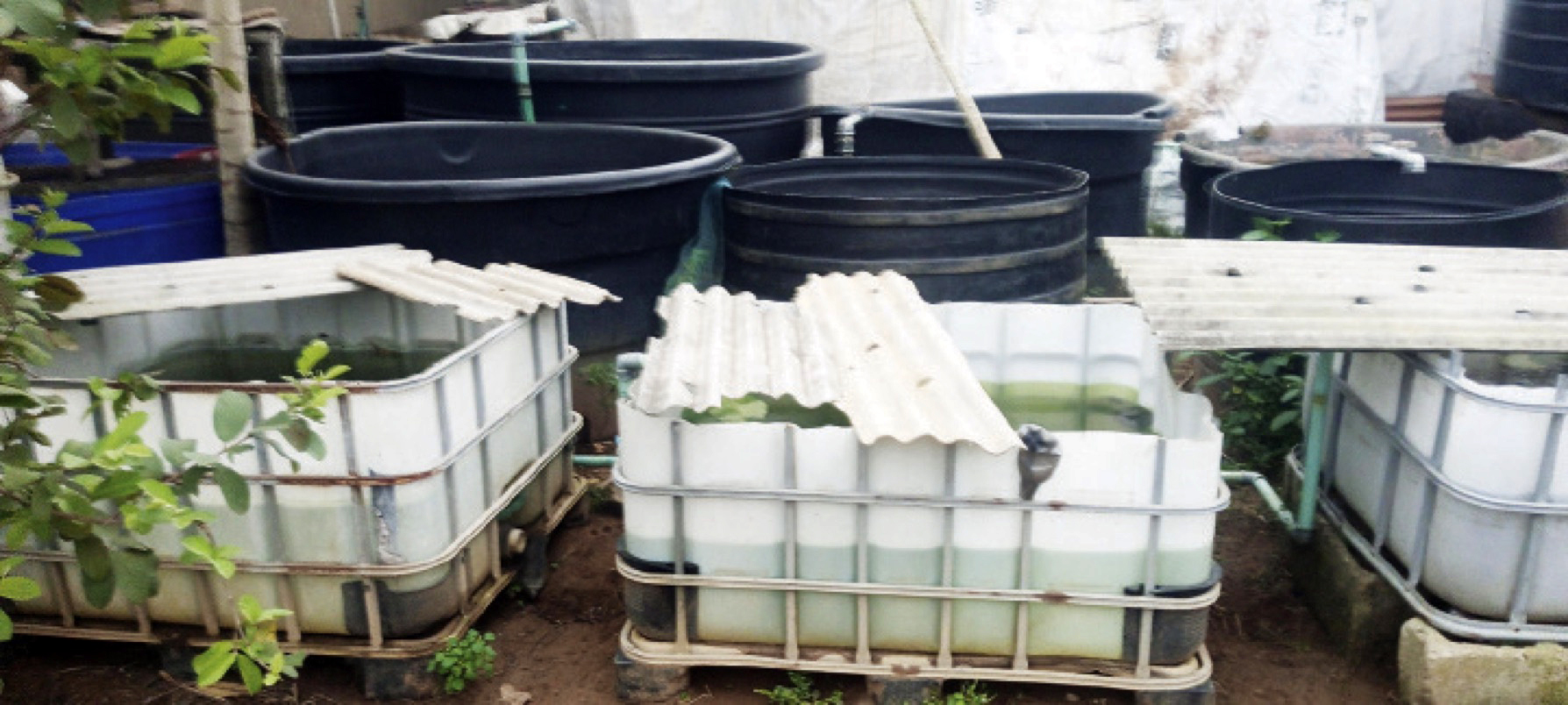
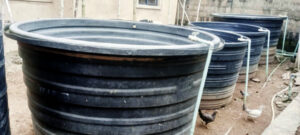
“The Plastic tank is usually 1000 litre and 5000 litres.It is very easy to manage, good for urban/ backyard, uses little space and water,but it is very expensive per volume,and can only stock small numbers of fishes. Plastic tank is also good for hatchery, fingerling production, or very small scale in compounds”, he said.
However, for Mr.Solomon Oligie, the rising cost of fish feed is taking a huge toll on the business. He expressed worry that the high cost of fish feed, if not curtailed would affect the prospect of the business in the future.
According to him,the feeds are costly now as compared to about five years ago when he started the fish farm business.
He said the increasing cost of feed is a major problem that is affecting many farmers these days and many are gradually losing interest in the prospect of the business.
“Fish farming would have been one of the most lucrative businesses in Nigeria except for the high cost of feed. Many farmers that could not afford the rising cost of feed have left the business. And some of us that are still doing it are struggling to meet up with the situation.
“Prices of fish feeds are not stable, and until the government decides to help and support us,we will continue to seek support.
“For instance, prices of some of the feeds like Blue Crown and Eco Float and several others have increased terribly and some farmers that could not afford the prices go for local feeds”, he said.