Follow Us on Google

• I thought my child was bewitched –Survivor’s mother
• It would have been worse without quick intervention –official
From Timothy Olanrewaju, Maiduguri
A few years ago, very few Nigerians thought malnutrition could strike any part of the country. But as insurgency persisted in the North-East for over a decade, a humanitarian crisis surfaced, and hunger became a second war, threatening the lives of thousands of people, especially children.
Hospital wards and health facilities were filled with children too weak to cry. They lay helplessly on their beds with lean arms, swollen bellies and sunken eyes, evidence of the devastating impact of malnutrition, a health problem which occurs when the body does not get adequate and nutritious food.
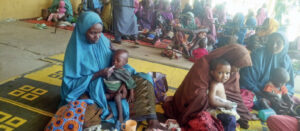
At a health facility in Gwange, Maiduguri, mothers watched their children with bated breath, unsure of their fate, as health workers screened more children outside the ward.
Initial misconceptions
At first, many had a different notion about the cause of the scourge. To some, it was punishment on the people for the unending bloodletting in the Boko Haram violence. Others thought it might be a generational curse.
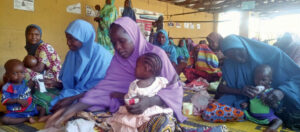
Aisha Usman, 30, mother of a survivor, Abubakar, thought her family and neighbourhood were being visited by some evil forces.
“Honestly, I thought my son was bewitched by an evil spirit,” she told Sunday Sun in an interview at the Nigeria Police Force Hospital, Akome, one of the malnutrition treatment centres in Maiduguri.
She recalled how she cried for days, unable to sleep, pleading with God to have mercy on little Abubakar.
The 14-month-old boy almost passed out. He had been vomiting for three days. His mother said his condition worsened on the third day of vomiting, and the development heightened her fears and those of the family.
“It was the first time I experienced that kind of sickness. I thought my baby was going to die,” she said as she looked at the boy on her lap, cuddled him, and then smiled. “Alhamdulillah!” (Praise be to Allah), she declared.
The health situation of her son changed days after his admission at the hospital. After physical examination, screening and other medical procedures, the boy started receiving treatment. That ended the family’s anguish and sorrow, the mother told the reporter.
For another survivor’s mother, 32-year-old Aishatu Mohammed, and her community members at Tarsan College, a Maiduguri suburb, the malnutrition scourge was triggered by a generational curse.
“Some people in our area told me the sickness is hereditary and must have been a generational curse,” she stated, adding, “I thought it was so then.”
She said she was disturbed by the claim and tried to find out about her and her husband’s childhood.
“They said the sickness was from the blood of the parents. It was a difficult period for me and my husband,” she disclosed.
Such were the community perceptions and beliefs in parts of Borno and Yobe when malnutrition first hit the area.
How it started
Other News
Malnutrition started around 2018 in the two states as a health crisis triggered by displacement. As insurgency escalated, people abandoned their farmlands and other economic activities. Families that once lived on millet, maize, wheat, nuts, melon, beans and livestock to produce nutritious foods, had to either skip meals or manage meagre rations.
Nursing mothers, especially in communities trapped in the violence, could not produce enough breast milk for their children due to hunger and poor quality of the available food. The children became weak, losing weight, leaving scary images of acutely malnourished children in most neighbourhoods.
The scary figure
Since 2021, the number of children projected to suffer acute malnutrition in the North-East has risen from over 800,000 to 1.3 million in 2022 and 2.1 million this year, according to UNICEF.
Sunday Sun checks show that the governments of the affected states, in collaboration with the Federal Government, UNICEF and other development partners, have made efforts to stem the tide. However, more children are still at risk because insurgency is still on, and the impact of climate change on agriculture in the area.
UNICEF Nutrition Specialist, Dr Kelechi Nwogu, described the situation as dire.
“The situation of malnutrition in the North-East has been dire due to the insurgency. While we are trying to stem the tide and making improvement, it is still bad,” he said.
To contain the health crisis, the global body, in collaboration with Borno and Yobe states, introduced a comprehensive approach known as a Multi-sectoral Integrated Nutrition Action for Women, Children and Adolescents in Northeast Nigeria (MINA) programme funded by the UK government.
The multi-pronged approach programme according to Nwogu, tackles malnutrition beyond just provision of Read-to-Use Therapeutic Food (RUTF) for malnourished children. It combines nutrition treatment, maternal and child healthcare, provision of clean water and sanitation, immunisation, cash support for vulnerable mothers, and training for caregivers for early detection of malnutrition.
The nutrition specialist said over 200,000 acutely malnourished children in both states, have been treated since 2023 under the MINA programme while more than five million doses of Vitamin A supplement were given to children ages 0 to 59 months
“More than 800,000 women have received skill nutrition counselling to build their capacity in taking care of their children by feeding them adequately. In addition, 14, 117 vulnerable women received cash transfer to enable them have dietary choices and improve their children nutrition,” he explained.
How volunteers track malnutrition cases
In Borno and Yobe, well-trained volunteers are deployed to the community to detect malnourished children since most community members hardly report cases on time.
Hajiya Zubaida Maina, a Nutrition Focal Person in Damaturu Local Government of Yobe State, said the volunteers do refer children suspected to be suffering from malnutrition to care centres.
“They track cases from house to house and refer suspected cases to the nearest centre with referral cards,” she told the reporter during a visit to the Mairi Primary Healthcare Centre in Damaturu, Yobe State capital.
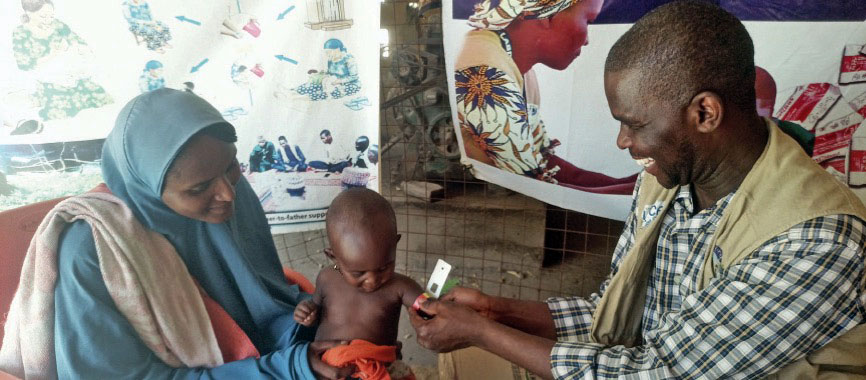
Hundreds of mothers waited outside the Out Patients ward of the centre for verification of their children referral cards by hospital support staff. They are moved in batches of five or more to the ward where health worker screen their children with MUAC (Mid-Upper Arm Circumference), a simple coloured tape used in measuring a child’s upper arm to check and determine his or her malnutrition status and level.
Hajiya Aisha Baba, a nurse at Maisandari Primary Health Care Centre, explained that a child has Severe Acute Malnutrition (SAM) when the child Mid-Upper Arm Circumference is in the red zone of the tape.. “In this case, the measurement is less than 11.5 centimetre or 115 millimetres. It is Moderate Acute Malnutrition (MAM) when it’s in. the yellow zone and Normal when it is in green zone,” she explained.
She said they also check the weight of months to ensure they are fit to feed the babies.
Treatment, including the use of RUTF, starts as soon as screening is completed. “If the situation of the child does not improve, we move the child to the stabilisation centre for intensive care,” Baba added.
Many in Borno and Yobe described the impact of the intervention as huge.
A deputy director of Community and Family Health Services in the Yobe State Primary Health Care Development Board (SPHCDB), Satomi Hikama said more than 200,000 lives have been saved in Yobe alone.
“An intervention for the life and right of a child is an investment in the future of any society. The situation would have worsened and become probably catastrophic if that intervention did not come,” he said.
As dozens of nursing mothers left the Akome treatment centre in Maiduguri on Monday afternoon, after a routine check-up of their recovering children, joy lit up their faces. It was a sharp contrast to their first day at the facility, when fear and uncertainty had weighed them down.