Follow Us on Google
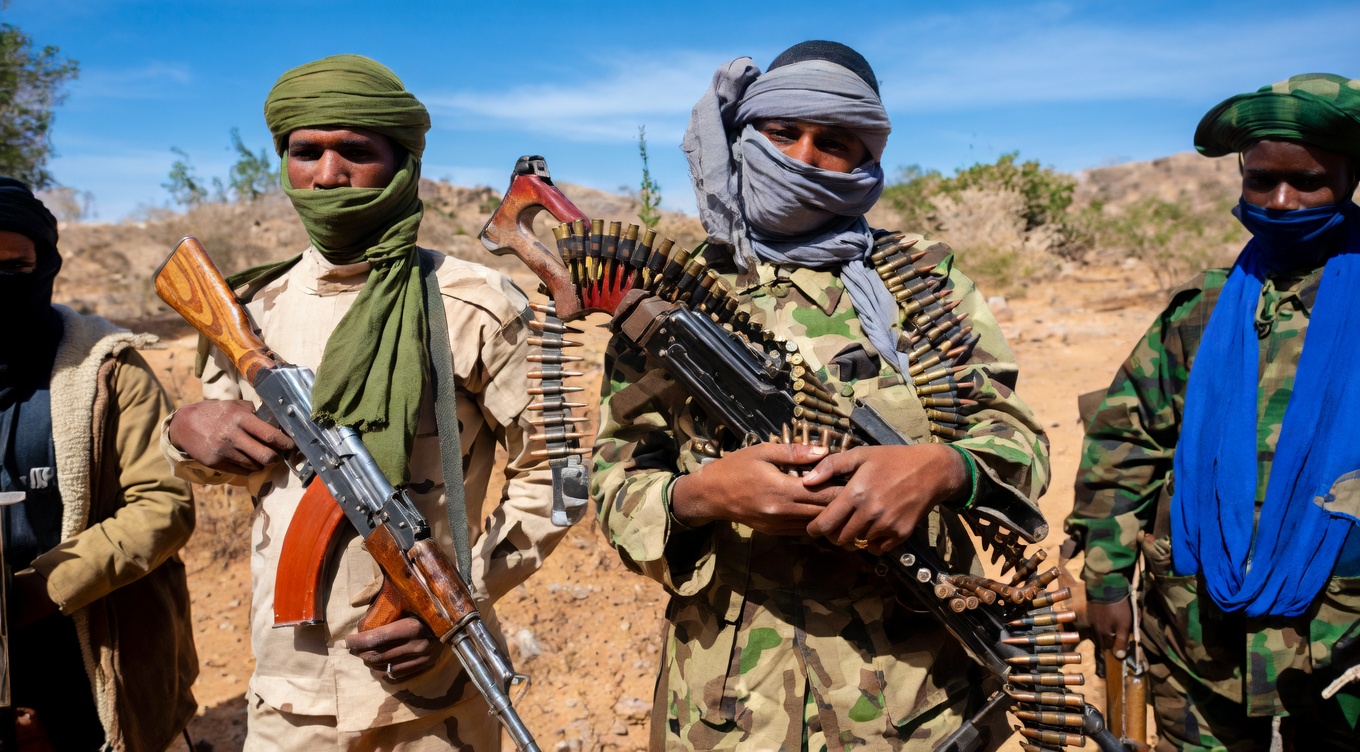
How terrorism is redirecting wealth from businesses to bandits
By Uche Usim
In Nigeria today, many legitimate businesses are dying, while criminal enterprises are thriving. No thanks to terror attacks on military, paramilitary and civilians.
They no longer make headlines, except when the casualty figures are truly spine-numbing. The casualties are not only those killed in the invasion; the living are gradually being economically strangulated due to ransom payments.

The security agencies, experts note, appear overstretched. While assurances from governments at national and sub-national levels pour in, many Nigerians are losing hope.
Terrorism has triggered protests in some parts of the country.
Countless houses have been burnt, farms destroyed, businesses crippled, communities levelled and deserted, many rural dwellers cramped in overcrowded internally displaced persons camps, thousands killed, many women raped and the horror continues.

These explain why Nigeria’s insecurity crisis is no longer just a humanitarian and security challenge but increasingly becoming an economic one.
Surviving in Nigeria has become very tough.
Many families have sold their houses and other properties just to raise funds for ransom payments.
Many are also added to various WhatsApp groups and other platforms to raise funds, not for business concerns, but for ransom.
More so, money is moving from banks in cities to bandits’ hideouts in bushes.
This has destroyed many businesses and households.
Across parts of the North-West, North-East and North-Central regions, terrorists and kidnappers are creating a parallel economy that siphons wealth away from legitimate businesses and productive sectors into criminal enterprises.
In recent months, kidnapping incidents have spiked in the southern part of the country as terrorists cultivate new grounds where they feel ransom is more handsome.
What was once a pattern of sporadic attacks has evolved into a structured system of extortion, illegal taxation and ransom collection, giving rise to what analysts describe as a “bush economy”, an underground financial ecosystem operating beyond government control.
The impact is being felt most acutely in rural communities where agriculture remains the primary source of livelihood. According to a recent report by SBM Intelligence, armed groups have moved beyond kidnapping and cattle rustling to establish shadow taxation systems, collecting levies from farmers, traders and transport operators in several conflict-prone areas. In some communities, farmers must pay fees before accessing their own farmlands, while traders are compelled to pay taxes to move goods through territories controlled by criminal groups.
These illegal payments represent a direct transfer of wealth from lawful economic activity to criminal networks.
The consequences extend beyond individual victims. Businesses that would ordinarily invest profits in expansion, equipment and employment are instead diverting resources to security arrangements, extortion payments and ransom negotiations. The result is reduced productivity, lower investment and slower economic growth.
Kidnapping for ransom has become one of the most lucrative components of this criminal economy. Research by SBM Intelligence found that between July 2024 and June 2025, at least 4,722 people were abducted across Nigeria, while victims and their families paid an estimated N2.56 billion in ransom payments. Kidnappers demanded roughly N48 billion during the same period, highlighting the scale of the illicit industry.
2026 holds the record of one of the most significant terrorist- and bandit-related abductions in Nigeria.
On January 3, 2026, gunmen attacked Kasuwan Daji community in Borgu Local Government Area of Niger state
and abducted 57 residents during a raid on the village.
About two weeks after, precisely on January 18, 2026, armed men stormed three churches in Kurmin Wali, Kajuru Local Government Area of Kaduna state during Sunday worship and abducted about 166 worshippers. The incident became one of the largest church-related mass abductions recorded this year. Conflicting accounts later emerged regarding the number of victims still missing.
On February 3, 2026 in Kwara state, terrorists attacked Woro village in Kaiama Local Government Area, killing scores of residents and abducting 176 people, including women and children. The attack was among the deadliest security incidents of the year.
On February 19, 2026 in Zamfara state, armed groups carried out coordinated raids in Anka and Tsafe local government areas, abducting at least 92 people.
From March 3–6, 2026 in Borno state, Boko Haram/ISWAP fighters attacked Ngoshe town in Gwoza Local Government Area, abducting more than 300 people, according to multiple reports. The assault formed part of a broader escalation of insurgent attacks in the North-East.
March 19, 2026 in Borno state, more than 100 internally displaced persons and civilians working in Kumbul Forest near Mafa were reportedly abducted by Boko Haram fighters. Most of the victims were engaged in farming and firewood collection activities.
On March 22, 2026, in Kaduna state, gunmen attacked three churches in Kachia Local Government Area and abducted approximately 30 worshippers.
On March 30, 2026 in Zamfara state, 18 passengers travelling in a commercial vehicle from Abuja to Sokoto were abducted along the Mayanchi axis of Zamfara State.
In Early April 2026 in Zamfara state, gunmen attacked Kurfa Danya and Kurfan Magaji communities in Bukkuyum Local Government Area, abducting about 150 residents, mostly women and children.
According to Amnesty International, at least 1,100 people were abducted across northern Nigeria within the first three months of the year, highlighting the scale of the country’s kidnapping crisis.
In May 2026, multiple school kidnappings in parts of Oyo state saw armed groups abduct 39 children and seven teachers from multiple schools.
This raised fears of a resurgence of Chibok-style mass abductions.
On June 7, 2026 in Zamfara state, bandits abducted 39 people during a peace meeting in Magamin Diddi community. The gathering had been arranged to discuss reconciliation, but attendees were instead seized and later held for ransom.
Other News
In June 2026 in Borno state, the Nigerian military announced the rescue of 92 abductees, including women and children, from jihadist captors during operations in the North-East, highlighting both the scale of kidnappings and ongoing rescue efforts.
The pattern that emerges from these incidents is that mass abductions remain concentrated in the North-West and North-East, although recent attacks in Oyo State suggest that kidnapping networks are expanding into previously less-affected regions. The targets have ranged from worshippers and schoolchildren to farmers, travellers and entire rural communities.
Every naira paid in ransom is money that could have been used to fund businesses, support education, purchase agricultural inputs or create jobs.
The agricultural sector has been particularly hard hit. Insecurity has forced many farmers to abandon their lands, reducing production and threatening food security.
A recent academic study on Benue state found that insecurity significantly reduced crop and livestock output, with increases in insecurity directly linked to declines in agricultural production.
The ripple effects are visible in food prices. As production falls and transportation becomes riskier, the cost of moving goods rises, contributing to inflation and putting additional pressure on consumers.
The crisis is also reshaping local governance.
In areas where government presence is weak, criminal groups are increasingly acting as de facto authorities, controlling access to markets, roads and farmlands.
According to the World Bank, insecurity, banditry and kidnappings remain major obstacles to development and state capacity in Nigeria, particularly in vulnerable regions. This transfer of economic power carries long-term risks.
When criminal groups derive steady income from extortion and illegal taxation, they become more entrenched and better equipped to sustain their operations.
Wealth generated by legitimate enterprises is effectively recycled into activities that perpetuate insecurity.
For businesses, the costs are enormous.
Investors become reluctant to commit capital to insecure areas. Entrepreneurs scale back operations. Farmers reduce cultivation. Communities lose income.
Meanwhile, criminal organisations gain resources and influence.
The emergence of Nigeria’s bush economy demonstrates that terrorism and banditry are no longer merely security threats; they are mechanisms for redistributing wealth. Instead of flowing into productive sectors that generate employment and tax revenue, billions of naira are being channelled into criminal networks.
Unless security improves and government authority is restored in affected communities, the flow of wealth from businesses to bandits may continue, deepening poverty, weakening investment and undermining economic development across some of Nigeria’s most vulnerable regions.
Experts’ views
The Minister of Defence, General Christopher Musa (retd) recently said that Nigeria’s battle against terrorism, banditry and insurgency remains a daunting challenge, largely due to the backing criminal groups continue to receive from their financiers and some members of the public.
He said this at the 2026 edition of The Platform Nigeria, an annual national discourse held to celebrate Democracy Day.
“Everything revolves around the people. If the people are ready and willing to make changes, changes will occur. If the people are not willing, nothing will happen.
“I can tell you that with what is going on with the challenges we have in the country, banditry, insurgency and terrorism, why does it seem so difficult to deal with them? Perhaps, we have people who are also encouraging and supporting these things because the terrorists and bandits survive among the people.
“There are several stories of how people have aided them by giving them food, water and information, and these are the things that keep them going. We call this the oxygen. Who are those funding them? Who are those giving them information? Who are those providing the logistics that keep them going? It is still the people”, he explained
In search of solutions to the ravaging insecurity, experts have weighed in, offering their views.
According to Dr. Evans Woherem, Nigerian technology researcher, security analyst and founder of the Evanswoherem Foundation, who advocates intelligence-led security operations, economic empowerment and institutional reforms, Nigeria cannot defeat insurgency and violent crime through arms and ammunition alone.
He noted that any sustainable solution must confront the internal conditions that allow insecurity to thrive.
For Audu Bulama Bukarti, Vice President of Programs at the Bridgeway Foundation and former Senior Fellow of the Tony Blair Institute for Global Change, bandits need military force, not negotiations.
He added that a lot of intelligence-driven synergy is required among the various security services in Nigeria in order to curtail emerging terror threats.
In his view, Dr. Joseph Ifedinma, a United Kingdom-based counterterrorism expert, said the federal government could only win the war on terrorism if it uproots the domestic pillars of terrorism and declares a total non-partisan war against terror.
Prof. Bola Akinterinwa, former Director-General of the Nigerian Institute of International Affairs (NIIA) said the way to secure Abuja is to take the fight to the bandits and terrorists in other parts of the country.
Other experts have said that Nigeria needs to strengthen its intelligence gathering and sharing apparatus as preventing attacks is more effective than responding to them.
They also said there is an urgent need to cut off terrorist financing since terrorist groups survive on ransom payments, illegal taxation, cattle rustling, extortion, smuggling and other criminal enterprises.
Security analysts say authorities must aggressively target these revenue streams through financial surveillance, stronger border controls and prosecution of sponsors and collaborators.
Also on the card is an urgent need to reclaim ungoverned spaces because many terrorist and bandit groups operate in remote forests and border regions where government presence is weak.
Experts recommend establishing permanent security bases, improving road networks and restoring civil administration in vulnerable communities to deny criminals safe havens.
Also key is investing in economic development. Poverty alone does not cause terrorism, but economic deprivation can make recruitment easier.
Creating jobs, improving education, expanding access to credit and supporting agriculture can reduce the pool of vulnerable youths targeted by extremist groups.
Also listed is the need to strengthen community engagement. Local communities are often the first to notice suspicious activities. Security experts advocate closer collaboration between authorities and traditional rulers, religious leaders and community groups to improve information gathering and build trust.
Improving border security is also key. Nigeria shares thousands of kilometres of largely porous borders with neighbouring countries. Experts say better surveillance technology, joint patrols and regional cooperation are necessary to prevent the movement of fighters, weapons and illicit funds.
Many analysts view weak governance, corruption and poor service delivery as factors that allow extremist narratives to gain traction. Improving accountability, justice and public services can strengthen citizens’ confidence in the state and reduce support for violent groups.