Follow Us on Google
• With prices of kerosene and domestic gas reaching for the skies, firewood is becoming the most appealing option in the kitchens of many Nigerians
• ‘It’s more economical, cooks better than stove, and meals cooked with it tastes better’
By Vivian Onyebukwa
From the dark ages, firewood has been part of humanity. Even with innovations in stoves and gas cookers, firewood, as a source of energy, hasn’t totally disappeared from kitchens, especially in the rural areas.
Surprisingly, in urban centres, it hasn’t fizzled out completely as the basic means of cooking. Some Nigerians, who spoke to Saturday Sun said, for one, it was faster to cook with firewood. They also claimed that food cooked with firewood tasted better. In terms of cooking large quantities of food, others referred to firewood as the best option.
From the 1960s up to the 80s, the over-reliance on firewood for cooking reduced drastically with the inroads made by western culture and the increase in the purchasing power of most Nigerians, who could now afford the latest kitchen appliances.
At one point, only an insignificant number of people were using firewood to cook, which they even considered as a last resort.
Today, with the adverse economic realities in Nigeria, coupled with the recent high cost of kerosene and cooking gas, most people are gradually returning to the ancient tradition of using firewood to cook.
Why we use firewood
“I use it to roast fish for sale,” said Abimbola Ojo in a chat with Saturday Sun. Ojo, who sells roasted fish at Ijegun Market, Lagos, described firewood as the most effective option in terms of roasting her fish in magnitude: “I can only roast with firewood, not gas or oven. In the 15 years that I have sold roasted fish, it’s only firewood that could serve the purpose perfectly,” she emphasised.
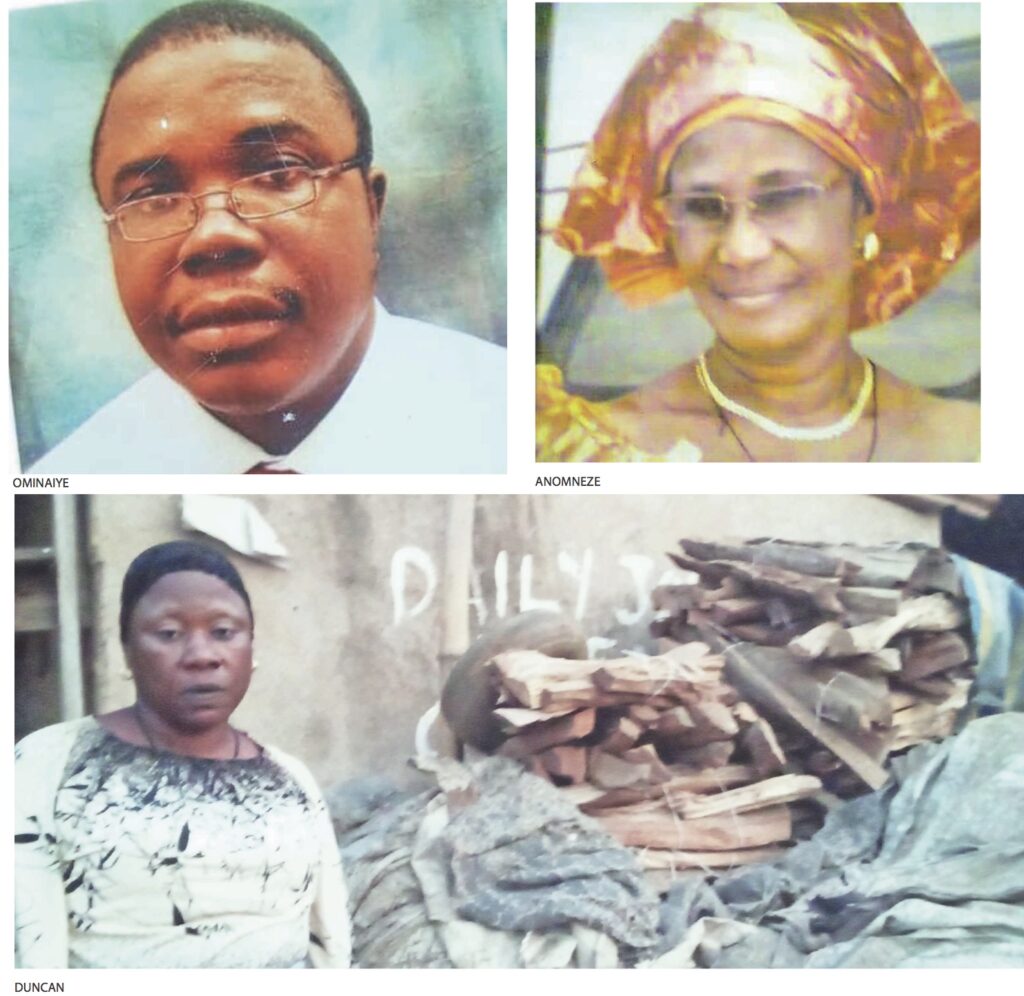
For Mrs Rose Anomneze, cooking with firewood is an age-old social practice: “It is a traditional cooking practice. My mother cooked with firewood. I also like to cook with it, because it is faster, except the smoke it emits, which affects the eyes. The food cooked with firewood tastes better, because it will be done very well, hence, bringing out the taste of the food.”
Anomneze, who said she just came back from the South-East after the Christmas break, admitted: “At home, when we travelled recently, we used it all through. Those who live in the village have a great advantage of using firewood, because they have enough space, and they can easily collect them from the farm.
“In the city, you would consider a lot of things before you use it. If you are living in a public compound, you can’t use it, because not everybody would tolerate the smoke associated with it. Some landlords, too, don’t tolerate it, because it is not environmentally friendly. Apart from this, I prefer it to modern types of cooking equipment.”
Mrs Ngozi Okonwo also said she had been using it for a long time: “I stopped using gas when our house was gutted by fire as a result of gas leakage. Even in Onitsha, where we live, I use firewood. Thank God that the house belongs to us, so I have the privilege of using firewood. Moreover, it cooks faster. Any soup cooked with firewood tastes sweeter because it boils very well.”
Highlighting more benefits of cooking with firewood, Okonkwo said it was more economical than electric heat, and, several times, more economical than gas and kerosene.
A food vendor, who gave her name as Angela Okodua, said she had been using firewood for several years. “Before I came to Lagos, it was firewood we were using in the village. I prefer it to any other thing like a stove or gas cooker. I can’t use it here in Lagos, because our landlord would not allow it, but each time I go to Edo State where I come from, I use it. It cooks better than stove and gas.”
Bolaji Thomson, a trader pointed out that, apart from the common challenge associated with firewood —the smoke — which, he said, could be hurting to the eyes, firewood remained the best, for “It cooks faster and tastier. I still relish the food from my grandmother each time I visit the village.”
A fufu seller at Jakande Gate, Oke Afa, Lagos, who identified herself as Bose, said she had been using firewood to prepare her fufu: “I would say that I have been using it from childhood, because that was what our parents used back in the village. Of course, it is not possible for me to make fufu on a stove. Firewood is the best, because it is more convenient for me.”
She, however, regretted that it could affect someone’s eyes, leading to undesirable tears, but said, “It depends on how good you are at using it. It is only if you don’t use dry wood that you have smoke hurting your eyes. But if you use dry wood and put them in place properly, you will not have any problem.”
Some people who still use firewood said it was as a result of economic hardship, as they couldn’t afford to buy kerosene or gas. Iya Sikira was seen at one of the filling stations along Ijegun/Ikotun Road buying N200 worth of kerosene. She is poor and can hardly afford safe cooking alternatives.
She told Saturday Sun that the kerosene was to only help her to light the firewood. “I can’t afford to buy kerosene for the stove. It is too expensive. Gas is for the rich, too.”
Dealers say firewood business is good business
Abimbola Beatrice Duncan is both a seller and supplier of firewood in Ijegun, Lagos. According to her, she supplies to both bakers and retailers. She told Saturday Sun that she had been in the firewood business for 16 years and in the charcoal business for 25 years. So, where do they get the firewood in large quantities? “We bring them from Ore, Ondo State, Ijebu Ode in Ogun State, Benin in Edo State, and even from the South- East.”
Duncan described firewood business as a good business, but cautioned: “It is a business you can’t just jump into. You must be registered with the association where you would be taught the rudiments of the business, how to tie it, the source of the items and so on. Else, you can’t make it.”
On how much they sell it, she said that four pieces tied together go for N300. “The price is uniform. We belong to a union and we agree on what price to sell.”
At the Ile Ibadan Bus Stop along the Ikotun-Ijegun Road, Alhaja Useni’s name rings a bell when it comes to firewood business. She has been in the business for about two decades. There, you find arrays of firewood from different parts of the country. Alhaja, who spoke through an interpreter, told Saturday Sun said that, even with the number of firewood there, she was still expecting more.
“We bring them from different places, such as Ore, Ogun, Ibadan, and so on,” she said, boastfully inviting Saturday Sun to come when the items arrive in larger quantities: “Any day you see plenty of firewood here, come back and see it for yourself.”
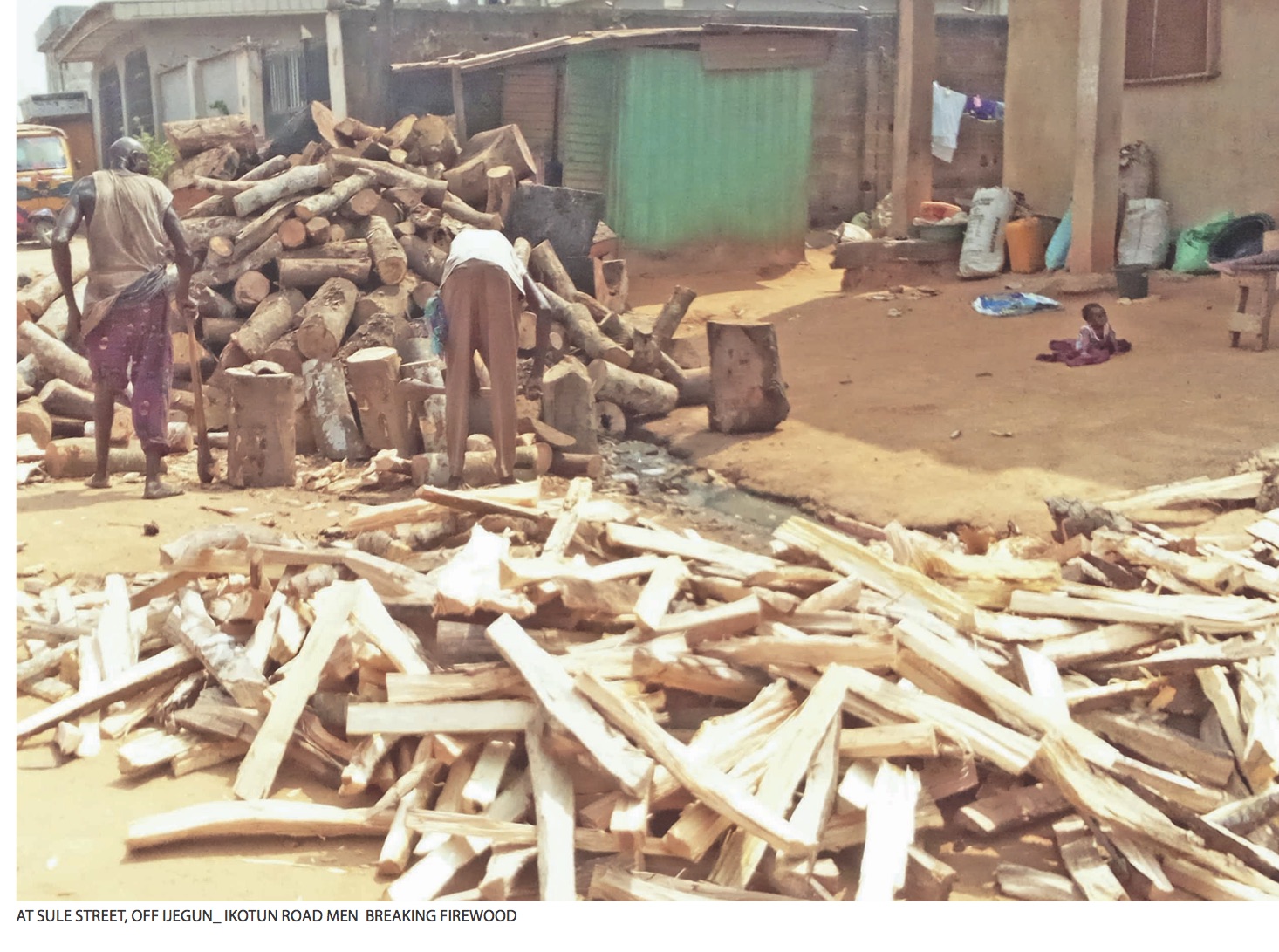
At Sule Street, off Ijegun-Ikotun Road, firewood business was booming when Saturday Sun visited there. There was also delegation of duties. Two men were seen breaking firewood. Another young lady was busy tying them in small quantities of four, while the other man was also arranging them in a vehicle (danfo) for onward supply to customers.
The workers, who refused to disclose their identities properly, said they were just employed to work. “Our duty here is to break the firewood. They bring them from different parts of the country in a log of wood, and we then break them into pieces,” one of them, who called himself Sule, said.
Health expert speaks
Despite health risks, firewood use still thrives in Nigerian communities. Dr Gabriel Omonaiye of God’s Goal Hospital said people still use firewood, because it was relatively cheaper and is a faster way of cooking. “Cooking for large events takes a shorter time when done with wood,” he said.
However, cooking with firewood has both health and ecological implications, Dr Omonaiye reminded. “The health problems are related to the smoke and different hazardous gasses released during the combustion process. The gasses produced during the burning of firewood, such as carbon monoxide, nitrogen oxide, benzene, formaldehyde, polycyclic aromatic hydrocarbons, could cause damage to the eyes and the lungs.
“In the eyes, there could be burning sensation, irritation. Cataract formation might occur when the exposure is prolonged. Cataracts will in turn create vision problems.”
According to him, the effects on the lungs include difficulty with breathing, chronic obstructive airways disease and exacerbation of asthma.
“On the lungs, the negative effects are similar to those of chronic smoking. Low back pain from constant bending is another health problem. On the environment are global warming, deforestation, erosion and population depletion,” he said.
So, what is the better alternative, even as kerosene and gas are becoming too expensive for the low income earners? Dr Omonaiye was queried.
“The better alternatives, especially gas and kerosene, are out of the reach of the low income earners, and it could become more difficult in the coming days as the costs of petrochemical products keep soaring higher and higher almost on a daily basis.”