Follow Us on Google
• Medical experts say breast cancer campaigns must include men
Gold Amopho, based in Kaduna State, shares her experience after her husband was diagnosed with male breast cancer on October 2024.
According to her, the lump first appeared about three years ago and looked like a pimple near the nipple. At the time, her husband thought it was nothing serious and had no knowledge of male breast cancer.
When they met as an intending couple, the lump was still small. Over the years, it grew bigger, and the skin around it changed colour. Amopho said she became concerned and involved her friend, a nurse, who convinced her to meet an oncologist.
Tests confirmed it was cancer. The couple is still undergoing treatment. She is now urging men to get checked early.
“If you are a man and you notice anything odd around your breast area, a lump, swelling, or change in colour, go for a checkup. Men suffer from breast cancer, too, but it is very rare and often more aggressive than in women. Do not wait for pain. In 98% of cases, the lump is painless. Early detection can save you. Stop considering the financial implication first. Male breast cancer exists.”
A disease only talked about for women
Breast cancer is widely seen as a woman’s disease, and awareness has focused only on women. Pink ribbons, October campaigns, self-examination jingles on radio – almost all of them show women.
That focus has left a dangerous gap. Because men have breast tissue, however small, they can also develop breast cancer. And because the conversation rarely includes them, diagnosis often comes late. In Nigeria, data shows male breast cancer is uncommon but not negligible. Globally, male breast cancer accounts for only about one per cent of all breast cancers. A 2025 study also notes MBC makes up only 0.5 to one per cent of all incidence of breast cancer.
But in parts of Africa the proportion is higher. In Nigeria, hospital-based studies have reported wide variations: nine per cent of all breast cancers in Zaria, 8.6 per cent in Jos, eight per cent in Eastern Nigeria, 1.7 per cent in a South-West Nigeria centre, and 1.2 per cent in another study.
For comparison, in Europe approximately 1% of all breast cancers occur in males, while in sub-Saharan Africa reports range from 5 to 15%.
Researchers say factors such as liver disease from hepatitis B, schistosomiasis, testicular conditions, and referral patterns to oncology centres may partly explain the higher numbers seen in some Nigerian hospitals.
The bottom line is that while far fewer men than women get breast cancer, thousands of Nigerian men are affected, and most hear about it too late.
Oncologists break silence
To understand why men are being left behind in the campaign against the disease, the reporter spoke to some oncologists.
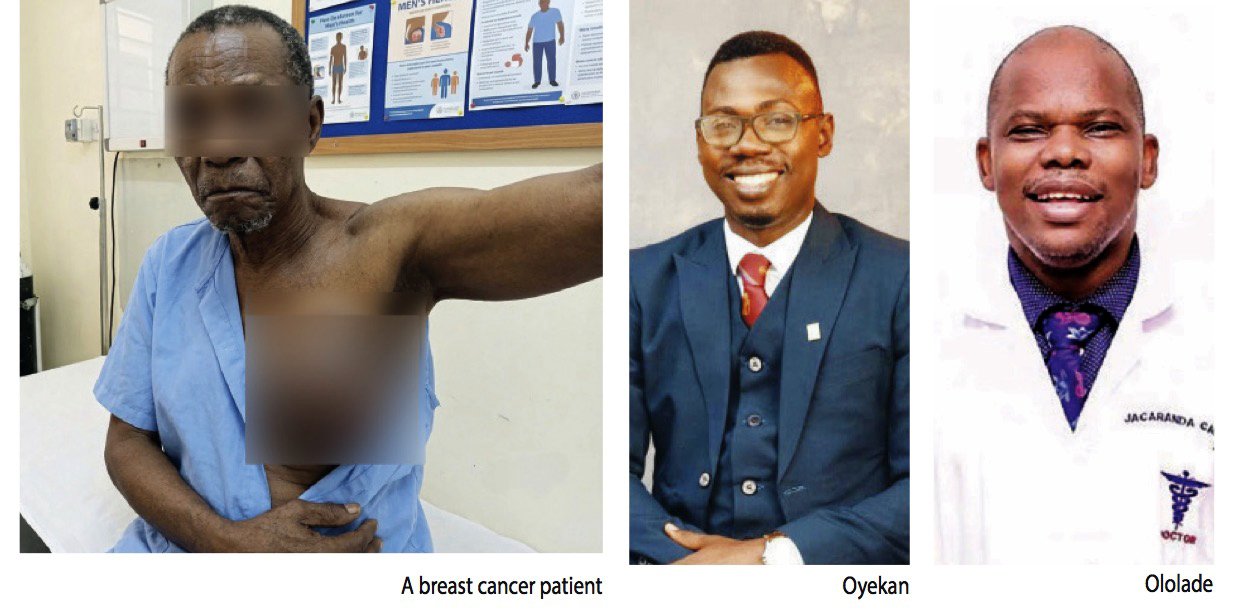
Ademola Oyekan, Consultant Radiation and Clinical Oncologist, Lagos University Teaching Hospital (LASUTH), said the neglect is historical.
“Only one per cent of global incidence of breast cancer occurs in men, hence, male breast cancer has been mostly ignored and less studied due to the very low incidence. Therefore men have been underrepresented in breast cancer clinical trials, and the treatment recommendations for male patients have largely followed those for postmenopausal women,” she stated.
Oyekan listed several risk factors associated with male breast cancer: these include increasing age, which allows accumulation of genetic mutations; mutations in the BRCA2 gene, which carry the highest inherited risk; and other mutations including BRCA1, PALB2, CHEK2, ATM, Li-Fraumeni syndrome, and Cowden syndrome. Family history of breast cancer also matters, he noted.
“Hormonal factors specific to men include Klinefelter syndrome, 47XXY, where increased estrogen in men raises the risk by 20 to 50 times higher than other men,” he explained. Other risks include testicular disorders like undescended testis, primary testicular failure, orchitis following mumps infection, liver cirrhosis, obesity, and exogenous estrogen use.
“Because of these risks, the expert said men at increased risk should undergo risk-adapted surveillance, particularly those with a pathogenic BRCA2, BRCA1, or PALB2 gene variant, a strong family history, or Klinefelter syndrome.”
He advised: “Rather than the formal monthly self-examinations as recommended in women, men should be familiar with the normal appearance and feel of their breasts and promptly report any abnormality. Clinical breast examination by a physician is appropriate for BRCA2 carriers and other high-risk men every six to 12 months, beginning at age 35. Routine mammography is recommended in selected high-risk individuals: men with a BRCA mutation and significant gynecomastia or dense glandular tissue, those with previous history of breast cancer, and those with a suspicious clinical finding.
Other News
“For families, genetic counselling is key. Men with breast cancer or known familial BRCA mutation or multiple relatives with breast, ovarian, pancreatic, or prostate cancer or early-onset breast cancer in the family should undergo genetic counselling and germline testing.
“High-risk men are also predisposed to other cancers, surveillance should include annual PSA testing and digital rectal examination from age 40 for prostate cancer, and consideration of MRI/MRCP or endoscopic ultrasound for pancreatic cancer at experienced centres. Routine skin examinations are also advised, especially for BRCA2 carriers.
“Lifestyle matters, too. Maintaining healthy body weight, regular exercise, reducing alcohol intake, and avoiding unnecessary exposure to exogenous estrogens. Promptly investigate gynecomastia or symptoms of hypogonadism,” Oyekan added.
On treatment, he noted that a multidisciplinary approach is best: surgery, chemotherapy, hormonal therapy, radiotherapy, targeted therapy, and palliative care, including clinical trials.
“Surgery for male breast cancer is similar in principle to that for women. A simple mastectomy and axillary lymph node dissection or sentinel node biopsy is often considered because men have much less breast tissue, hence breast conserving surgery and reconstruction is less commonly required. Postoperative issues can include pain, seroma, infection, bleeding, shoulder stiffness, and lymphedema.
Kehinde Ololade, a clinical oncologist and nuclear medicine physician at Jakaranda Cancer Care, supported the call for awareness.
“There are various risk factors for breast cancer in men. The risk factors include a family history of breast cancer, exposure to dye, and the use of diethylstilbestrol by mothers,” he said.
He listed symptoms men should not ignore: a small swelling or lump, ulcer of the breast, bloody discharge from the nipple, swelling of lymph nodes in the armpit, and changes in breast size.
“The major difference is in the counselling and in the nature of treatment. Breast cancer in males is usually smaller, but the treatment requires more caution due to the limited tissues in the male breast. Male hormones are also more involved.”
Ololade pointed to a cultural barrier like limited awareness and denial, noting that men always feel strong and ignore warning signs. Early screening, improved awareness, and routine monitoring are needed for the identification and treatment of male breast cancer.”
Anthony Gaius, another oncologist, answered to the question on whether men are more likely to die from the disease.
“The rate of survival for men with breast cancer is generally lower compared to women, largely because of late presentation. Men are not thinking about breast cancer, so they come to hospital at advanced stages.
“When diagnosed early, stage I or II, survival rates for men are comparable to women. But because awareness is low, a lot of men present with stage III or IV disease, and that drives the mortality up. The biology can also be more aggressive in some cases. The message is simple: early detection closes the gap.”
That matches Amopho’s experience. By the time her husband saw a doctor, the lump had grown and the skin had changed.
What patients should avoid
Cancer patients are often told to live healthy. For breast cancer patients, Gaius added a practical note on personal care products.
“As cancer patients, when choosing your body care products, please avoid any product containing these properties: Parabens, Phthalates, Toluene, Benzene, Lead, Mercury, Oxybenzone, Aluminium. These can be found in perfumes, deodorant, conditioner, shampoo, creams, and lotions.
“If you have a history of cancer in your family, as cancer has also been proven to be genetic, please avoid anything that has all these I mentioned above. Cancer has no exact known cause, but these properties mentioned above are known to be a trigger for cancer.”
All three doctors agreed that public health campaigns must include men. They said current breast cancer programmes focus mainly on women and that needs to change, adding that men also need to see themselves represented in the messaging.
They called for awareness to be taken beyond hospitals to places where men gather regularly. They implored community health workers, churches, mosques, and workplaces to speak to men directly, noting that a brief talk on checking the chest could help save lives. The experts stressed that education on breast cancer should begin early and cut across different institutions, emphasising that the media, schools, and primary health centres should teach the public that breast cancer is not limited to women, but is a human disease.