Follow Us on Google
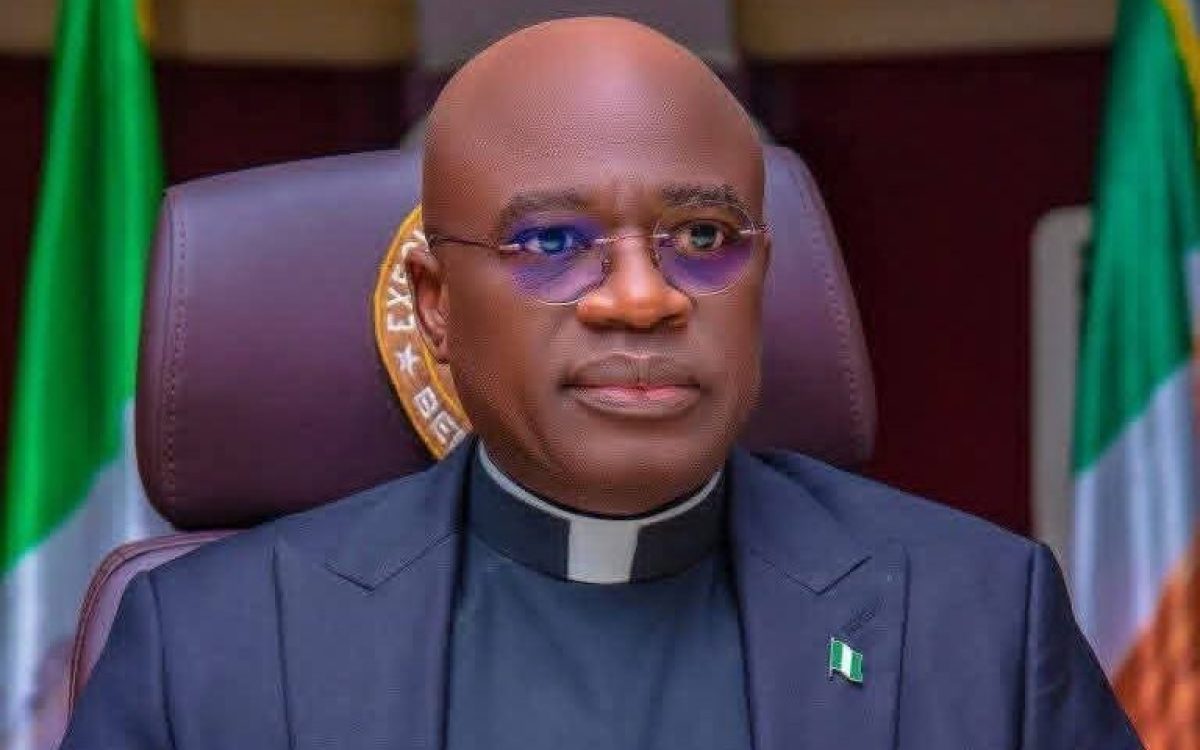
•Says security improving; we’re closing IDP camps •Economy: Only naysayers won’t see improvement under Tinubu
By Romanus Ugwu
Governor of Benue State, Reverend Father Hyacinth Alia has said it could only take a naysayer to claim ignorance of the economic transformation the country under President Tinubu
Speaking during an interactive session with the Renewed Hope Ambassadors in collaboration with the Presidential Media team, the governor addresses several issues concerning the transformation the state has undergone, the relationship between the federal government and the sub-nationals. He also frowned on the criticisms against President Bola Tinubu over the removal of fuel subsidy.
How would you describe the journey so far?
It is good that you have gone round to see what we have been able to achieve from the blueprint we have. And even as much has been done, I know that more is still left to be done.
When we came in, we declared a state of emergency on road infrastructure. This is why if you move around the 23 Local Government Areas (LGAs), there has been a very good connectivity of road networks in most parts of the state.
In a number of our urban places, we are doing urban renewal roads. All the roads within some major townships here have also been transformed into what they are today. We have achieved enormously on the reformation and revamping of our primary schools. They were in the ICUs.
The children no longer attend primary schools in the local governments. We were able to give some priority attention just to revamp the primary schools, and hundreds of primary schools at the local governments are now back to life. We were also able to hire 9,700 teachers just for the primary schools.
We also went statewide to take care of the primary health institutions. Life was literally running out from the Teaching Hospital. Since it was fixed, we are witnessing medical tourisms from all the surrounding states. We are very grateful that we also have a VIP wing of it. And in fact, this is one of the units that is most attended to by high profile visitors.
The patronage is simply due to the fact that we have several specialists to cover those areas. It is quite welcome to have them.
We have to get back to the basics: the primary healthcare establishments. They had vanished for some reason because no attention was given. We had to recreate some traction there. And what we did was to ensure that hundreds of established primary healthcare facilities are brought back to life.
We intend to do more, and as I speak here now, we are expecting some consignment from the United States. We have been in some collaboration and partnership with some US subnational governments on health. We ordered some instruments that will be arriving very soon. They are meant to be delivered for primary healthcare in different local governments.
We had a hiccup, and the hiccup was insecurity and insurgencies that cropped up. Thank God the federal government swung in immediately. And we have a very high, I would call it, amount of relative peace in this state. How did we get the indices? It was through our security apparatuses in all the local governments, then through the traditional institutions as well as our own people, the citizenry of the state who are there.
We had a chunk of IDPs; about 15 IDP camps were set up around the state. In a few of the camps we were privileged to visit, we are already making some plans to close down many of them because the IDP occupants have voluntarily gone back to do their farming.
By the plan, durable solution we have made with the collaboration and the partnership of the international communities, the United Nations, the IOM, and the UNCHR, we truly appreciate the efforts and support they sent to us; they made so much inroads into ensuring that the IDPs are returned to their homelands and to their farms.
It is not just for them to go back to the farm and then come back again. We have continued to see a dwindling number from the IDP camps. And this is because they are out there, not just farming, but now reconstructing their own homes. We hope that we will continue to pump, in various forms and shades, security frameworks, so that they remain back there and do what they know how to do best: farming.
What are the development plans of the state?
This is a very tricky question. To answer it explicitly, we need to address the inefficiencies of certain leadership. But I will try to pull that out from the attempts in here. There has to be a direction. There has to be a mission and a vision. Benue State is 50 years old today, and in the 50 years, we have had a series of leaderships.
As a state, do we have a master development plan? The answer is no, we didn’t. When others came in, they made some inroads on what they thought was best for the people. But again, this is not what the blueprint is expected to be. You have to filter the people you are going to serve. What are their priority needs? Do they really want this? Do they really have this as a need? Want is different from a need.
When you do not do a filtering, there is the tendency to simply do the wants of the people. We had to go down to the trenches to ensure that this is what the market woman is needing at this particular time. This is what the farmers are desiring. And this is what everybody in the state truly seeks to have to take us from the so-called glorified village status to the proper status of citizenship.
What we have where we are headquartered, and then to improve our other townships and all that. This is directly from the people. And on a number of other projects we have done, there are some caveats to enable it to stay sustained. And if you people say the government does not have business into business. If the government does not have those whose minds are hung on business, then every little effort made will go down the drain.
We have established, very fresh, the Benue Food Basket Brewery. We had one before. If you take the statistics from the people to know why we had beer breweries here previously during Aper Aku, it was simply because people desired it.
If truly, that means a lot of capital flight is being taken out against the state, against those who are supposed to be enjoying it. You would experience some problems like that. It is not that we have people who love to drink so much. It is, after all, not food. People love it. We make it from local produce, from the Sorghum we produce, the cassava we produce, and the corn we make.
If we are producing these raw materials, why are we not converting them so that we all have the rippling effect of the value chain being made? There are several things we put in place to ensure that Zeva factory survives.
We have the juice factory. We also have a separate factory from the juice, the concentrate factory. All three of those factories, made in the last three years, are functional and meant to remain as such because we will continue to monitoring. We have the right people to ensure that things work.
Now we are also getting some partnership from the civil society who wants to have these. In the last one year, a bag of oranges sells from N3,500 to N17,500 now as I speak. There is a lot of competition on that. What do we do? The farmers are also going to enjoy. We have already registered all the site rooms and those who have orchards.
Those different frames of farmers are registered under cooperatives. They know that this is the source of where the funds are coming to them: to keep their farms; expand them; and to keep smiling to the bank.
There is assurance that what they do today sustains tomorrow. They know that we are going to be very constant. We are business-minded, which means we have put in place measures to ensure they stay.
It is quite unfortunate that we lost the Taraku Mills. It is one of the very huge components of driving the economy in the state. That arm had died because people felt it was just a common cake. Get your knife, cut a chunk, and then leave. But at the end of the day, everybody lost in the state.
Benue State was the number one producer of Soybeans nationwide. We are now working our way back to the front line again. What will that do to the farmers? They understand that the Taraku Mill has come back. It is going to be a market sustenance for the produce they are getting from the farms.
Already, we have started giving farm incentives. We are giving some money to small farmers, to very big farmers, to go back into Soybeans farming. We are already giving farm inputs to those who have identified themselves. Some data were already taken.
If some good guard, as we have in place now, would be sustained as we have designed and planned, I want to believe that we are going to even raise more companies here.
The cottage industries are the ones, and once they are in place here, a number of lives are going to be changed. We are even intending to have a Benue Farm Market in Abuja. The road is now express. We used to do five and a half hours from here to Abuja. Now it is even shortened. It takes under three hours for us to get to Abuja.
What stops us from bringing the Benue fresh farms, oranges, yams, name them, over there. Because except if you do not plant, you must harvest on this land.
These are the advantages we have. If people are making money consistently from their produce, we are going to remain on the path we have now taken. We did not just bring back to life the Taraku Mills, it is just one factory that we have resurrected.
But all the other new ones are also going to be sustained. I am very hopeful that as people get some more money and supply to the bank, they are also going to ensure they will keep coming back to us.
Other News
What are those teething challenges that have kept you awake?
Things keeping leaders awake, for those in Benue, five years back are different from what they are today. You knew what it looked like then and coming back now, you can tell what it is. There is a political will. Benue is a large quarter, 23 local governments with a large land mass and a population of about seven million. It is large.
But again, what was exhibited and executed by the leadership previously, you cannot keep doing one thing all the time and expect a different result. We have to bring in reforms, but in doing so where there is so much drought of funds, drought of ideas, again, drought of implemented projects on the ground, you really have to sweat, and sweat badly.
The reforms we have brought to bear are the ones that are giving us results. But then reforms present a pushback from those who had enjoyed just a normal, same old status quo. Would the earth stop going round if we do them? The answer is no, but status quo now becomes a problem.
Is it roads that we will eat? No, it is not roads that you eat, but at the same time intrinsically you enjoy the roads, and eat the roads because they have gone through your farms, they have gone through the market square, and from the produce on the farm they are coming back to the buyer in the town or in some suburb area.
It means you are still eating the roads. But, at the same time a boy that doesn’t have anything to show for, physically, is a problematic child. He has to augment himself. We are augmenting the state in the manner that people have already started enjoying the reforms that are here.
Parents are enjoying not paying any school fees for their children from basic one to basic nine because we are using their own money given under the custody of government leadership to take care of this.
In other words, we are pinching the pennies to ensure that we do these things. We are taking care of the primary health system now. If you have malaria, you don’t have to leave your village to come all the way to Makurdi to spend three and a half hours to treat malaria here.
With the clinic we have, with the hospital we have, with the general hospital we have, we have the primary, and then we have the second tier, the general hospital by the same axis. That takes care of several things, and it’s the same thing with the primary schools and all that.
So, why we are able to do this? Initially there was a kind of resistance. If you go back to history, reforms bring resistance, and it is part of what even the Federal Government might be suffering from.
So much is done. I just made a pronouncement here that with the much money that the Federal Government is giving us, thank God you have been out there, to see that the money is translated into those projects, in Otukpo Water Works, in the series of roads and the underpasses, in the schools, and in the hospital systems you have seen.
It is the only way to go. There has to be a direction. In fact, part of your question is calling for an immediate establishment of this master plan on development because each administration that comes in now takes a look at this, one, two, three, four, taken care of. I am going to take care of one, two, three, four, and then we are moving forward.
This is how Lagos also began. This is why I was highly enthused about President Bola Tinubu becoming the president. I have been there as a younger man many, many times; and I knew what we went through. I knew how the city was, and in 25 years, the master plan that was made has been religiously executed.
If we have similar things, and this is the trend we have actually taken, but reforms have to be brought in so that the newness of what we seek is being established. As we continue to do this, it is going to be very helpful. Since we came in, we have never ceased paying salaries in the last three years and counting now. We have never stopped paying pensioners. We do today, and then we go back to their arrears. Why are we able to do this? Pinching the pennies.
Can you give further explanation on the source of the financial war chest?
They say that what is being distributed helps the state so much, but at the same time, what it gives me is what is being distributed elsewhere as well. We all have just a very common share. In fact, we have so much on the ground, but since the harnessing of what we have hasn’t fully taken its position on the table, we are yet to have 13 per cent derivatives. Quite soon we are going to be there.
You may hear the announcement on the oil and gas found in this state. Once much attention is already given there; not just having a pipeline, work has already begun on harnessing the series of solid minerals we have, Nigeria has quite a chunk, Benue has a share in that of 43 varied solid minerals, and quite a number are at a commercial basis.
Once we go in there, we are also going to continue to support the Federal Government. Our IGR has been increased. The oil subsidy is the one throwing this back to us, throwing much money back to us.
The funds used to ship the oil, to get the oil in different places, is now brought to us directly in this cache of the thing. We must say it. Previous administrations tell me, I hear what several people, including the state here, speak with the media.
The amount of money we are receiving is way much more than what they were receiving. Let me try to be very cautious so that I don’t make it very personal. The management skills of those funds is what would be of import here.
If we have this, as someone with a background from the church, if the intent for what we receive is meant to take care of salaries, infrastructure, our security, then it simply means the intention of the donor has to be respected. In this case, what we receive is meant to go to them; not for individual pockets; it is meant for the common good.
If you understand the common good, the poor masses, then they must be on the front burner of everything you do, and this is why very good attention is given to this. Again, I spoke about inspecting what you expect. I want to come back, God’s willing, and the people again seeking unwilling, they sent me, if I perform abysmally, then they are not going to look at my direction. So, I also had to work this, not the fine line, but how to make it in a manner that they know that I’m worthy as a messenger. And this is why I had mentioned pinching the pennies.
If we can hold ourselves accountable and govern ourselves, then we will be able to govern all the resources that come our way for the people. And that is what makes democracy.
What was the turning point in the relationship between the federal and state governments?
We had to renew our relationship. It is superb, quite superb. And this is why the Federal Government, Mr President, has been quite good to us, the subnational. Remember, we are running a federation, the federal government, then the subnational in here.
What we receive from our federation account is what enables us to do what we do. The attention we have given to re-energising our internally generated revenue is what enables us to do what we are doing today and to ensure we are paying salaries without owing anybody. There is a very good love lost here between us and the federal government.
This is why when we are rejoicing, they are here rejoicing with us. When we are mourning, they are also feeling the pinch, and they are here with us also to mourn.
Why so much attention is given to us? There are lots of appointments that we enjoy due to this friendship. We didn’t have that prior to my coming in. There is so much that the federal government is giving because of our position and where we are. In fact, at the end of the month, the state is going to host the entire nation here at the Security Summit.
They are coming over here. Why us? Again, I feel that it is because of this very great relationship. We are going to represent the entire North Central. Everybody is coming in here. The entire nation is coming in here for us to share ideas, for us to see possible ways of curbing all the insecurities and all that, and then to explore the different dynamics on how these things work. We have this great relationship, and we must remember and be grateful again to the President.
It is not just myself as a governor, but all the other governors, at least of this administration. There is this very heavy competition among us. I have a name I am bearing. I didn’t give it myself. It’s a family name I bear. If I perform very badly, it’s also going to leave some input on my siblings, even way, way after me. We are talking about Aper Aku today, why is he on the minds of so many? He came with the interest of the people, and he created a good relationship, and there was a fine synergy. This is why we had the number of things we had back then in the day.
Anything you do, they say it’s AI. When we went somewhere on some of the roads we did, shortly before the Minister, Umahi came to the state to monitor some projects, we urged him to also monitor the state projects. He now kept asking us, is this part of the federal project? We say, no, this is the state project.
He asked where are you getting the money from? We told him, we are utilising what we are getting. Going forward there would be better results. When people see several things and claim it is AI, having gone out there to see, tell them it is not AI, but the reality of what we have on the ground. The naysayers have to shine their eyes to see that there are changes and we are moving.
The reforms are bearing fruits, and it is difficult to change a certain fixed mind, to change the status quo, but what is even more permanent is that change itself. For those who may still want to dabble, those who may still have their agitations or reservations that the economy is not working, the economy in the state is improved.
I must admit that it has improved. If a bag of oranges was sold, as a compound example, for N3,500, and then people even had to beg for the oranges to be bought, and then because we have gained a lot of financial support, we chose to do some factories, and there is a lot of competitiveness on the oranges from the farms already, how would you say it is not spreading?
We are pushing the poor women out there. It is their money we are using even to push them. If you do not pay your child’s school fees for nine solid years, definitely there is some saving for you. It is something new. Reforms are new, but then if you give it patience, study it, look and look again at the differences, they are dropping bit by bit.
And you realise that reforms are the way to go so that we get everything, not just in part, not just by a bit, but in total.