Follow Us on Google

‘Whether we like or support it or not, restructuring will eventually happen in Nigeria’
From Noah Ebije, Kaduna
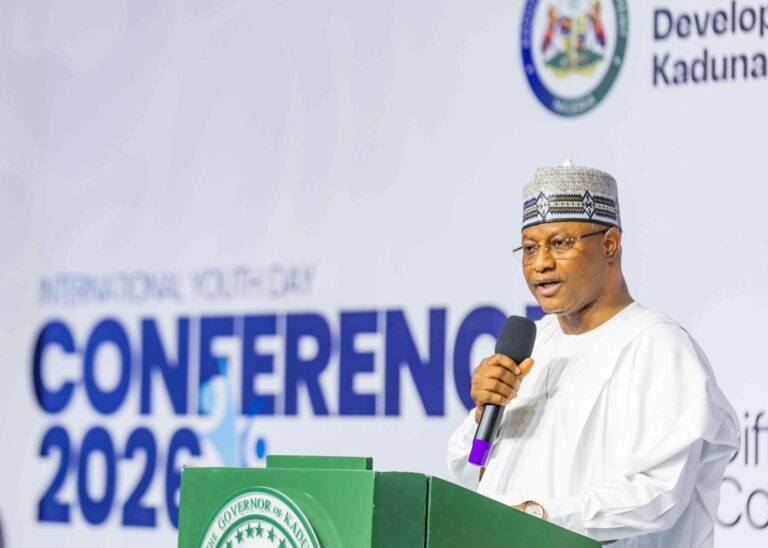
THE roaring din for self determination currently rocking the nation and demands for restructuring to stem the tide, yesterday rang high at the Umaru Musa Yar’Adua Memorial Hall, Kaduna. A rare assemblage of leaders of northern extraction, including President Muhammadu Buhari dissected the sore issue and tacitly sought for a less costly means of dousing the flame. They spoke at the memorial conference in honour of former military governor of the defunct northern region, the late General Hassan Usman Katsina. Buhari urged Nigerians to make use of the 1999 constitution to fight for their rights, instead of toeing the line of illegality in their agitations
The president spoke as special guest of honour.
He stressed that the constitution contains all necessary portions that guarantee the rights the people should enjoy.
Buhari who was represented by the Minister of Interior, Abdulraman Dambazau added that Nigerians, particularly northerners, should emulate the virtues of General Katsina.
He said, “Nigeria has come a long way as a democratic nation. So the rights of all Nigerians are in the 1999 Constitution. They must abide by the constitution to achieve whatever goals.
“I call on all elected persons to give good governance to the people, Nigerians deserve good governance.
“My leadership is improving on security, fighting corruption; Boko Haram insurgency has been brought under control.
“We must unite as a nation for national integration; emulate virtues of late General Hassan Usman Katsina.”
Former vice president, Alhaji Atiku Abubakar hit the nail on the head when he said that it will be better for Nigeria to be restructured than to go to war with the various agitating groups in the country before allowing them to realize such agitations. Atiku, who has been consistent in his call for restructuring contended that “whether we like or support it or not, restructuring will eventually happen in Nigeria.”
He further canvassed the idea that, to either restructure or allow the agitators have their way in a peaceful manner, a National Conference should be convened by the Federal Government to allow every part of the country come to a roundtable to negotiate how to go their separate ways as brothers and sisters doing business together in the environment.
He spoke on the topic, “The challenges of national integration and survival of democracy in Nigeria”. Dwelling more on national integration, the former vice president, and twice presidential aspirant described it as the process by which different components of a country, with economic, political and cultural links, develop a sense of nationhood, of unity, of oneness, of interdependence, irrespective of their different histories, experiences, ideologies, and cultural values and practices. He, however, regretted that “as a country we have mightily struggled to live up to this ideal. We have obviously not done enough to realize national integration, and the survival of our democracy is still a work in progress. The cost to us has been enormous. We even fought a civil war to forcibly keep the country together.” Reviewing the pervading socio-political climate, he observed “that different segments of Nigeria’s population have, at different times and sometimes at the same time, expressed feelings of marginalization, of being short- changed dominated, oppressed, threatened, or even targeted for elimination.” These agitations and misgivings, according to him have always been met with various measures which include “ the creation of states from the earlier three(and later four)regions to the current 36 states; a civil war, and other military operations in different parts of the country at different times; federal character principle; changes to revenue allocation formulae, National Youth Service Corps; federal takeover or establishment and management of schools, universities, hospitals, and huge federal presence in the economy as an investor. Others include the excessive centralization and concentration of power at the federal level and the weakening of the federating states; and amnesty for repentant ex- militants of the Niger Delta. He said these measures have failed woefully, leading to a fragile unity, unstable democracy and more grievances. Atiku blamed the failure of the policies on “sectional interests and sentiments.” Accusing the Nigerian state of inflicting conflicting policies on the people, Atiku cited the requirement of state and local government of origin rather than residency for access to government services and jobs.
He blamed the pervading belief among many Nigerians that the greatest beneficiary of the status quo is the North on their knee- jack resistance to calls for restructuring, the reliance on oil revenue which comes from outside the North, the leading role it played in the civil war, and northerners being the heads of government at the national level for much of the post independence period until 1999, during which period much of the current structure was put in place. He deplored the pervading poverty in the North, the bankruptcy of most of the states that depend on federal allocation to survive, alarming school dropouts, dwindling agricultural output, and obsolete way of herding in the 21st century as some of the ills plaguing the North. He emphasized the inevitability of restructuring the country, saying
“The question is whether it will happen around a conference table, in a direction influenced by us and whether we will be an equal partner in the process. Or will it happen in a more unpredictable arena and in a manner over which we have little influence? It should be at a table and we need to be at that table.
“A nation is an organism; it grows, it evolves, it changes, it adapts. And like other organisms if it does not adapt, it dies.” Expatiating further on restructuring, Atiku said; “those who argue that restructuring of the polity won’t be necessary once we diversify the economy are mistaken.
“As long as the Federal Government remains overly dominant relative to the federating states, it will continue to matter which section of the country captures federal power with its attendant instability.
“And as long as the Federal Government keeps the bulk of oil revenues for itself, its desire and will to provide the leadership needed to diversify the economy will continue to be limited.”
He extolled the virtues of the late Usman Katsina and the role he played in fostering the nation’s unity, regretting that his efforts in that direction should not be in vain, because Nigeria’s unity is currently under severe stress. Calling on statesmen to rise up to the challenge and proffer solutions, he said “We cannot tell a person who says he feels pain that he does not feel pain.”
This was even as former military head of state, retired General Yakubu Gowon, who was the chairman on the occasion said that the Nigerian military did not see Biafran fighters during the war as enemies, but rebels fighting a cause they believed was right.
Gowon said it was this perception of seeing them as rebels rather than enemies that forced the Federal Government to integrate the Biafrans into the federal system without a carryover of animosity.
In his speech, a former vice chancellor of Ahmadu Bello University, (ABU) Zaria, Professor Ango Abdullahi said the northern region can no longer guarantee the unity of the country because, it has paid its dues in doing so since the era of the premier of the North and Sardauna of Sokoto, Sir Ahmadu Bello.
He said those Nigerians who are saying that Nigeria can’t be divided are actually making a mistake, stressing that the country is very divisible in the face of current avalanche of agitations and separatist tendencies.