Follow Us on Google
For decades, agriculture was at the heart of the economy of the old Eastern Region, providing food, employment, raw materials and wealth for millions of people.
It was a period when the region’s agricultural enterprise was not merely about subsistence farming. It was an organised economic system in which production was linked to processing, trade and industry.
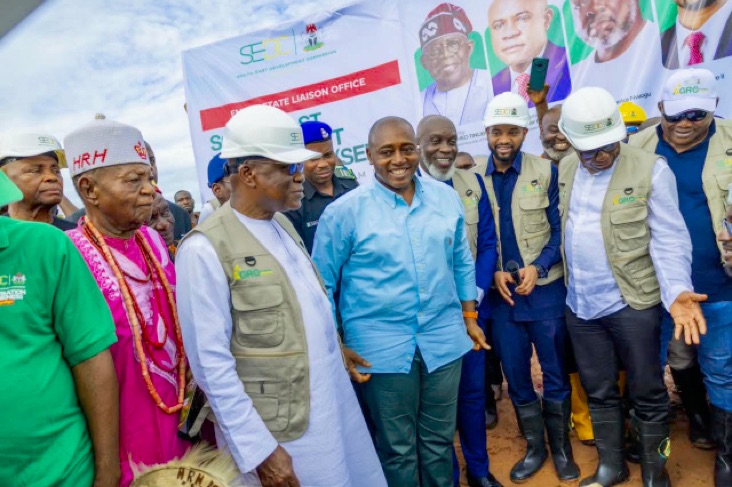
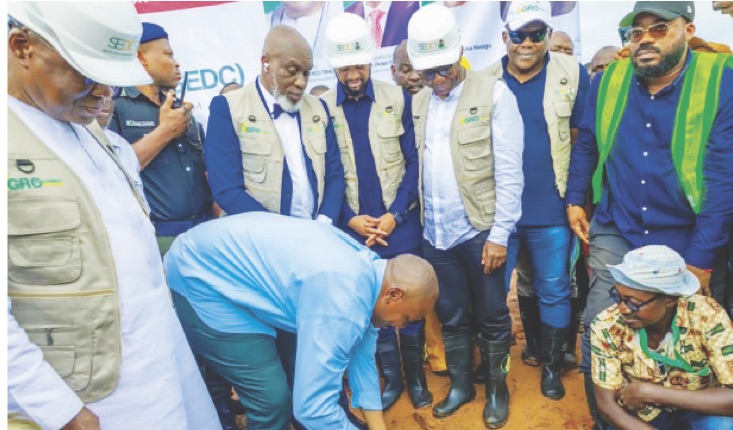
That history was repeatedly invoked at Nomeh Unateze in Nkanu East Local Government Area of Enugu State, last week, September 22, 2026, as the South-East Development Commission (SEDC) began the implementation of what it described as an integrated agricultural development programme on about 200 hectares of land.
The project, which is being implemented under the Commission’s South-East Agro-Development Programme, is designed to combine agricultural production, processing, mechanisation, training and market linkages in one location.
Dairy, poultry, fishery, crop production, greenhouses, processing facilities, mechanisation and practical agricultural training are expected to form part of the facility.
But beyond the foundation-laying ceremony and the heavy equipment deployed to the site, the project represents something bigger for its promoters: an attempt to move agriculture in the South-East from predominantly small-scale subsistence farming to commercially viable agribusiness.
For the SEDC Managing Director, Mark Okoye, the beginning of work at Nomeh marks the point where months of consultations, studies and planning give way to implementation.
“Today the work begins. Today we are putting the first shovel in the ground. Or perhaps more appropriately, we are driving the first tractors and bulldozers onto the land on behalf of SEDC. And I cannot think of a better place to begin than Nomeh Unateze,” Okoye said.
He explained that the choice of agriculture was deliberate, given the entrepreneurial character of the South-East and the need to build a productive economy capable of generating employment and reducing dependence on imported food.
“Our people know how to build businesses, create value and make something out of very little. But the next phase of our regional development must also be about production, productivity and industrialisation.
“We must produce more of what we eat. We must create productive jobs. And we must build agriculture value chains. And we must transform agriculture from predominantly small-scale subsistence activity into modern, commercially viable enterprise.
“That is what the South-East Agro-Development Programme is designed to support,” he said.
The SEDC boss said the Nomeh project was conceived as more than a conventional farm.
According to him, the approximately 200 hectares would serve as an integrated agricultural development facility where production would be connected to processing, farmers to markets, and training to employment and enterprise.
“The idea is simple. Production should connect to processing. Farmers should connect to markets. And training should connect employment to enterprise,” he said.
Okoye stressed that the success of the programme would not be measured by the ceremony marking its commencement but by its actual impact on farmers, young people, businesses and the wider economy.
“And the investment we make inside these 200 hectares should create economic opportunities well beyond the 200 hectares,” he said.
“Through the Outgrower Programme, farmers in surrounding communities will have opportunities to participate in the value chain, receive technical support, and connect their production to markets.
“This is how we intend to measure this programme. Not by the ceremony we hold today, but by the hectares we are going to develop, by the food we produce, and by the farmers we support, and by the young people we train, and by the businesses that emerge around this facility.
“And ultimately, by the jobs and economic activity it will create.”
He gave examples of how the project could extend beyond its immediate location.
“A young person who learns modern dairy production here and establishes an enterprise elsewhere is part of the impact. A farmer supplying maize or soya beans into the feed value chain is part of the impact. And the poultry or fish farmer who learns better production techniques here and takes that knowledge back to his community is also part of the impact.
“That is how development spreads. And that’s how a regional programme is supposed to work.”
The project also fits into the Federal Government’s broader emphasis on food security.
Okoye said the SEDC would seek to establish similar agricultural interventions across the five states of the South-East, working with state governments, communities, farmers, development institutions and private sector operators.
“Nomeh is our starting point, but it’s not our destination. Our ambition is to establish agricultural interventions across the South-East, working with the five state governments, the communities, the farmers, the development institutions, and the private sector,” he said.
He noted that the South-East must become a more significant contributor to Nigeria’s food security, adding that the Commission’s regional mandate would be aligned with the Federal Government’s agricultural priorities.
“We will produce more, we will improve productivity, and we will reduce the distance between farmers and markets.
“And increasingly, we must stop exporting raw agricultural potential and start creating value here from the South-East,” he said.
For the Minister of Regional Development, Abubakar Momoh, the Nomeh project was evidence that the newly created development commissions could translate government policies into practical interventions.
Momoh, who praised the SEDC and the North Central Development Commission for what he described as demonstrated capacity and vision, said the commissions were established to pursue specific development objectives and should not operate as personal entities.
“They are government organisations, governed by rules and expert government regulations,” he said.
The minister said the SEDC’s approach was also consistent with the Federal Government’s policy direction.
“I want to confirm to you today that what you are doing here today is in conformity with the ministry’s policy and the Federal Government’s policy. We are transforming policy into implementation now.
“And what you are doing is in alignment with the eight presidential priorities of this very government,” Momoh said.
He particularly linked the project to food security, which he said was one of the administration’s priority areas.
Momoh disclosed that he had recently attended a summit of the North Central Development Commission in Abuja, where he spoke about the performance of the newly created regional development commissions.
He said two of the commissions had, in his assessment as supervising minister, demonstrated capacity and vision.
“I made a statement there that, of the first new development commissions that have been created by the President, Commander-in-Chief of the Armed Forces, President Bola Ahmed Tinubu, two of the commissions have actually demonstrated capacity, they have demonstrated vision.
“I want to tell you today that the two commissions referred to were SEDC and North Central Development Commission,” he said.
The minister, however, urged the other commissions to move faster in delivering on their mandates.
“I made it clear, and I want to re-emphasise today, that the other three remaining commissions, one is at the middle, two are still sleeping. And they have to wake up from their slumber.
“Those two that are sleeping, they know themselves. They have to wake up from their slumber because there is a purpose of establishing these commissions,” he said.
For Momoh, the Nomeh project also demonstrated the importance of cooperation between the Federal Government, regional development commissions, state governments and host communities.
He particularly commended Enugu State Governor Peter Mbah for providing the land for the project.
“Two hundred acres of land that you want to commence is not a small quantity of land. So I have to commend him and also thank him for remembering a community like this, Nomeh,” he said.
Representing Governor Mbah at the event, Deputy Governor Ifeanyi Ossai described the project as an example of what could be achieved through collaboration between governments and communities.
He said food security should not be viewed simply as the availability of food but as part of a wider strategy for tackling poverty, insecurity and unemployment.
“When we attack agriculture by way of investing in it, it is because we believe it is the lowest-hanging fruit,” Ossai said.
“And aside from the fact that it has the potential to remove our people substantially from poverty to sufficiency, it also helps to grow the middle class.
“History has taught us all over the world that communities and states and governments that invest in agriculture with a geometric progression are able to migrate their people faster from poverty to middle-class economy.”
According to him, Enugu State’s investments in education, infrastructure, healthcare, transport and security were designed to provide the wider environment required for businesses and investments to thrive.
He said the state’s Smart Green Schools, infrastructure expansion, healthcare projects, transport initiatives and security investments were part of the foundation for attracting investors and supporting economic activity.
Ossai, however, challenged the SEDC to think beyond the immediate 200-hectare facility and develop a model that could spread agricultural opportunities across the senatorial district.
“What is also important is that we have invested hugely in security. And that is why we can all gather here without getting concerned about the safety of our guests and those that will work in this facility,” he said.
“But I get concerned when government institutions invest directly in businesses because sustainability is always a problem. Those of you who initiated this idea who work today, at some point you may not be here.
“We must have made proper institutional framework that compels those that will come after you not to depart from the dream that all of us institutionalise today.”
The deputy governor suggested that the SEDC should develop an arrangement that would enable farmers in different parts of Enugu East Senatorial District to participate in the project without necessarily relocating to Nomeh.
“You must also think of how what investment we do in Nomeh will extrapolate to the entire Enugu East Senatorial Zone,” he said.
He proposed the development of smaller production and processing clusters that could feed into the central facility.
“A young man from Ugbo, from Ikem, may not be able to travel that distance to work here. But when we make effort to decentralise this investment by creating sub-sectors that can fit the production facility here, processing facility here, I would rather say, those people are also engaged.
“And over time, you can also begin to conceptualise mini processing of what they produce to make transportation to your central facility a lot easier.
“That way you’re encouraging people to get into logistics, to get into transportation. You’re also encouraging people to learn more. The people you train here from your facility can go there, establish support under your guidance.”
Ossai said such an approach could represent a departure from the traditional pattern of government interventions that often involve distributing inputs without creating a sustainable commercial ecosystem.
“We are governments. We always procure fertilisers, tools every year, every farming season and give it back to farmers. But most of those investments are not able to get their farmers back to business the next year,” he said.
He described the SEDC project as potentially providing a new model for agricultural development.
“If all we have done in the last couple of years has reached the end of its design life, what the South-East Development Commission is doing may be a redefining moment where we must reclaim a new idea that can extrapolate what you’ve tried to do to grow our people from subsistence farming, crude way of farming, to a more affordable but workable farming process.”
For the Enugu State Government, however, the success of the project will depend not only on the SEDC but also on the host community.
Ossai therefore appealed to the traditional institution, community leaders, youths and local authorities to protect the facility.
“And finally, and more importantly, for all of us gathered here, and I’m happy the Honourable Minister made remarks towards that, this is not a South-East Development Commission investment. It is our investment,” he said.
“The members of the council, the town union, the forest guard, the community, the youth. You must secure this investment.
“The government of Enugu State will take full responsibility for the protection of every investment made by South-East Development Commission. And we put that responsibility on the communities that host those investments.
“We put the responsibility on the council chairmen, who are the local authorities that will guide and protect these investments because we can’t afford to discourage investors.
“That’s the only way we can grow an Enugu that is private-sector driven but enabled by us as government.”
For the people of Nomeh Unateze, the project has brought a sense of renewed hope and responsibility.
Speaking on behalf of the community, its President-General, Dr Chukwudi Anyianuka, described the project as a restoration of the community’s glory and pledged the community’s support.
“We welcome this project because we see it as an investment in the future of Nomeh and our people. Our community understands that a project of this scale requires cooperation, responsibility and a shared commitment to its success.
“We are ready to work with SEDC, the state government, contractors, investors, and all the partners involved to ensure that the project delivers the opportunities that our young people, farmers and community deserve,” he said.
The Executive Director, Natural Resources, Agriculture and Rural Development, SEDC, Dr Clifford Ogbede, said the Commission was committed to reviving the agro-industrial model that contributed to the rapid economic growth of the old Eastern Region between 1954 and 1964.
He linked the aspiration to the administration of the late Premier of the Eastern Region, Dr Michael Okpara, whose government placed considerable emphasis on agriculture, rural development and industrialisation.
The SEDC’s agricultural programme is premised on the belief that the South-East can once again build a productive economic base around agriculture, not by returning to the past but by combining its entrepreneurial tradition with modern technology, processing, mechanisation, finance and markets.
Momoh also made a similar connection when he described the Nomeh project as part of the process of rebuilding the region’s commodity ecosystem.
“When I was told that we were coming here for agricultural development, a great programme, I had it in mind and I said, well, of course, it is not just sufficient to develop the land, but we must go beyond that to embark on processing.
“From what I see here, it is a complete change from developing the land, then processing and the rest of them. Once you do that, it means you have reinvented the commodity ecosystem of the Federal Government in the First Republic, where, of course, the people of South-East were well noted for oil palm production.
“So I am sure with this group of people, the commodity ecosystem of the South-East is gradually coming on board.”
The excitement surrounding the commencement of the Nomeh project will ultimately be tested by what happens after the ceremony.
The tractors and bulldozers now on the 200 hectares are only the beginning. The real measure will be whether the project can create productive farms, sustainable businesses, processing capacity, jobs and a network of farmers who can participate in a wider agricultural value chain.
If the model works as envisaged, the lessons from the facility could be replicated across the South-East, connecting communities to production, production to processing, and processing to markets.