Follow Us on Google
- Inside Ose Oyamendan’s MKO
By Beifoh Osewele
For Ose Oyamendan, October 1 was a sweet denouement to an extraordinary journey that had consumed almost 13 years of his life, repeatedly taken him away from home and family in America, carried him across countries and continents in search of elusive witnesses and swallowed more than $1 million before MKO, his 108-minute documentary film on Chief Moshood Kashimawo Olawale Abiola and the June 12 struggle, finally came home.
Asked shortly before the national premiere at the Wole Soyinka Centre for Culture and the Creative Arts, Iganmu, Lagos, whether MKO represented perhaps his greatest feat in Nigeria, Oyamendan resisted the easy temptation to make the achievement entirely about himself.
“I think it’s a great day for Nigerian history,” he said. “We are able to actually document this period, and we are able to lay a foundation for tomorrow to remember yesterday. And for me personally, it’s an accomplishment… finishing the film and bringing it back home for our people to see.”
The accomplishment came at a formidable price: in money, time, emotion and absence and much more.
“A lot of time — almost 13 years,” he said. “It took a lot of money, over a million dollars, a lot of it that we’re owing.”
The less measurable cost was his repeated absence from home.
“It takes you away from home a lot,” he said.
Oyamendan could still laugh about it, reaching for an unmistakably Nigerian metaphor to describe a filmmaking journey that seemed unwilling to end.
“It’s like doing another youth service, only much, much longer.”
The joke was good, but the journey was hardly funny. National Youth Service lasts barely one year. Oyamendan’s second “service” lasted almost 13, except that there was no fixed place of primary assignment, no monthly allowance and, for much of the time, no certainty when his discharge certificate would come.
In their place came airports, hotel rooms, highways, archival searches, closed doors, appointments that did not always happen and repeated attempts to persuade people who had lived the history to sit before his camera and tell what they knew.
By the end, the financial pressure had become so severe that the makers of MKO had to put the documentary itself on the line. “We have a film we do not own because we had to mortgage it to gap financiers just to complete it,” Oyamendan disclosed.
That admission perhaps conveys the scale of the undertaking more powerfully than the figure of more than $1 million. At that point, the filmmakers were no longer simply putting money into MKO; they were wagering the product of almost 13 years of their lives to ensure that those years did not end in an unfinished project.
Nearly 800 hours of recorded material would eventually be boiled down to one hour and 48 minutes. For every minute that survived on the screen in Lagos, therefore, there were hours that did not; interviews, archival material, journeys, alternative sequences, false starts and editorial decisions hidden behind the finished work.
Behind all those hours was a man who had become almost obsessive about finding the people who mattered.
Ose Oyamendan spared neither sweat nor effort, neither time nor distance, in his quest to tell the story. He traversed hills and valleys, crossed mountains and the Sahara, moved through dry lands and wetlands, tracking down the voices that mattered — those who played a role, those who witnessed history and those who knew what happened, or sometimes what did not happen. Such was the breadth of the search that one was left with the feeling that, if necessary, Oyamendan would have gone to hell and back to bring those voices into MKO and preserve their accounts for history.
Yet behind that almost obsessive search was a deeply personal relationship with the story.
“My journey into film was born in crisis about three decades ago,” he has said.
“1993 was a year that was meant to be the dawn of a new era for Nigeria, the world’s most populous Black nation. After years of military rule, the country stood on the cusp of democracy. I had just stepped into the world of journalism, a fresh college graduate working for Weekend Concord, Africa’s biggest-selling weekly paper.”
Abiola was therefore not a historical character Oyamendan discovered decades later. He was his employer and publisher, and the young reporter found himself in the journalistic trenches as the June 12 crisis unfolded around the newspaper organisation in which he worked.
He wrote through the annulment, the Interim National Government and the tightening atmosphere of military repression, part of a generation of journalists for whom wit and irreverence were sometimes weapons against power. One recollection has survived the years: during Chief Ernest Shonekan’s Interim National Government, Oyamendan remembers describing him in print with the unforgettable expression, “Olori Kenge.”
It was vintage newsroom mischief, but the circumstances around it were anything but frivolous.
“Moshood Kashimawo Olawale Abiola (MKO), emerged at a pivotal moment in Nigeria’s history, offering the nation a vision of its greatest future,” Oyamendan recalled. “He was the most charismatic man I had ever met and I have met thousands through my work as a journalist, activist, and filmmaker.”
Then came the annulment and repression.
“When the press and dissent was crushed with bullets, I fled to America where, working at Amnesty International USA, I became part of a high-stakes global battle to save Nigeria’s soul, uncovering global hypocrisy where oil interests outweighed human lives.”
Thus, the young reporter who had once lived inside the story returned to it decades later with a filmmaker’s camera and a journalist’s instinct to interrogate rather than merely celebrate.
That distinction matters because Abiola had been his employer and Oyamendan plainly admired him. The temptation to produce a cinematic valentine must have been considerable. He said he deliberately resisted it.
“Going into this film, my first objective was that I am going to take my biases out of it.”
The result does not read like an employee’s thank-you note to an old boss. Affection and familiarity are there, but so are complications, controversies, uncomfortable questions and competing accounts. Oyamendan could not erase his relationship with the events, but he could refuse to become their sole interpreter.
“Most of the key actors have refused to talk until now,” he said.
Over the years, he found many of them.
General Ibrahim Babangida, under whose military government the election was annulled, speaks in MKO. So do General Abdulsalami Abubakar, former President Olusegun Obasanjo, former electoral commission chairman Prof. Humphrey Nwosu, Abiola’s running mate Baba Gana Kingibe, Nobel laureate Prof. Wole Soyinka, President Bola Ahmed Tinubu, American diplomats Thomas Pickering and Walter Carrington, Theodore Zadok, who guarded Abiola in detention, journalists, activists and members of the Abiola family, including Doyin Abiola, Lola Abiola-Edewor, Kola Abiola and Hafsat Abiola-Costello.
“It is a story told by those who lived it — presidents, diplomats, politicians, activists, family members, and journalists,” Oyamendan said.
That formidable assembly of witnesses is one of MKO’s great strengths, not merely because of who agreed to talk but because Oyamendan largely resists forcing them into one convenient version of events. The witnesses sometimes reinforce one another and sometimes collide. Those who exercised power explain themselves from one side; those who resisted them recall the consequences from another. Diplomats bring the calculations of governments, journalists and activists the experience of repression, while the Abiola family brings the intimacy of people for whom a national political crisis became private tragedy.
The viewer is not always handed the comfort of a neat answer because the people who made the history do not always agree about what happened or why.
“When you don’t tell your story, somebody will tell it for you and it’s not always rosy,” Oyamendan said. “June 12 is a significant part of our history and we must know it. You build strength from knowledge.”
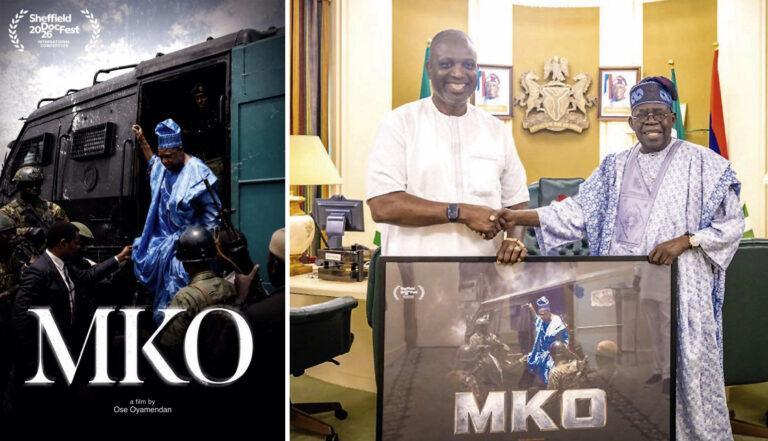
That conviction had already taken MKO to Sheffield DocFest, where it had its world premiere on June 12, exactly 33 years after the election at the centre of its story. On October 1, the film came home.
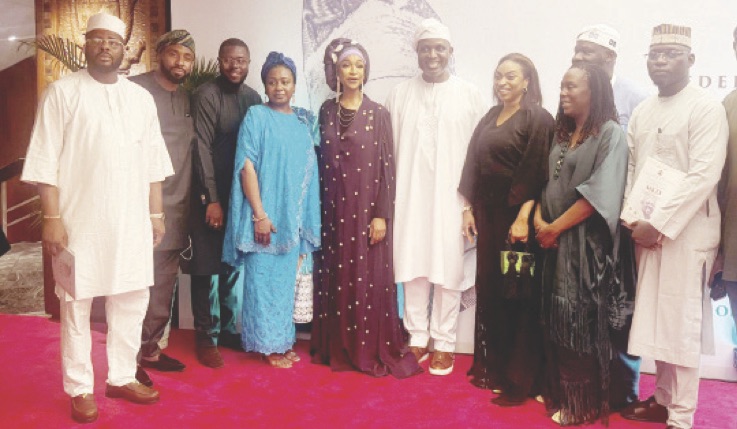
Entry into the Wole Soyinka Centre in Iganmu Lagos offered a pleasant contrast to the heavy security architecture that normally attends presidential movements. Outside, the expected security presence was evident. Inside, once guests established that they possessed valid invitations and accreditation, those handling entry were professional, courteous and warm. The militarisation outside virtually disappeared within, while the refurbished theatre proved a fitting location for a documentary rooted so deeply in the national past.
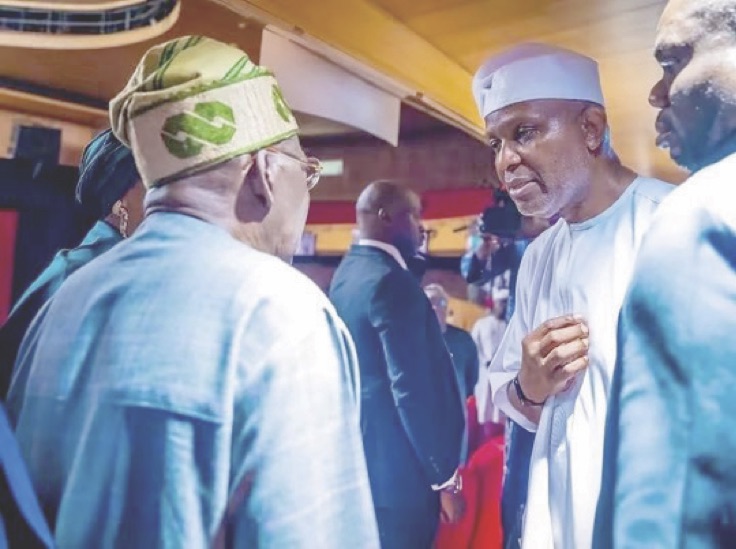
The room also held a delicious irony. Veteran journalist Dapo Olorunyomi, whose own life intersected with the struggle against military rule, was there. So was Tinubu. And many from all walks of life. The Gen-Zs were not excluded.
Years earlier, when political activists and journalists sometimes had to speak in codes, Oyamendan recalled the cryptic message, “Adan wan e O” — “BAT wants to see you.” In Yoruba, adan means bat, making it a discreet play on Bola Ahmed Tinubu’s initials, BAT.
More than three decades later, the man whose name once required code sat openly in the theatre as President and Chief Host of a documentary revisiting the period that had made such coded communication necessary.
Olorunyomi saw significance beyond the screening. “Challenges aside, we seem to be coming together. I am extremely happy.”
Asked whether the moment represented merely a premiere or the beginning of something larger, his answer was unequivocal. ‘Without question. I think this is the beginning of a great journey.”
Oyamendan himself found a contemporary echo in the language of the two eras.
“There was Hope ’93 and now there is Renewed Hope,” he said. “The link is our common destiny. Our fight to be a great nation.”
There was symbolism in that convergence, but Minister of Art, Culture, Tourism and the Creative Economy Hannatu Musawa pushed the evening beyond slogans and into the more difficult terrain of sacrifice and inheritance.
“On June 12, 1993, Nigerians stood as one people. Across religion and ethnicity, we came together and gave Moshood Abiola that mandate,” she said.
“That mandate was unfortunately denied. But the voice behind it was never, ever silenced.”
For Musawa, that surviving voice could not be separated from the people who paid the price for keeping it alive.
“It was carried by men and women who paid with their freedom, their comfort and, perhaps, their lives. MKO himself gave his fortune, his liberty and, in the end, he gave his life.”
The gathering observed a minute’s silence for the known and unknown heroes and heroines of the struggle before Musawa turned towards Tinubu.
“Mr President, it is fitting that you are our chief guest. You were not a spectator of June 12. You stood in that struggle, and you paid its price with exile.”
Her most consequential words, however, may have been directed not at those who survived June 12 but at generations born after it.
“For too many young Nigerians, June 12 is simply a public holiday. This film turns it back into our memory,” she said. “It reminds us that our democracy did not arrive by chance. It was a choice. It was defended. It was painful.”
Then she spoke directly to the young. “To the young people of Nigeria, we say: this is your history. This is your inheritance. And the next chapter, it really does belong to you.”
Musawa widened the argument further: “Nigeria has a story. Africa has a story. The black world has a story. Our story matters, our history matters, our voices matter, and our story deserves to be told.”
That is where the minister and filmmaker effectively met. Musawa’s warning was that a hard-won democratic landmark can gradually be reduced to ritual, its meaning thinned out until only the holiday remains. Oyamendan’s answer has been to return faces, voices, argument, pain and contradiction to the record.
“Documentary remains one of the most powerful ways the Black diaspora remembers its history and imagines its future,” he said. “Through the medium, we preserve memory, reclaim identity, and affirm that our stories matter.”
At exactly 4.37 p.m., the lights went down and the sirens came.
Abiola’s voice filled the theatre, followed by Oyamendan’s deep baritone, and MKO began pulling its audience through the businessman, philanthropist, publisher and politician; the election and its annulment; arrests and repression; journalism under siege; exile and international diplomacy; the assassination of Kudirat Abiola; Abiola’s detention and, ultimately, the circumstances surrounding his death.
At its best, MKO is more than a moving scrapbook of archival material. The archive becomes another witness. Old images do not simply decorate present-day interviews; they sit beside them, sometimes confirming an account and at other times quietly challenging it.
Babangida speaks from where he stood. Those who resisted the annulment speak from where they stood. Diplomats recall the calculations of governments, journalists the struggle to report, activists the price of resistance and family members what public history did inside their home. Oyamendan allows those voices to meet without compelling them to agree.
The result is at turns illuminating, unsettling and uncomfortable, perhaps, precisely as it should be. History scrubbed clean of disagreement can easily become propaganda; history in which participants are allowed to expose their recollections, explanations and contradictions gives the audience considerably more with which to think.
Guests watched with rapt attention. The theatre was so quiet that the proverbial pin drop might have sounded deafening. Even those clutching packs of popcorn seemed reluctant to reach into them, afraid of missing a line of the powerful narration or a frame of the striking archival images unfolding on the screen.
For one hour and 48 minutes, the past took possession of the theatre.
When the lights returned at 6.25 p.m., MKO had demonstrated why it cannot comfortably be reduced to a biography of Abiola. Abiola is its centre of gravity, but Nigeria is its canvas. Through him, the film enters questions of military rule, democratic choice, wealth and influence, journalism, diplomacy, international interests, family, courage, ambition, resistance, betrayal and the consequences of political decisions.
Nigeria’s official relationship with June 12 has itself changed over the years, but official recognition alone cannot keep the past alive. People, stories and documentaries can — if they are made with sufficient rigour to outlive the excitement of their premiere.
That perhaps explains why Oyamendan does not want MKO to end its life at Sheffield, Iganmu or on the commercial cinema circuit.
“We want to take it to schools, towns, villages and anywhere where there are people,” he said.
For him, the intended audience includes children not yet born when June 12 happened.
“You’re creating something for my children and your children, laying a foundation for tomorrow to remember yesterday.”
Seen from that perspective, the almost 13 years acquire another meaning. The million-dollar-plus expenditure becomes more than a budget line. The absences from family become more than inconvenience. The flights, highways, closed doors, interviews, hundreds of hours of footage, debts and eventual decision to mortgage the film become the price one filmmaker was willing to pay to leave a record behind.
Oyamendan places that responsibility in even larger terms.
“I was born in Nigeria but partly shaped in America. That duality is not theoretical. It lives in my body. It hums in my memory. It is a rhythm, sometimes dissonant, sometimes beautiful, that guides how I see, how I listen, how I tell stories.”
Then comes perhaps the clearest statement of the philosophy behind MKO:
“MKO is not just Nigerian history. It is a warning to the world. Art is never merely entertainment. Art is memory. Art is resistance. Art is survival.
“The stories we tell today will shape the moral imagination of tomorrow.”
Those words offer perhaps the best answer to the question of whether MKO represents Oyamendan’s greatest Nigerian feat. He declined to pin that medal on himself. Instead, he spoke about bringing the film home, documenting a crucial period and giving tomorrow something with which to understand yesterday.
For almost 13 years, that pursuit took his money, his time, his presence at home and a sizeable portion of his life. At the finishing line, it even demanded that he mortgage the work itself. That is why the joke about a second National Youth Service carries more truth than humour.
When the lights went down at 4.37 p.m., almost 800 hours of interviews, testimony and archival material became 108 minutes of cinema. Presidents, generals, diplomats, journalists, activists and family members spoke across three decades, while a generation that knew June 12 principally as a date on the calendar was invited to meet the people behind it.
At 6:25 when the lights came back on,, Oyamendan’s objective no longer sounded abstract.
He had wanted to “lay a foundation for tomorrow to remember yesterday.”
For one hour and 48 minutes on October 1, yesterday spoke. And art made it speak; and loudly for that matter.