Follow Us on Google
• Says FG’s policy on solid minerals producing results
By Enyeribe Ejiogu
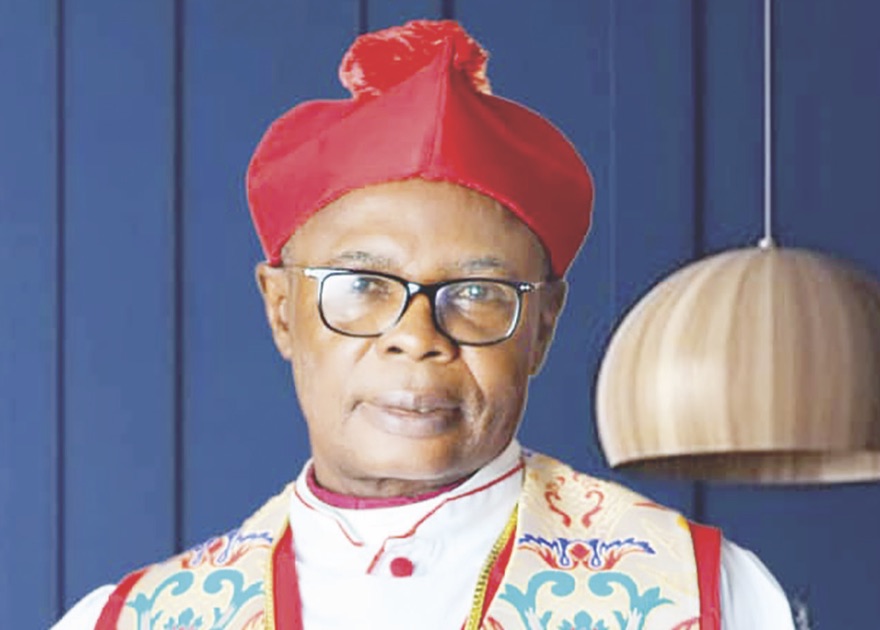
The Anglican Archbishop of the Ecclesiastical Province of Southern Sudan, His Grace, Most Rev. Silas Eze Anoruo, has commended the Fedaral Government for the efforts to end the era of sharp practices in the solid minerals subsector through implementation of appropriate policies to streamline operations in the strategic subsector of the economy.
The Anglican bishop who spoke with Sunday Sun on the sidelines of the philanthropic outreach held in his Imo State country home recently, noted that a robust solid minerals development programme would create enormous job opportunities. To continue the charity works he has been doing informally and personally for 47 years, Archbishop Anoruo disclosed that he founded PROISA Care Foundation, which will enable his lifelong philanthropic activities to be run under a properly structured and managed entity.
In this interview, he relives his life journey and the pain of losing his father when he was just 10 years old.
How did you begin your journey into philanthropy?
Some decades ago, I began to do philanthropic acts as a child.
What I have been doing informally is now being done under the PROISA Care Foundation. Before it was incorporated, we had been taking care of people for 47 years. I started even before I got married. I even started when I was in second year in school. What led me into philanthropy was the death of my father in 1970, when I was 10 years old. When it was time to pay school fees, my siblings from my stepmother and myself went to the first son of my father who was the oldest, from another mother, to collect our school fees.
He took me into another room, grabbed my two years and twisted them viciously, to the point that he broke the cartilage. As he twisted my ears, he said sternly, “your father is dead. I am not your father. Go to your mother to get your school fees.”
What thoughts ran through your mind when he said that?
What came into my mind was the fact that I had really become fatherless. I thought to myself that this was what fatherless children or orphans experience when they lose their father or parents.
When I left the place, I returned to the small room where I used to sleep. I knelt down and said, ‘God, if there’s any blessing in heaven, I want you to give it to me. I want to take care of the widows and orphans.
I locked myself in that room for three days. My mother came a number of times to knock on the door. She didn’t know why I was not coming out to eat.
When my father died, I was very young. So, I didn’t feel the impact until my elder brother twisted my ear and told me that my father was dead. The pain from twisting my ears did not affect me much like being told to go to my mother.
After that experience, I decided to be a father of the fatherless and a helper of the widows.
My elder sister who was a nursing officer gave me money to pay school fees. But I gave the money to somebody else to pay his fees.
I find that intriguing. You needed your school fees, and when you got it, you gave it to another young child. Please explain this.
I was at Christ Church Primary School at the time. My mother was very angry with me. I never told her about my experience with my older brother. But the testimony was that God gave me another money and I resumed school. Eventually, I finished college at Emekuku High School.
I also had a second sad experience when my elder brother from my mother and elder sister came to our mother and said they could no longer carry the burden of paying my school fees. They said that my mother should take care of me and my younger sister.
At the time, my desire was to be a medical doctor. So, when the second disappointment happened, I decided to put all hope in God. So, I started doing various things to survive. There was nothing I didn’t do. I would go to the bush to gather firewood and sell. I worked on farms, planting cassava. When it was mature, I would harvest, process and sell it to pay my school fees. I did all these things to support my mother and my younger sister.
At the time, my mother engaged in sand excavation at the Otamiri River in Owerri, which she sold to building contractors. After school, I would go to meet her at the excavation site, to do the calculations for her. This was how I struggled to pay my fees and stay in school. It was not easy. The situation got to a point when I couldn’t even live in the dormitory. I had to move to the home of my elder sister, who was married, to live with her. From her house I trekked to school, and sometimes I rode a bicycle to school.
Imagine a student going to school with no textbooks. My mother had become sick and so I couldn’t disturb her for money to buy books. So, I managed with no textbooks, to complete secondary school. I decided that I did not want to continue schooling.
So, what did you then do from that point onwards?
I started doing whatever God called me to do. With the little money God was giving me, I began to use it to help train other people’s children and taking care of them. I began to care for the children of my sisters and do Christian ministry. I was attached to a church on Zander Street. Later I was posted to Egbema, to be in charge of a new church planted there. I worked there till I was able to unify the Rivers State and Imo State branches under the Eastern States Conference together. This was before I gave my life to Christ in 1985. I was 25 by then. Becoming a pentecostal made a big difference in my life. I was able to put up a small structure for my mother and moved to Lagos.
What did you do in Lagos?
I continued to do church work and went to Faith Bible College, to improve myself and get a deeper understanding of the word of God and get equipped for what God wanted me to do. When I passed out of Bible college, I founded the End-Time Miracle Bible Church. The ministry is still existing till today. I wanted to focus on planting branches in various places, but God said that was not what He called me to do. God said clearly, “Give me Africa.” Based on this I handed over the church to other pastors and went into full time missionary work. I began holding crusades in different places in Nigeria and all over Africa, evangelizing and doing charity. That is what I have been doing since 2005.
What we do is that we go to minister in hospitals and prisons in Lagos. When we go to the prisons, we pay off the fines imposed on inmates held in the prisons because they could not pay. We pay the fines and set them free.
Meanwhile, as part of the missionary work, we do Back-To-School programme, whereby we buy school bags, books, sandals, uniforms for children from indigent homes, to enable them resume school in Lagos, Ibadan, Abuja and some other places.
You see, I could not go to school the normal way because there was no help. So, part of my mission has been focused on ensuring that children will go to school, especially orphans. We pay school fees for some children. I derive joy seeing these children get back to school, remain in school to study and finish school.
Did you get some kind of sponsorship support?
No, we never got assistance. I have been funding this charity effort with my earnings, for the past 47 years, and that is what I am going to do tomorrow. (This interview was held a day before the community outreach held in Umuorie-Urata, Owerri West LGA, Imo State, for widows and other indigent women). It is from the money my wife and I save that we fund our charity works.
Did you at any time do other things apart from missionary work?
Yes, I was once engaged in the mining of solid minerals. But I don’t do that anymore. Besides, I can no longer do some of the things I used to do anymore because of age. That is why I want to bring in other people to support this worthy effort, to sustain it. Sustainability is key to prolonged success of any effort ; that is what makes it become a legacy. We strongly desire to collaborate with sponsors who will assist to make it more elaborate.
You just mentioned that you were engaged in mining solid minerals. Were you focused on any particular one?
I used to mine tantalites and gemstones. Then I got into gold in the Gurara area of Niger State. We brought mining equipment from China for this purpose. But we became victims of the insecurity in Niger State. The specialised washing machine we brought in from China was carted away by the terrorists and bandits.
Also, I had a gold mining operation at a site in Ghana. But the Nana people took the site from me. These losses affected me terribly.
How do you feel about the Federal Government’s policy on mining and gold?
I would say, the present administration is putting the right policy framework in place. In the past, it was not controlled by anybody and the Federal Government was losing huge revenue from the royalty that was supposed to be paid to it. But today, I want to tell you, the federal government is 100% in control. We have a set of structures to manage the resources we have. Before, you could see the Chinese in the bush with their money. However, whatever they buy, they take it away with the helicopter.
But they are still doing that…
Yes. We still have illegal miners. As the chief executive officer of Proisa Oil and Solid Minerals Limited, in Ibadan, I brought the illegal miners together, to formalise and legalise what they were doing. I got them to form cooperatives registered by the government. This way, they began to pay royalty to the government. The cooperatives are still functioning.