Follow Us on Google
…Decries sector’s GDP decline
By Bimbola Oyesola
Chairman of the Ogun State branch of the Manufacturers Association of Nigeria (MAN), Mr. George Onafowokan, has raised alarm over the manufacturing sector’s shrinking share of Nigeria’s economy, calling for urgent reforms to halt the decline.
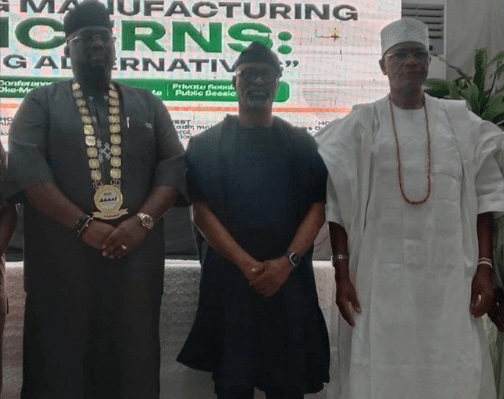
Speaking during the Private Session of the 40th Annual General Meeting (AGM) held in Abeokuta, during which he was re-elected for the third term, Onafowokan cited official figures showing the sector’s contribution to the national Gross Domestic Product (GDP) dropped from 16.04% in Q4 2023 to 12.68% by mid-2024 — a worrying slide for an industry seen as vital to Nigeria’s economic diversification.
“This downturn is no coincidence,” Onafowokan stated. “Manufacturers are facing a storm of rising costs, volatile exchange rates, and limited access to finance. Innovation is being suffocated, and expansion plans are frozen.”
Onafowokan was re-elected as Ogun MAN Chairman for a third term during the AGM, with his return widely seen as a vote of confidence in his leadership amid turbulent times.
He pledged to deepen advocacy and defend the interests of manufacturers struggling to navigate one of Nigeria’s harshest economic climates in recent memory.
He identified several key challenges confronting the sector, including runaway inflation (headline inflation hit 34.8% by December 2024), steep borrowing costs, and unfriendly policy shifts. The Monetary Policy Rate (MPR), raised six times in 2024, peaked at 27.5%, pushing commercial lending rates for manufacturers as high as 35%.
“At these rates, working capital dries up fast. Businesses are forced to cut back or abandon projects entirely,” he warned. “Access to affordable finance is no longer optional — it’s existential.”
He criticized recent government reforms that, while well-intentioned, have yielded mixed outcomes. The downstream deregulation and Naira-for-Crude exchange scheme opened up opportunities for local refining but also drove up fuel and transportation costs.
Other News
A sharp increase in Band A electricity tariffs and a controversial — though later reversed — ban on sachet and small PET bottle alcohol products also disrupted production lines and triggered job losses across various sub-sectors.
Onafowokan took particular aim at what he called “a resurgence of anti-business behavior” at the local level.
“Some local authorities in Ogun State are levying unconstitutional fines, harassing operators, and in some cases, threatening to shut down compliant businesses,” he said. “This must stop. Ogun MAN is intensifying engagement with stakeholders to put an end to regulatory impunity.”
He acknowledged recent positive developments, such as the Tax Reform Act signed into law in June 2025, which simplifies tax obligations and includes cuts to corporate taxes — changes he said could boost investor confidence if properly implemented.
“We welcome reforms that are predictable, fair, and business-friendly. But success depends on continued dialogue with the manufacturing community,” he said.
Despite the bleak data, Onafowokan ended on a note of cautious optimism, celebrating the Ogun MAN chapter’s 40th anniversary and its legacy of resilience.
“We have survived economic cycles, policy shocks, and market disruptions. This 40th AGM is more than symbolic — it’s a reaffirmation of our commitment to growth. With better financing structures, stable policy, and less interference, manufacturers can lead Nigeria’s recovery.”
He emphasized the need to explore innovative financing routes such as bonds, equity capital, green finance, and development funding through bodies like AfDB and BOI. The session, he noted, was designed to spark new thinking on funding options, build stronger collaboration with government and finance institutions, and develop actionable strategies to reposition the manufacturing sector to be able to deliver on core responsibility like job creation and others.
Also re-elected alongside Onafowokan was Ms. Motunrayo Elegberun as Executive Secretary, with other members of the executive council retaining their positions. Their continued leadership was described by members as a stabilizing force for Ogun’s industrial ecosystem during challenging times.
“We don’t just represent manufacturers; we speak for Nigeria’s industrial future, and that future deserves to be protected and empowered,” Onafowokan said.