Follow Us on Google
The resurgence of xenophobic hostility in parts of Southern Africa is a troubling reminder that the continent’s greatest threat may not always come from outside its borders but from within. Recent events in South Africa and Mozambique—from violent protests to controversial deportations—underscore a growing pattern of Africans turning against fellow Africans. This trajectory is not only morally indefensible; it is economically self-defeating and historically ungrateful.
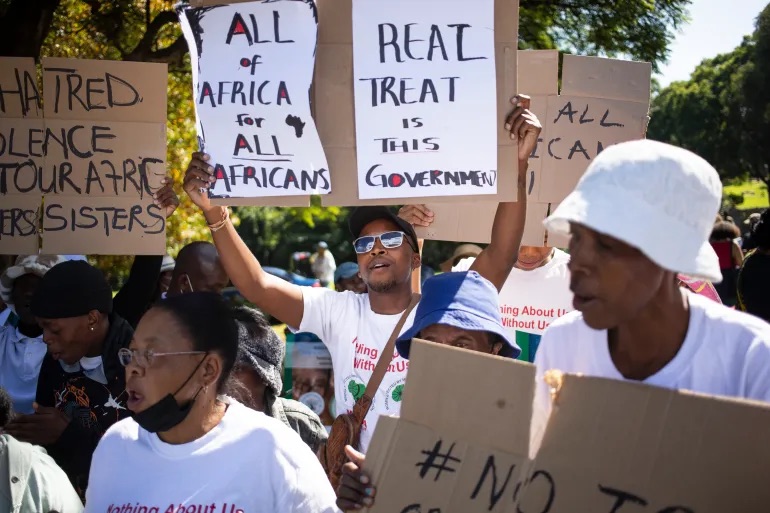
In South Africa’s Eastern Cape, tensions flared dramatically recently following the installation of an Igbo leader in the city formerly known as East London. The event, intended as a cultural affirmation by the Nigerian Igbo community, was perceived by some locals as a challenge to traditional authority. What followed was a march reportedly organised under the KuGombo banner, drawing participation from political groups and civil society organisations.
Initially framed as a protest against illegal immigration, it quickly degenerated into violence in areas, including Albany and Buffalo. Video footage showed Nigerians being harassed, assaulted and told to leave—an alarming descent into mob justice fuelled by fear and misinformation.
While some local voices argued that the inauguration violated indigenous customs, the Igbo community maintained that it was an internal cultural matter. What should have been resolved through dialogue, instead, escalated into a diplomatic sore point between Nigeria and South Africa.
Nigerian officials expressed concern for the safety of their citizens, while South African authorities called for calm and promised investigations. Diplomatic channels have since been activated, with Nigerian representatives urging restraint and mutual respect.
Meanwhile, in Mozambique, another controversy unfolded. Forty-two Nigerians were reportedly arrested and detained for alleged immigration violations, with 40 eventually deported. Mozambican authorities cited irregular documentation as justification. However, some of the affected individuals claimed they were robbed, alleging that large sums of money were withdrawn from their accounts via mobile apps during detention. The Nigerians in Diaspora Commission rejected claims that the deportees lacked proper documentation, instead, pointing to possible xenophobic targeting. Nigerian diplomats have called for a thorough investigation, while also engaging Mozambican officials to ensure such incidents do not recur.
These episodes are not isolated.They are condemnable. Xenophobic violence has periodically erupted in South Africa over the years, often with devastating consequences. In 2008, widespread attacks left over 60 people dead and thousands displaced. In 2015, renewed violence targeted migrants from across Africa.
Other News
In 2019, another wave of attacks saw foreign-owned businesses looted and burned, prompting the evacuation of about 500 Nigerians in three batches by Air Peace Airlines. Among the victims were not only Nigerians but also Mozambicans, Zimbabweans, and other African nationals—proof that the hostility is broadly directed at fellow Africans.
The justification often cited for these attacks—competition for jobs and economic resources—does not hold up under scrutiny. South Africa’s unemployment crisis is rooted in structural economic challenges, inequality, and governance issues, not the presence of immigrants. Blaming foreigners is a convenient but dangerous oversimplification that diverts attention from necessary reforms.
Equally troubling is the apparent selectivity of these attacks. There are persistent reports that migrants from Western countries or Asia are rarely targeted, raising uncomfortable questions about the underlying motivations. Why should Africans, who share historical struggles and cultural ties, bear the brunt of such hostility?
This unfortunate actions are particularly painful, especially as they concern Nigerians, given Nigeria’s role during the anti-apartheid struggle. Throughout the 1980s and early 1990s, Nigeria provided financial support, scholarships, and diplomatic backing to South Africans resisting apartheid. Many South African students found refuge and education in Nigerian universities. That legacy of solidarity should not be forgotten or repaid with hostility.
At the same time, it is important to acknowledge that migration must be governed by law. No country is obligated to accept undocumented migrants, and compliance with immigration regulations is essential. Across Africa, visa requirements vary. While some regional blocs promote free movement—such as ECOWAS in West Africa—others maintain stricter entry rules. Travellers are generally required to carry valid passports, visas where applicable, residence permits, and proof of legal status. Respect for these rules is necessary, but enforcement must be humane, lawful, and free from discrimination.
The broader vision for Africa, as championed by the African Union, is one of integration, cooperation, and free movement of people. Xenophobia runs counter to this vision. It fractures unity, discourages investment, and undermines the continent’s global standing.
Africans must reject the dangerous narrative that pits them against one another. The principle of being one another’s keeper is not just a moral ideal; it is a practical necessity in an increasingly interconnected world. Governments must act decisively to protect all residents within their borders, regardless of nationality. Civil society must promote dialogue and counter misinformation. And citizens must resist the urge to scapegoat the vulnerable. The path forward lies not in exclusion but in collaboration. Africa cannot rise if its people are busy tearing each other down.