Follow Us on Google
“I have said this many times, there seems to be enough room in the world for mediocre men, but not for mediocre women, and we really have to work very, very hard.” —Madeleine Albright, former US Secretary of State
By Enyeribe Ejiogu
In his lifetime, Dim Chukwuemeka Odumegwu-Ojukwu was a very brilliant, cerebral, excellently sharp-witted individual with a granite-strong personality.
His deep insights on issues never left you in doubt about his thoughtful analysis. He had a unique elocution and charm that mesmerized.
He rarely granted interviews. If as a journalist, you got the opportunity for a sit-down interview with him, of course you had to spend time to really prepare for the deep, intellectual interaction with him.
So, for a lady to be paired in marriage with the embodiment of the heart and soul of the Igbo struggle for survival in Nigeria between 1967-1970, the chosen lady, expectedly had to be a somewhat rare breed with intellectual endowments that would resonate with the veritable Ikemba Nnewi, Eze-Igbo Gburugburu, Dim Chukwuemeka Odumegwu-Ojukwu.
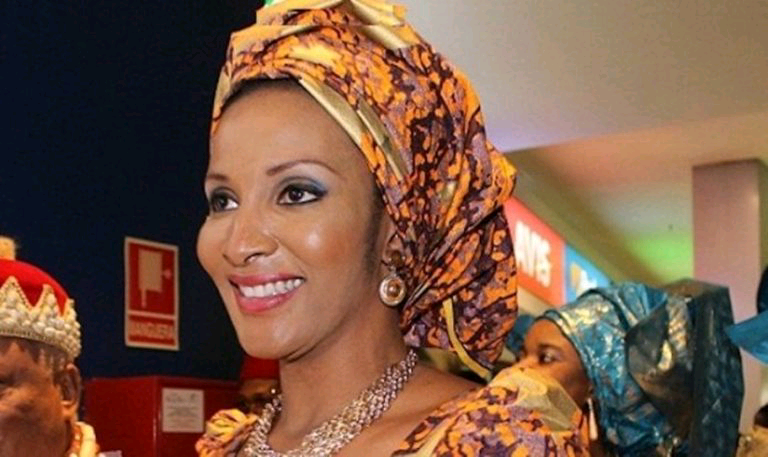
To put it mildly, Bianca Odinakachukwu Ojukwu came into the union appropriately packaged with brains, intellectual brawn and, of course, beauty. As the daughter of the redoubtable Chief C.C Onoh, a renowned lawyer and politician, who later became the Governor of the Old Anambra State (now split into the present Anambra and Enugu states with a part in Ebonyi State), she got the best education money could buy and eventually graduated from the University of Nigeria with a degree in Law.
While growing up in the rarefied world of the Onoh Family, she was quite unknown beyond the circle of her family and school friends. Then she burst on the national scene after winning the Most Beautiful Girl in Nigeria in 1988. Thereafter, she engaged in pageantry-related activities representing Nigeria and winning in various competitions until she got married to Ojukwu in a glitzy wedding in 1994.
Coming from a politically savvy family, a lawyer and married to Dim Ojukwu, it would have been strange for her not to feel the tugging of governance. In 2011, then President Goodluck Jonathan appointed her as Senior Special Assistant on Diaspora Affairs; the following year she became Nigeria’s Ambassador to Ghana and later Ambassador to the Kingdom Of Spain. Her performance in those positions eventually paved the way for her appointment by President Bola Ahmed Tinubu as Minister of State for Foreign Affairs on October 23, 2024. And on March 30, 2026, she was elevated to the position of Minister of Foreign Affairs.
Other News
Just as there are hundreds who commend her seemingly meteoric rise in governance, there are those who scoff at her rising profile, dismissing her appointments as being motivated by geopolitical balancing and tokenism. For a small clan of those who have such dim view of Bianca’s growing relevance in the political governance space, the globally respected Director General of the World Trade Organisation, Dr Ngozi Okonjo-Iweala has a word to shut them down.
Commenting on the competence and capacity of women, she said: “It’s about competence, not gender,” elaborating that her appointment as WTO DG was based on competence. “I think I have the skills to bring people and members together. The bottom line is capability to do the job and deliver.”
She could well have been speaking about Bianca Ojukwu, noting that “women are competent but underrepresented at the decision table.”
So, then what impact has Ojukwu made through the governance positions she has held or still holding today, critics may ask? Yes, has she been all fluff and beauty or what? Put that question to the National Coordinator, Take Back Nigeria Initiative (TBNI), Abumchukwu N. Okoye, who is a lawyer, and he will regale with the story of how the foundation of the most recent major achievement of Ambassador Ojukwu was laid, which he never ceases to talk about: the successful repatriation of Nigerians detained in Ethiopian prisons, who did not commit any crimes.
His law firm valiantly fought in a Federal High Court and secured a favourable judgement that paved the way for the Ministry of Foreign Affairs to sign an agreement between Nigeria and Ethiopia for the repatriation.
“Let me start by congratulating Ambassador Bianca Odumegwu-Ojukwu on her appointment as Nigeria’s first female Minister of Foreign Affairs. She merits it and that shows that President Bola Tinubu is thinking seriously about the success and progress of Nigeria. When she was Minister of State for Foreign Affairs, her achievements were numerous. She consistently helped to ensure that Nigerians in Ethiopian prisons were released because the matter was brought to her table.
“We were going to Abuja over the case and she worked tirelessly to ensure these Nigerians were returned despite the fact that a treaty on exchange of prisoners between Nigeria and Ethiopia had not been put in place. But now this has become a reality. The agreement between Nigeria and Ethiopia, signed by Foreign Minister Bianca Ojukwu, facilitated the repatriation of over 100 Nigerian prisoners. President Tinubu and the Attorney General of the Federation made it possible.
“The case started early February 2024, when my law firm was contacted by Nigerians in an Ethiopian prison called KALITI. The prisoners complained that the Ethiopia Government had requested the Nigerian Embassy at Addis Ababa to evacuate Nigerians in KALITI and other prisons in Ethiopia. They informed us that Ethiopia had made it clear it had no budget for their food, medicare and fulfilment of other minimum rights of prisoners and people in detention. Due to the horrible conditions there, some died. Those of them taken to hospital were not given drugs as they were asked to buy their drugs. Upon inquiry, we found that many of them committed no offence and were arrested in the street or at the airport and framed, extorted, tried in a strange language and imprisoned. Many of them died. So, when we deliberated on this matter, we came to the conclusion that these events, actions and inactions of the Ethiopian Government and Nigerian Government violated the African Charter on Human and Peoples Rights, BPT, CAT, ICCPR, principles of medical ethics, principles on detention or imprisonment and Robben Island guidelines, SMR, and UDHA- all these are international instruments that bind the whole world. Before then the Senate of the Federal Republic of Nigeria had deliberated on this matter and did nothing. We quickly mobilised and wrote letters to the Chairman, House of Representatives Committee on Diaspora Affairs, Chairman, Senate Committee on Diaspora Affairs and Non-Governmental Affairs, demanding that something be done to bring back our citizens from Ethiopia. We got no response. The Executive Secretary, National Human Rights Commission, listened to us and suggested the way forward which we sincerely appreciated. We also went to the Chairman/CEO, Nigerians in the Diaspora Commission. We got some support there, but they appeared to be handicapped. So they explained that it was a consular matter and directed us to the Ministry of Foreign Affairs and the matter was passed on to the then Hon. Minister of State, now the Minister of Foreign Affairs, Iyom Bianca Ojukwu. We got a reply, but when we felt that we needed to ensure the ministry has a legal basis to do its job, and having given sufficient notice and the 14 days ultimatum lapsed, we proceeded to court and got a favourable judgement.”
In addition to her law degree and postgraduate degree from Birmingham University, Ojukwu received a master’s degree in International Relations and Diplomacy from Alfonso X el Sabio University in Spain in 2016. She also holds a Diploma in Human Rights and International Relations from the Berg Institute as well as a Diploma in Dynamics of Conflict and Cooperation from the University for Peace, Costa Rica.