Follow Us on Google
By Chukwuma Umeorah
The phrase is old, older than many alive today, yet it still carries the weight of unfinished business. “Aku ruo ulo – wealth must return home.” The message has echoed through generations, whispered in market stalls, debated in town halls and repeated in every gathering of Igbo professionals across the country and beyond: the future of the Igbo nation depends on the willingness of its people to invest at home.
It is a message rooted not in sentiment but in history, survival and the sheer weight of evidence that prosperity, security and cultural continuity are strengthened only when a people build on their own soil. This idea, captured in the powerful philosophy of “Aku ruo ulo,” once defined the identity and economic strength of south-eastern Nigeria.
Today, it is being reawakened with urgency, not as nostalgia, but as a practical blueprint for survival.
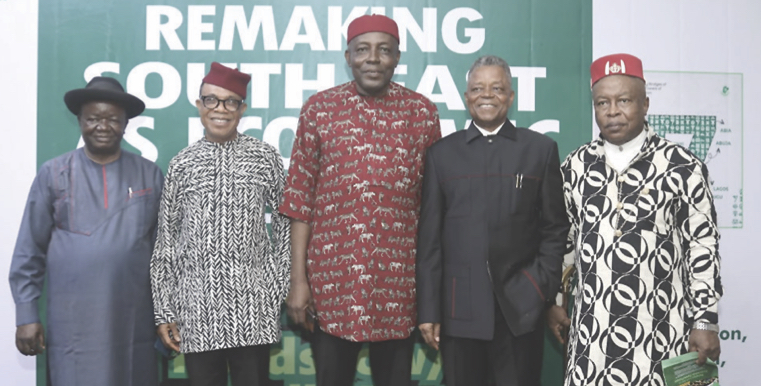
For many leaders, thinkers and investors who have gathered to speak on the future of the South-East, the starting point was a return to memory. The Executive Secretary of the Southeast Business and Investment Summit Group (SEBIS), Dr. Ifedi Okwenna, while speaking at the group’s pre-summit road show in Lagos, reminded the public of the economic identity the region once held. He recalled that there was a period when the East stood among the fastest-growing economies anywhere in the world.
“There was a time when we were the fastest-growing economy in the face of the earth, in the world, growing at 9.2 per cent per annum.” He explained that this growth did not emerge from early advantage; the region, in his words, “were latecomers,” with the first credit infrastructure arriving nearly a century after the earliest foundations in the West. Yet the Southeast overtook many other regions just before independence.
Okwenna’s reflections were not designed to glorify the past but to show how rapid progress was once normal for the region and can be again. According to him, the pride of the old Eastern Region was built by ambition, cooperation and an intense understanding of collective strength. “This was an economy built around innovation, education, agriculture and commerce, and it established a developmental foundation the world would later admire.
“But the civil war altered the course of that progress. Homes were abandoned, savings were wiped out, and the post-war economic policies that followed were devastating.”
Okwenna narrated how people returned home only to discover that everything they had worked for was gone. “The money they made, they were in the bank. They lost it,” he said.
The symbolic yet painful “twenty pounds” policy marked the beginning of a structural setback that would take decades to repair. Yet, even in the ruins, the Igbo spirit of reinvention took shape again. Young men migrated to Lagos and Port Harcourt with nothing but determination, rebuilt fortunes and rose to national prominence within nine years of the war’s end. According to Okwenna, “that is who we are. We are a determined people.”
It is this same determination that frames today’s call to reinvest. Those who addressed the room were not merely reminiscing, they were diagnosing a present-day crisis. The South-East, by 2015, was the second-largest economic zone in Nigeria. Today, it has slipped to fourth place, with the North-Central moving rapidly ahead of it. They noted that the decline, though reversible, signals a dangerous erosion of economic influence.
Okwenna warned that without strategic action, the region could lose even more ground. Yet, he was quick to emphasise that the path to revival is not dependent on relocation alone.
“Development is not only when you leave where you are living in Lagos and return to Anambra,” he said. “You may not return to Anambra. But you can develop Anambra. Projects and businesses.”
This thinking reflects the modern practicality of Aku ruo ulo. The objective is not to uproot lives but to invest deliberately in one’s homeland. He offered a simple truth: business today no longer requires physical presence. Technology has changed everything. “The world has advanced to the point that you don’t need to be here to serve here,” he said, pointing out that multinationals thrive without being physically located in every market they serve. What matters is ownership, capital flow and commitment to building the regional economy.
Okwenna mapped eight areas where investments can yield immediate impact: agriculture, agro-processing, agri-tech, MSMEs, innovation and technology, fintech, security technology and energy.
According to him, these are low-hanging fruits, sectors where the South-East holds natural comparative advantage. Agriculture remains a core strength; agri-tech offers scalable efficiency; MSMEs already fuel the region’s commercial heartbeat; fintech solutions are thriving because, as he noted, “our people don’t trust conventional banks.” Meanwhile, energy and security innovations are essential to creating a conducive business environment.
Yet none of these efforts can succeed unless the perception of insecurity is addressed. General Obi Umahi (retd), Chairman of the South-East Security Committee and President of Ndi-Igbo Lagos, who spoke firmly on security perspectives, challenged the false narratives that have shaped national conversations about the region. He began by reminding the audience that before 2015, the South-East was the safest geopolitical zone in Nigeria. According to him, the changes that followed, and which have brought what seemingly feels like a deplorable condition, were not organic but the result of external infiltration, internal reaction and escalating political tensions.
Other News
Umahi outlined how “extremist groups infiltrated the region through Benue and parts of the South-South, sparking initial clashes with farmers that were violently suppressed. By 2020, new groups emerged, claiming to defend the region, but their actions only worsened insecurity.”
He recalled the Monday lockdown declared in 2021 by the IPOB group, quoting the directive that shut down economic life weekly: “Every Monday from 6 a.m. to 6 p.m. until our leader, Mazi Nnamdi Kalu, is released by the Federal Government.”
This self-inflicted paralysis, he said, triggered widespread anarchy and invited retaliation from security forces who interpreted the attacks on troops as open provocation. “We alone incurred the wrath of the entire nation against us,” Umahi said.
But he insisted that the narrative is outdated. According to him, the security landscape has improved dramatically in the last two years. Communities have adopted self-defense strategies, using CCTV systems, drones and vigilant community watch groups. State governments have restructured security architecture, creating command-and-control systems capable of rapid response.
He described one model where “any little thing that happens anywhere will be picked up at the headquarters,” with drones deployed immediately to track movements until suspects are apprehended.
More importantly, Umahi argued that the region is not descending into chaos; it is advancing toward better coordination and efficiency. He highlighted the Federal Government’s plan to introduce forest guards, an interim measure before state police becomes fully constitutional, which will strengthen local authority over security. “While the situation has improved greatly, I am also telling you that it will get even better with time.”
Umahi also personalised his argument by sharing his own investment choices. He narrated how he sold his properties in Port Harcourt and reinvested in his state capital, including a shopping mall and an estate development. “I am not giving you empty encouragement,” he said. His call was clear: if prominent men from other regions always return home upon retirement, Igbo people must do the same. His plea to well-established Igbos across the nation was emphatic: “Relocate while you are still alive and be useful to our people.”
Another voice driving the reinvestment narrative was Goddy Uwazurike, President of the Credibility Group and chairman of the occasion. Drawing from historical resilience, he reminded the audience that Igbo survival has always depended on ingenuity rather than external support. “After the war, people did not wait for restitution; they created new paths. In Nnewi, for instance, traders built the largest motor parts market in West Africa because they could no longer rely on access to their old bases in Port Harcourt.” He recalled how Cyprian Ekwensi, once a director of news before the war, was shown in a BBC documentary hawking plastic items from his car after the conflict. When asked whether he felt embarrassed, Ekwensi replied: “No apologies, no regrets, I’m an Igbo man to the core.”
Uwazurike argued that the strength of Ndigbo lies in their capacity to act when necessary. He rejected the narrative that Igbo people lack unity. “Whoever tells Igbo they don’t love themselves, I will tell you the person is lying,” he said, pointing to the consistent culture of Sunday meetings and community networks across Nigerian cities. He emphasised that insecurity will fade because “it takes more than 30 years to produce one criminal,” meaning the cycle is not easily replenished once addressed. He stressed that while non-Igbos own the biggest investments in the region, most Igbo businessmen have over 70 per cent of their investments outside. The imbalance, he said, must be corrected.
Meanwhile, Mazi Sam Ohuabunwa, Chairman of the Council of Ohaneze Ndi-Igbo and a veteran industrialist who spoke earlier, emphasized that the significance of the moment goes beyond economics. He described it as a historic turning point, a moment where the conditions for change are finally aligning. He explained that the progress of the eastern region requires a shift from lamentation to action.
“This is not the time for long speeches alone. The ideas have been rehearsed repeatedly at conferences and summits; what is needed now is execution.”
Ohuabunwa drew from his personal journey to illustrate what is possible when investment returns home. He has established a modern manufacturing plant in Abia, advanced food-processing ventures and taken positions in fintech projects arising from the region. He noted that the Enyimba Economic City offers one of the largest potential infrastructure and real-estate investments in Nigeria. He encouraged other professionals, including lawyers, engineers, doctors and pharmacists, to establish branch offices at home, even if they remain based elsewhere. “Every Igbo man should have an investment,” he urged.
He believes that the South-East is transitioning from a talking stage to an accountability stage. The Summit’s new framework requires that the progress of investments be measured each year so that real outcomes, not speeches, define success.
“I want to make sure that you are not just coming there as big drama. The time to act is now,” he said. His push was not only for the wealthy but for anyone capable of planting even the smallest seed in the region. In his words, “Start from where you are.”
These speakers stressed that without economic revitalisation, the South-East risks permanent decline. But with coordinated investment, it can reclaim its position as a regional powerhouse. They collectively described the region’s economic heritage—Trans-Amadi, Aba industrial clusters, Nnewi’s engineering base—and emphasised that these legacies can be revived through strategic capital injection.
The ideas shared by these leaders converge on one truth: the South-East has the capacity to become prosperous again, but only if its people take deliberate steps to build at home. The region’s slide in national rankings, the loss of manufacturing competitiveness, the challenges of insecurity and the exodus of young talent are all symptoms of a deeper problem—underinvestment by its own people. Yet the talent, resources and entrepreneurial energy needed for revival already exist within the Igbo nation.
They insist that Aku ruo ulo is more than a slogan; it is an economic strategy rooted in identity. It recognises that wealth scattered across distant cities offers limited long-term security. It acknowledges that no community rises by relying on outsiders to build its institutions. It understands that cultural survival requires economic strength. And it demands that every Igbo person contribute meaningfully to the rebuilding of the homeland.
“In the story of the Igbo nation, prosperity has never come from waiting for the perfect time. It has come from bold, collective action. Today, the call to divest and reinvest at home is not simply about economics. It is about reclaiming dignity, rewriting narratives, strengthening identity and securing a future for generations yet unborn. If the people respond as their forebears once did, by building, creating, cooperating and believing, then the South-East can rise again, not as a memory of what was, but as a living testimony of what is still possible,” they said.