Follow Us on Google
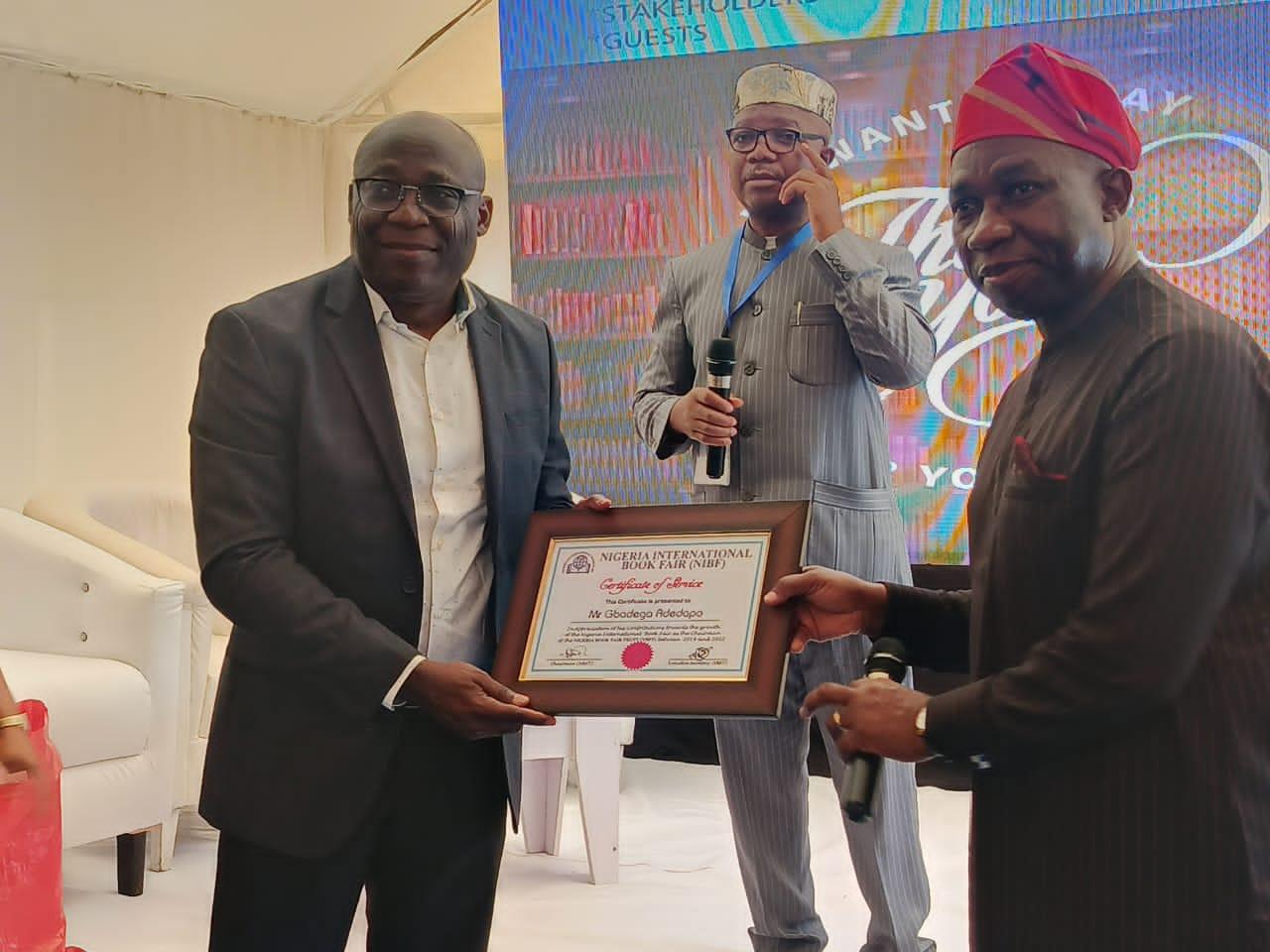

•MD/CEO of Accessible Publishers Ltd, Mr. Gbadega Adedapo (left) being honoured with a plaque for service excellence by the DG of Nigerian Copyright Commission (NCC), Dr. John Asein (right) while the Chairman of Nigeria Book Fair Trust, organiser of Nigeria Int’l Book Fair (NIBF), Mr. Dare Oluwatuyi (middle) looks on at the 2024 edition of the book fair in Lagos recently
In a bustling conference hall at the 23rd Nigeria International Book Fair in Ikeja, Lagos State, Professor Olufemi Victor Adeoluwa, the Vice-Chancellor of Bamidele Olumilua University of Education, Science and Technology, Ikere-Ekiti, took to the podium to deliver a keynote address that resonated with educators, policymakers, and literary enthusiasts alike. His message was clear: the foundational role of books and a thriving book ecosystem in advancing universal basic education (UBE) across Nigeria.
Prof. Adeoluwa’s speech focused on the urgent need for every educational institution in Nigeria to have a fully functional library, complete with adequate resources and staffed by trained librarians. He emphasized that such facilities are not mere luxuries but essential components in nurturing a culture of reading and intellectual exploration among students.
“At the heart of quality education lies access to books,” declared Prof. Adeoluwa. “A school without a library is like a ship without a compass, lacking the direction needed to navigate the seas of knowledge.”
His words struck a chord in the audience, many of whom nodded in agreement. Across Nigeria, disparities in educational resources persist, with some schools lacking even the most basic amenities for learning. Prof. Adeoluwa’s call for equitable access to libraries echoed a sentiment shared by educators nationwide.
The Vice-Chancellor also stressed the importance of updating book reviews and ensuring a steady supply of quality textbooks to complement the basic education curriculum. He pointed out that collaborations between publishers and the government could play a pivotal role in achieving this goal, making essential educational materials more accessible to students.
In addition to his recommendations for improving physical access to books, Prof. Adeoluwa urged The Nigerian Book Fair Trust to ramp up efforts in promoting a robust reading culture. Local book fairs, festivals, and reading competitions, he suggested, could ignite a passion for reading among Nigerians of all ages.
“Books are not just tools for education; they are gateways to new worlds, catalysts for innovation, and vehicles for social change,” Prof. Adeoluwa proclaimed. “We must invest in our book ecosystem to empower future generations and drive national development.”
As the applause subsided, the Vice-Chancellor delved into the broader significance of education in societal development. Drawing parallels with global best practices, he highlighted the transformative impact of education on economic growth, political stability, and environmental sustainability.
“An enlightened citizenry is the bedrock of any thriving nation,” Prof. Adeoluwa asserted. “Education empowers individuals to contribute meaningfully to their communities and participate effectively in shaping the future of our nation.”
Reflecting on Nigeria’s journey with UBE, Prof. Adeoluwa acknowledged the strides made since the programme’s inception in 1999, under President Olusegun Obasanjo’s administration. Although the programme officially launched in 1999, it was not fully operational until 2004, aiming to provide quality education to children aged six to fifteen.
“The UBE programme has significantly increased school enrollment at primary and junior secondary levels, particularly among children who previously lacked access to education,” noted Prof. Adeoluwa. “However, challenges remain, particularly regarding the availability of essential educational resources.”
Indeed, one of the core challenges highlighted by the Vice-Chancellor was the discrepancy in book accessibility, especially in public schools. Many students, particularly from low-income backgrounds, struggle to obtain the necessary textbooks due to financial constraints.
“The literacy rate in Nigeria stands at 54.77%,” Prof. Adeoluwa lamented, citing a statistic that underscored the urgency of addressing educational disparities. “We cannot achieve the goals of UBE without ensuring that every child has access to quality educational materials.”
To bridge this gap, Prof. Adeoluwa advocated for strategic partnerships between government agencies, publishers, and booksellers to ensure the consistent supply of books to schools across Nigeria. He emphasized that investing in education is not merely a moral imperative but an economic necessity, with far-reaching implications for national development.
Transitioning from policy recommendations to a celebration of Nigeria’s rich literary heritage, Prof. Adeoluwa lauded the contributions of writers and scholars who have shaped the nation’s intellectual landscape. Names like Wole Soyinka, Chinua Achebe, and Chimamanda Adichie evoked a sense of pride among attendees, showcasing Nigeria’s vibrant literary tradition.
“Our writers and scholars play a pivotal role in shaping our national narrative,” remarked Prof. Adeoluwa. “Their works inspire critical thinking, challenge societal norms, and broaden our perspectives on culture and identity.”
The Vice-Chancellor’s address underscored the interconnectedness of the book ecosystem, comprising publishers, writers, libraries, booksellers, and literary organizations. Each component, he explained, plays a unique role in fostering intellectual discourse and nurturing a vibrant reading culture in Nigeria.
“The book ecosystem is a dynamic network that sustains our educational infrastructure,” Prof. Adeoluwa explained. “From publishers who produce essential textbooks to libraries that serve as repositories of knowledge, every stakeholder contributes to the educational journey of our nation.”
Throughout his speech, Prof. Adeoluwa emphasized the need for collective action in advancing education in Nigeria. He called upon stakeholders from all sectors – government, academia, industry, and civil society – to collaborate in building a more inclusive.
Michael Oluwadare Oluwatuyi, Chairman, Nigerian Book Fair Trust in his welcome address said “ I am delighted to meet and welcome our esteemed exhibitors from different countries of the world to the 23rd Nigeria International Book Fair. It is not a fallacy that your participation contributed in great deal to the excellent book event that the world is witnessing in Nigeria today.
I also use this medium to welcome all our guests, speakers, panelists, participants and local visitors across the length and breadth of Nigeria to this annual event. Gentlemen of the Press in our midst, I welcome you all.
This year, our general theme revolves around Universal Basic Education. We believe that education plays an important role in the development of minds and nations, and there is no better time to talk again about it than now that education in Nigeria has little to write about. We are aware of the frantic efforts the Lagos State Government and the Federal Government of Nigeria are making to address the problems in our educational systems. We hope that the various government policies along this line will germinate good fruits in earnest.
Today, we have gathered experts from all walks of life to critically look at our basic education challenges and come up with ways that would reshape the system for the benefit of the citizens and the nation at large. Please do not miss the International Conference for anything.
We equally want you not to miss the second edition of the Tertiary Education Summit. The Summit this year is put together to consider the causes of the brain drain crisis that is bedeviling Nigeria presently and how it can be nipped in the bud. You cannot afford to miss the Summit because scholars from different tiers of tertiary education in Nigeria have prepared to take us through the genesis, effects, and remedy for the crisis.
I cannot but appreciate the support and contributions of individuals, corporate organisations and government agencies towards the success of the Nigeria International Book Fair 2024.
The second edition of the Tertiary Education Summit we are witnessing this year enjoyed the full support of the Committee of Vice Chancellors of Nigerian Universities (CVCNU). I thank the Committee’s Chairperson, Prof. Lilian I. Salami, the Secretary-General, Prof. Yakubu Ochefu, the Council, and every other member of CVCNU for giving us their full support to put the Summit together. I look forward to more support from the Committee as we encourage other government agencies to join hands with the Nigerian Book Fair Trust (NBFT) to bring back the culture of reading in Nigeria.
I am delighted to see our foreign exhibitors and trade visitors at this year’s book fair. Our exhibitors from the far East, especially from India; your consistent presence at the NIBF is highly appreciated. I also welcome representatives of publishers from the United Kingdom back to the Nigeria International Book Fair. We love you all and we will always be on top of the world anytime we have you participating in our events.
Since year 2021, we have been consistently making NIBF hybrid and this year will not be an exception. Programmes and activities of NIBF 2024 will be live on YouTube and other social media platforms. This allows those in Nigeria and overseas to get involved in the book fair’s activities virtually. We appeal to our local and foreign exhibitors to encourage their people back home to join the Nigeria International Book Fair 2024 virtually.
As NIBF 2024 is full of activities, I enjoin all our exhibitors to have a good time and make good use of the business opportunities the book fair will offer.
Oluwatuyi hinted that the 2025 edition of the Nigeria International Book Fair will take place from Wednesday 8th to Friday 10th of May, 2025. At the next edition, we will introduce the state of focus in our activities.
We intend to involve states to participate actively at NIBF. By extension, we will expand our reading culture plans to the states by holding major regional book fairs at selected states within each of the six geo-political zones of our country.