Follow Us on Google
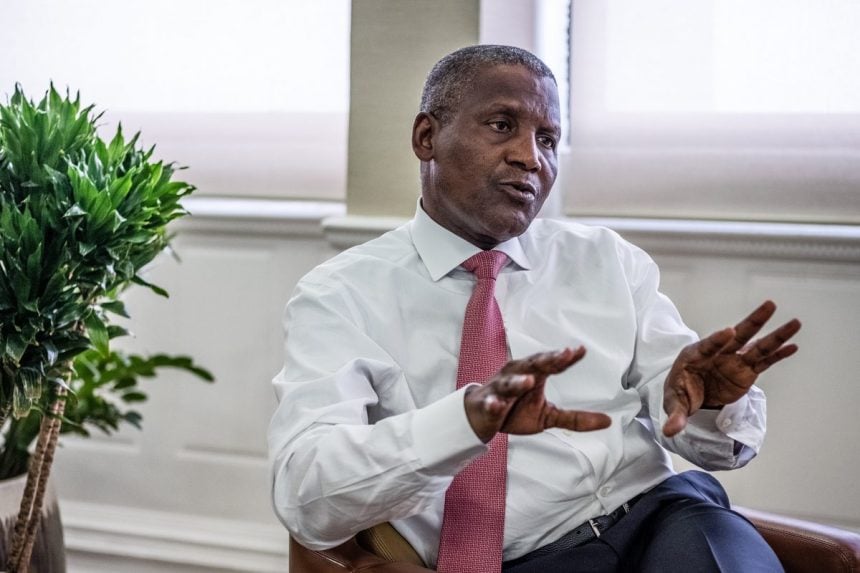
Nigeria’s quest to industrialise and enhance the ease of doing business may drag for more years as a result of high costs of borrowing, inadequate electricity supply and inconsistent government’s policies. Africa’s richest businessman, Aliko Dangote, who stated this recently, also maintained that investors would not commit capital to new projects if there is no assurance that the business environment will be receptive.
Dangote’s position tallies with that of the Organised Private Sector (OPS), which has repeatedly warned that Nigeria’s industrialisation would be hard to realise in the face of high interest rate and power supply crisis. The business mogul has also argued that Nigeria’s current commercial lending rate of about 30 per cent is unsuitable for industrialisation, a situation that makes it difficult for manufacturers to build factories and remain competitive. He stated that investors would most unlikely commit to any meaningful project in Nigeria without assurance that the business environment will be receptive and power supply and interest rates are stable and favourable to business.
According to available statistics, an acceptable lending rate for meaningful industrialisation in the country is a single digit of between 10 per cent and 12 per cent, while the commercial banks’ current interest rate of between 30 per cent and 37 per cent will make long-term manufacturing visibility and profitability hard to achieve. Nigeria requires baseline uninterrupted power supply of between 25,000 MW and 30,000MW to stabilise multi-sector generation demand and a daily 13,000MW. Sadly, daily power generation is less than 4,500MW, far below generation capacity required for industrialisation.
The constraints of gas supplies have made manufacturers to rely heavily on expensive fuel and diesel and solar capital power, in addition to inflationary headwinds, all of which have raised the cost of products and suffocating business competitiveness. The immediate consequence is that the cost of financing business in the country doubles the amount required to establish industries, especially where the project would take years to complete. This is so despite Nigeria having entrepreneurs who are capable of driving industrialisation.
Government assurances alone would not be sufficient to attract investments unless they are backed by concrete policies that will remain stable over some time. Dangote’s assessment of the cost of doing business in Nigeria and the power deficit across the country is realistic. It is a pointer to other factors that hinder Nigeria’s economic growth. For instance, in the second quarter 2026(Q2 2026) The Manufacturers Association of Nigeria (MAN) has also raised the alarm over the plunge in industrial growth and other severe structural headwinds. Industrial growth dropped to 3.96 per cent during the Q2 2026 from 7.46 per cent in 2025. The manufacturing sector growth was 3.24 per cent against 3.29 per cent in Q12026. No doubt, the high energy cost has adversely affected business operations. Also, expensive tight commercial credit for Small and Medium Enterprises (SMEs) is suffocating under high borrowing costs. This is creating a widening disconnect between service-led GDP and real production, and between macroeconomic figures and real sector vitality. Besides, import dependency has put structural pressure on the naira, making business planning unpredictable.
Besides, GDP report by the National Bureau of Statistics (NBS) in Q2 2026 revealed that the overall year-on-year growth trajectory remains disproportionately service-driven at 56.62 per cent, while the broader industrial sector could only muster 17.23 per cent GDP. Again, while the overall year-on-year real growth in the Q2 2026 rate of 4.43 per cent may suggest economic resilience, the performance of the economy in the second quarter under review, does not represent the realities in the country and the living conditions of the people.
All of this can be gleaned from the reaction of foreign investors in the country. For instance, foreign investment inflow recorded a net equity outflow of N266.7 billion between January 2023 and July, 2026 in the Nigeria equities market. This means that foreign investors took more money out of the market than they brought in during the period, according to data compiled by the Nigerian Exchange Limited (NGX). This also shows that foreign portfolio investment remains in net outflow territory throughout the period.
Foreign investors brought in only N81.47billion against an outflow of N100.15billion, resulting in a net outflow of N22.68billion. It tripled in 2024. Put together, the federal government should heed the advice by Dangote and the OPS on the urgent need to tackle the challenges that undermine effective business operations in the country. The fact remains that sustainable national prosperity must be anchored on active domestic manufacturing and not just on service consumption as most government policies seem to favour instead of production, which should drive the economy for growth.