Follow Us on Google
From Okey Sampson, Umuahia
In Igboland cultural festivals are celebrated by communities to rekindle the ancestral heritage of the people. Most of the festivals are celebrated annually.
However, the Okobi cultural festival of Olokoro, Umuahia South Local Government Area of Abia State does not follow the annual sequence, it is rather celebrated once every 40 years, making it a very unique cultural festival in Igboland.
The Okobi festival is symbolised by masquerade that comes out to public view once in every 40 years. The last Okobi cultural festival, the villagers said, was held in 1984.
Actually, the festival could have been held in 2025, but the death of a prominent son of the area, Prince Vincent Ogbulafor, necessitated the postponement of the festival to this year, out of respect for the fallen prince.
The two-day ceremony began on Wednesday, February 18, when Okobi emerged from its ancestral home, Ama Umuolile, in Itaja, and was heralded by traditional cannon fire, before proceeding, on Thursday, to Ahiaukwu, the community’s central square.
The festival began with the ceremonial cannon shots that announced the emergence of Okobi from Ama Umuolile in Itaja, Olokoro. The emergence marked the symbolic return of one of the most revered cultural festivals of the Umutowe people, a festival last performed four decades ago and long awaited by a generation that had only heard of it through oral history.
In line with tradition, days earlier, the Enyi Itaja Okonko Society, in collaboration with the Kwa Okobi Itaja February 2026 Committee, issued a formal restriction notice, limiting movement and noise around Okata Enyi between February 14 and 21, to safeguard the sacred process. The restriction notice was endorsed by the community leaders and copied to neighbouring villages, as not to allow anybody fall short of the order.
On Thursday, at about 4pm, Okobi journeyed to Ahiaukwu, the central gathering place in Olokoro, drawing a vast crowd who sang and danced around in ecstasy.
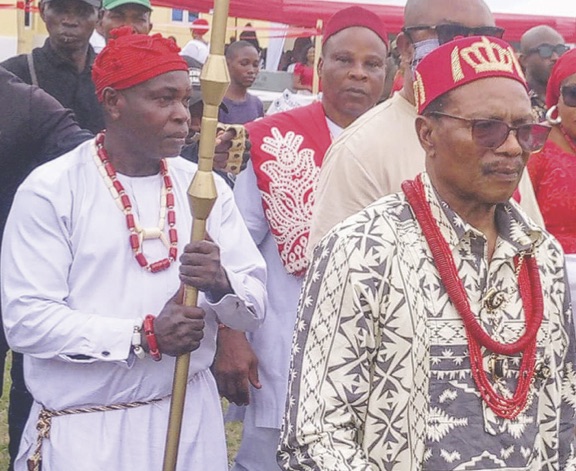
Speaking on the significance of the festival, the traditional ruler of Umutowe Autonomous Community, Eze Godfrey Onwuka, said the festival was inherited from his ancestors.
The traditional ruler disclosed that the Eboh ritual performed in February 2025 was a precursor to the 2026 festival, without which the festival will not hold.
Eze Onwuka, who is the immediate past deputy chairman of the Abia State Traditional Rulers Council, said it was the first time he would witness Okobi festival as a monarch.
“This was the first time I witnessed the Okobi festival as a monarch. The Eboh ritual performed in February 2025, served as formal notice of the 2026 Okobi festival”, the monarch enthused.
The traditional ruler announced plans by the community to reduce the interval between when the festival is held from 40 years to about 10 years, to prevent the extinction of the Okobi cultural festival and allow younger people to grow with time into its custodianship.
Eze Onwuka stressed that the community intentionally put measures in place to ensure youths actively participate in Okobi festival, one of which was to reduce the entry cost into Okonko society, and urging the participants to maintain the peace.
Community leaders, including Okonko chairman, Obisike Atuma, and the President General, Prince Okezie Uzuegbu, described the event as a major cultural milestone and said it was postponed from 2025 out of respect for a deceased clan prince. They emphasised that the festival was cultural rather than religious and aimed at education and continuity.
Others who spoke, including the Eze-elect, Sunday Ubani; Chukwuemeka Julius Onyeziri; Chukwuemeka Christopher Odumuko; Clement Ifeanacho Nwajiobi, and Prince Okezie, all alluded to what their traditional ruler said of the need to shorten the interval Okobi would be celebrated.
They observed that the last Okobi cultural festival was held in 1984, stressing that many youths, even some elders, are unfamiliar with it. To them, the holding of Okobi festival after the mandatory 40 years window stands as a powerful statement on cultural survival in a rapidly changing world, highlighting both the fragility and resilience of indigenous traditions and the responsibility of communities to pass them on with care and conscience.
The festival featured traditional processions, masquerades, and communal feasting, with leaders calling on the government to support cultural preservation and integrate indigenous history into education.