Follow Us on Google
Sanusi declares financial inclusion meaningless if Nigerians remain poor
__________________________________________________________
Fifty-three per cent of adults in Nigeria’s poorest wealth group remain financially excluded, despite a decline in national exclusion to 21 per cent, the 2026 Access to Financial Services in Nigeria (A2F) survey has found.
The report, released by Enhancing Financial Inclusion and Advancement (EFInA), found that almost half of all financially excluded Nigerians are in the poorest 20 per cent of the population, compared with just one per cent among the richest.
The finding highlights a widening poverty gap in financial access and raises questions about whether increased use of bank accounts, mobile money and digital payments is translating into better livelihoods.
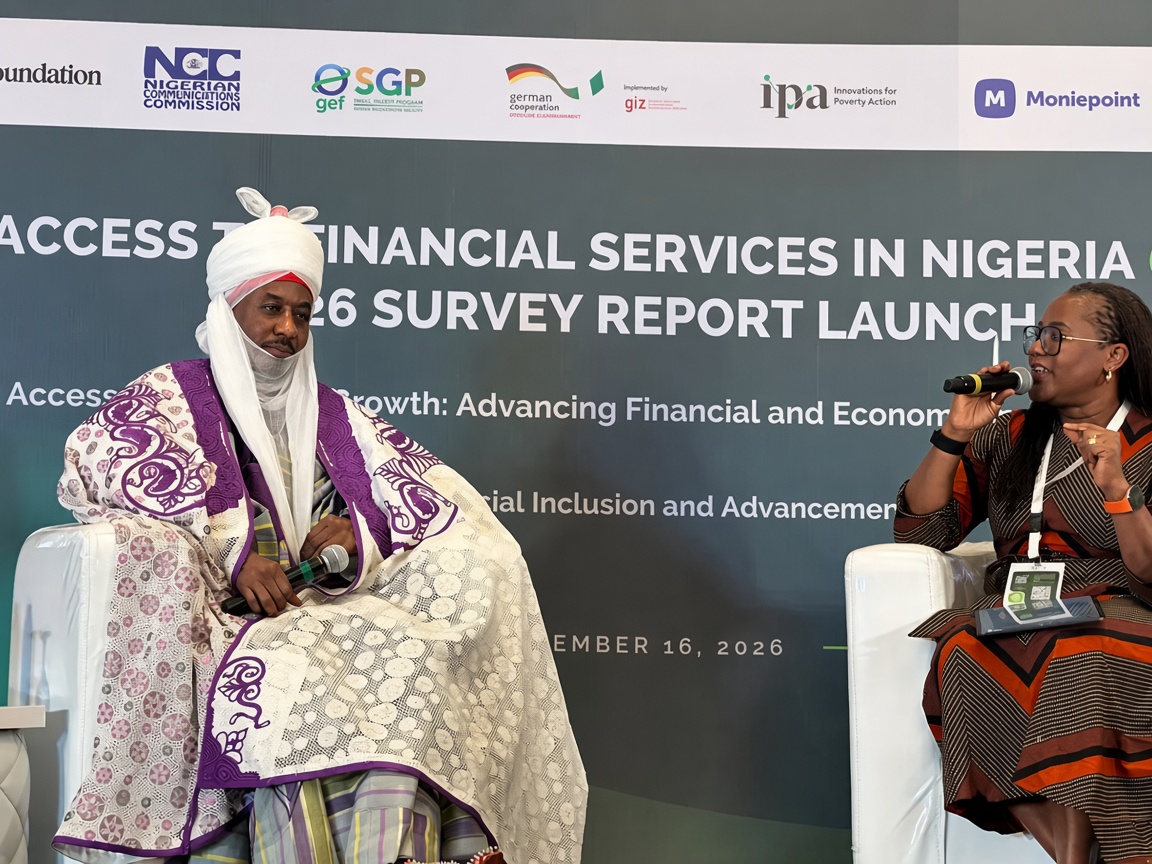
Speaking at the report’s launch in Abuja, the Emir of Kano and former Central Bank of Nigeria (CBN) governor, Alhaji Muhammadu Sanusi II, warned that financial inclusion would have little impact if it did not help Nigerians earn more and escape poverty.
“Opening an account, moving money, is not the same as earning money. It’s not the same as operating out of poverty,” Sanusi said.
He said Nigeria must stop measuring financial inclusion mainly by account ownership and transaction volumes.
“The financial system basically sits on top of that. You want to build an economy, you need to have the right structural policies, the right fiscal policies, create an environment that attracts investment,” he said.
Sanusi said fintechs and payment service providers were helping to connect financial flows with farmers, markets and manufacturers.
“This is actually connecting real goods and services to money flow,” he said.
Opening the event, EFInA Board Chair, Dr Agnes Martins, said the survey was intended to examine not only who had access to financial services, but what that access enabled Nigerians to achieve.
She said EFInA’s strategy had broadened from access alone to the “usage, quality and impact of financial services” and their contribution to wider economic inclusion.
“Access is only the beginning of the journey. It is not the destination,” Martins said.
She said EFInA was established to help build a financial system that works for all Nigerians, particularly those historically excluded or underserved, by generating evidence, identifying barriers, supporting innovation and strengthening the conditions for inclusive financial markets.
Martins said the survey was timely because Nigeria’s financial landscape had changed significantly since the previous round, with digital channels expanding, new providers and business models emerging, and Nigerians changing how they interact with financial services.
She urged stakeholders to consider what financial inclusion should enable Nigerians to achieve, including whether it expands opportunities, helps households and businesses manage their finances and supports greater economic participation.
Martins also warned against designing policies and products around an assumed “average Nigerian consumer.”
“Nigeria is a large and diverse country. People’s financial needs and experiences differ by income, by gender, by geography, by age and economic activity,” she said.
“In summary, there is no single Nigerian financial consumer profile,” she added, warning that interventions based on such an average could fail to address the needs of those most excluded.
The survey found that digital financial usage rose from about 47 per cent to 64 per cent, while mobile money use more than tripled from 12 per cent in 2023 to 38 per cent in 2026.
Formal savings increased from 38 per cent to 53 per cent. But formal credit remained at 10 per cent, insurance at five per cent and pension participation at about nine per cent.
The figures suggest that more Nigerians can move and save money, but fewer have access to financial products that can help them finance businesses, protect income or manage shocks.
The report found that 61 per cent of adults remained in severe liquidity distress. Among adults who experienced shocks, 71.6 per cent relied on fragile or erosive coping mechanisms, compared with 13.8 per cent who used protective or adaptive measures.
Other News
Farmers were particularly vulnerable. The survey found that 51.2 per cent experienced a shock, while 52.2 per cent of shock-exposed farmers relied on erosive coping mechanisms and 76 per cent experienced residual distress.
Sanusi called for savings, pension and insurance products to be built around transaction data generated by digital financial service providers.
“If I were at the Central Bank today, I would call in MoneyPoint and OPay and say, guys, you have all this data, you’re transferring money. Tell me, how can you build pension products on top of this? How can you build savings products on top of this?” he said.
He proposed deducting small amounts from transactions to build savings, insurance and pension pools.
“You can have a small system where out of every transfer you take a small amount and it’s forced savings, it is insurance, it is pension,” he said.
Sanusi also warned against policies that offer short-term relief while weakening domestic production.
He cited the reopening of the market to imported food after rising prices, asking: “On the consumer side, yes, food prices have come down. But have we counted how many farmers were bankrupted? How many rice millers were bankrupted?”
“Overnight, we opened the market, went back to where we were in 2011, importing rice from Thailand, importing rice from India, basically wiping out domestic production,” he added.
He also raised concerns about the reported opening of Nigeria’s beef market to United States imports.
“We need to really, really remember that everything has to be integrated. We need to get the macro right,” he said.
On inflation, Sanusi said the CBN must remain focused on price stability, describing inflation as the greatest threat to household wealth.
“There is no enemy to wealth that is bigger than inflation,” he said.
He advocated targeted cash transfers for vulnerable households, saying increased purchasing power could stimulate demand for locally produced goods and services.
Sanusi also admitted that he would have handled some aspects of financial inclusion differently during his tenure as CBN governor, particularly the entry of telecommunications companies into financial services.
“I’m responsible for delaying the entry of telcos into this space,” he said, explaining that concerns over customer funds after the banking crisis had influenced his decision.
“I do think if I had allowed that to happen, we would have made much more progress,” he added.
He also warned that overlapping regulatory mandates could weaken consumer protection and public confidence.
“If you begin to have multiple regulators involved, you’re creating a situation where the customer will not be protected,” Sanusi said.
He called for clear regulatory boundaries and a single, identifiable channel for resolving complaints involving banks, telecommunications companies, pensions and other financial services.
“Consumer protection is so critical to financial inclusion that once you begin to fragment and there isn’t one point of call, there is an issue,” he said.
The A2F 2026 findings suggest that Nigeria’s next financial inclusion challenge is no longer simply bringing people into the system, but ensuring that access helps poor households build livelihoods, withstand shocks and escape poverty.