Follow Us on Google
From Isaac Job, Uyo
Akwa Ibom state Attorney General and Commissioner for Justice Uko Udom has explained that 76 oil wells belonging to the state have not been ceded to neighbouring Cross River state contrary to speculations that the Federal Government Inter-Agency committee has returned the oil wells to Cross River state in their report to Revenue Mobilization Allocation and Fiscal Commission recently.
Udom faulted media the reports and insisted that the 76 oil wells legally owned by the state were out of two Supreme Court judgements in favour of Akwa Ibom and wondered why the wells could be possibly returned to Cross River saying that none of the oil wells has been ceded to another state.
According to the report, the Revenue Mobilisation and Fiscal Commission had projected Cross River State to be re-enlisted as oil producing after receiving the final report of the Federal Government’s Inter-Agency Committee on oil producing states.
The committee mandate was to determine scientifically, the precise location of oil and gas assets within Nigeria’s onshore and offshore boundaries.
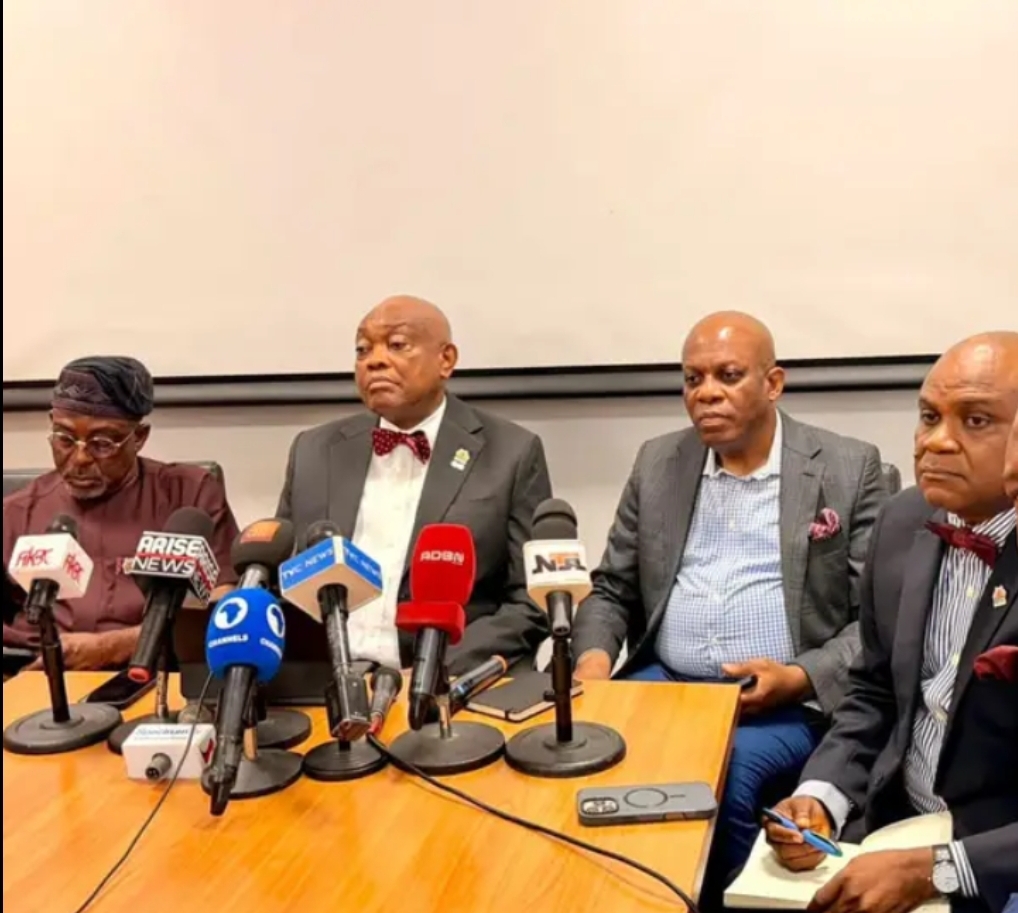
Speaking during a press conference at Government House in Uyo , the commissioner for Justice Uko Udom (SAN) said the state has reviewed the process and restated the facts to prevent misinformation and deliberate distortion of constitutional realities on the issue .
Udom who was accompanied to the briefing by other commissioners including legal luminary, Paul Usoro SAN, clarified that the Commission has publicly restated that what it received on 13th February 2026 is a draft report not a decision, not an approved recommendation, and certainly not a reallocation of oil wells.
According to him, RAAMFC has described the circulating claims as speculative and not reflective of any final position.
”Akwa Ibom State Government has carefully reviewed recent media reports suggesting that oil wells attributed to Akwa Ibom State may be “returned” to Cross River State following the submission of a “report” by a Federal Government Inter-Agency Committee to the Revenue Mobilisation Allocation and Fiscal Commission
”We consider it necessary to restate the facts clearly and authoritatively, in order to prevent misinformation and deliberate distortion of constitutional realities.
Other News
”Firstly, the Revenue Mobilisation Allocation and Fiscal Commission has publicly clarified that what it received on 13th February 2026 is a draft report — not a decision, not an approved recommendation, and certainly not a reallocation of oil wells. The Commission has described the circulating claims as speculative and not reflective of any final position”
Udom emphasized that the Supreme Court has dismissed Cross River’s claim over the estuarine southern territory, where all the oil wells are situated.
”The Court made it clear that the October 10, 2002 judgment of the International Court of Justice on the land and maritime boundary between Nigeria and Cameroon had fundamentally altered Cross River State’s coastal status. The Court held that the ICJ decision effectively eliminated Cross River’s estuarine sector, with the legal implication that Cross River no longer possessed a seaward boundary.
”Subsequently, despite Akwa Ibom State’s efforts to promote peaceful engagement and preserve kinship and harmony, further litigation was initiated by Cross River State seeking clarification on offshore entitlements.
”On 10th July 2012, the Supreme Court again ruled decisively in favour of Akwa Ibom State, holding that : Cross River State was no longer a littoral state entitled to offshore derivation;Its case was founded on a legally unsustainable assumption; and Akwa Ibom State’s entitlement to the oil wells was fully recognized.”
He said no inter-agency committee, no technical panel, and no institutional process can alter, amend, reinterpret, or sit in appeal over a judgment of the Supreme Court,adding that any action inconsistent with a subsisting judgment of the apex court would be unconstitutional, null, and void.
” If Cross River is interested in the judgement, they have to return to International Court of Justice (ICJ) where the case originated and not even the Supreme Court ”