Follow Us on Google
From Idu Jude, Abuja
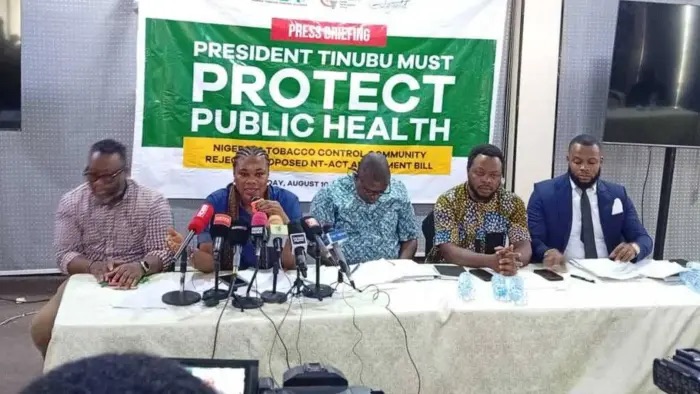
A coalition of more than 300 civil society organisations has raised the alarm over the alleged circulation of a different version of the National Tobacco Control Act (Amendment) Bill 2025, urging President Bola Tinubu not to assent to the legislation.
The Nigeria Tobacco Control Community (NTCC) alleged that the document currently being circulated is substantially different from the version presented to Nigerians during the public hearing, describing the development as a threat to public health.
The coalition also accused the National Assembly of compromising the legislative process and called for the immediate recall of the consolidated bill for a fresh, transparent and public health-led review.
The groups made the demand on Monday in Abuja at a press conference themed, “Why Nigeria must reject harmful amendments to the National Tobacco Control Act.”
Executive Director of Corporate Accountability and Public Participation Africa (CAPPA), Oluwafemi Akinbode, said Nigeria needed a strong and product-neutral regulatory framework covering all tobacco and nicotine products.
Akinbode said a review of the proposed legislation showed that the bill could weaken existing safeguards and create loopholes that would benefit tobacco and nicotine companies at the expense of public health.
He called for its immediate recall and comprehensive review.
“We agree that our primary law, the National Tobacco Control Act of 2015, alongside its 2019 Regulations, requires updating to address evolving markets,” Akinbode said.
“However, modernising our legal framework must not mean rolling out a red carpet for new and emerging nicotine and tobacco products.
“We cannot protect public health by carving out weak rules and loopholes for vapes, heated tobacco products, and nicotine pouches.”
He acknowledged that the amendment bill contained some positive provisions, including Clause 5, which extends smoke-free zones to within 30 metres of schools and health facilities, and Clause 3, which adds the Nigeria Police Force and the Ministry responsible for youth development to the National Tobacco Control Committee.
However, he said those provisions could not justify what he described as more damaging changes contained in other sections of the bill.
Akinbode particularly cited Clause 16, which amends Section 45 of the principal Act by defining heated tobacco products as non-combustible products and excluding non-combustible items from the legal definition of a tobacco product.
He also raised concerns over Clause 7, which amends Section 12 by introducing a new Subsection (6), noting that Section 12(1) of the 2015 Act currently prohibits tobacco advertising, promotion and sponsorship.
In-Country Coordinator of the Campaign for Tobacco-Free Kids, Michael Olaniyan, said public health was under threat and urged the Federal Ministry of Health and Social Welfare to take a stronger position on the proposed legislation.
Olaniyan alleged that the National Assembly had disregarded recommendations made by stakeholders during the public consultation and produced a new 31-page tobacco control bill that differed from the documents presented earlier.
According to him, the proposed legislation reduces the size of health warnings, removes some penalties for non-compliance and gives the minister wide discretion over the regulation of tobacco products.
“The bill now permits online sales of tobacco products, despite previous prohibitions, raising concerns about verification and enforcement,” Olaniyan said.
Other News
He also alleged that the bill contained a loophole that could allow product sampling in enclosed areas, potentially creating a situation where tobacco use could continue under the guise of sampling.
Olaniyan further criticised the proposed provision on health warnings, saying the bill introduces a maximum rather than a minimum size for such warnings.
He said the approach was inconsistent with public health practice, under which minimum warning sizes could be increased when necessary to respond to emerging health concerns.
The activist also alleged that the bill deleted provisions covering offences and penalties relating to sales, which he said could weaken enforcement and encourage non-compliance.
He further expressed concern over what he described as unprecedented powers granted to the minister to determine products that would not be required to comply with certain provisions of the law.
The coalition subsequently issued a series of demands, including a call for President Tinubu to reject the legislation if the disputed version reaches his desk.
“President Bola Ahmed Tinubu must withhold assent should this compromised draft reach his desk,” the coalition said.
“The National Assembly must immediately recall the consolidated Bill and subject it to a transparent, public health-led review.”
The group also demanded the publication of committee reports, voting records and stakeholder submissions that informed the development of the bill.
“The Federal Ministry of Health and Social Welfare must publicly clarify its position and demand the recall of the Bill if it was not properly consulted,” it added.
Alliance Coordinator of the Nigeria Tobacco Control Alliance (NTCA), Olawale Makanjuola, expressed concern over what he described as inadequate attention by the Federal Government to the health risks associated with tobacco use.
Makanjuola said Nigeria appeared to be reversing gains made in tobacco control at a time other African countries were tightening their regulations.
He also criticised provisions that could permit wider tobacco advertising, saying such measures could expose more young Nigerians to tobacco products.
Assistant Executive Director of CAPPA, Victoria Ibeh, alleged that commercial interests were influencing efforts to promote tobacco products.
She said public interest should not be sacrificed for the interests of manufacturing companies.
“The public interest can’t be compromised for the interest of manufacturing companies,” Ibeh said.
She urged government authorities, health institutions and civil society organisations to oppose provisions they consider harmful to public health.
The coalition maintained that the disputed bill was inconsistent with the Federal Government’s Renewed Hope Agenda and warned that weakening tobacco-control measures could reverse progress made in protecting Nigerians, particularly young people, from tobacco-related health risks.