Follow Us on Google

…High, low points of the Red Chamber
By Fred Itua, Abuja ([email protected])
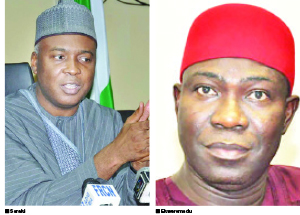
On Friday, June 9, 2017, the 8th Senate will be two years old. Like it has become the norm, a dispassionate attempt will be made to mirror the high and low moments of the Senate, spearheaded by a political Machiavellian, Bukola Saraki.
Abraham Lincoln, the 16th President of the United States of America, in one of his many remarks, noted: “Do not interfere with anything in the Constitution. That must be maintained, for it is the only safeguard of our liberties.”
Nigeria as a collective entity was not in the picture when Lincoln made the timeless remarks. The underlying message of the declaration, however, sums up the face-off between the Senate and the Presidency, since the former was inaugurated two years ago.
While the Senate, in maintaining its independence, has often hinged its action on the principles of separation of powers, as enshrined in the constitution, the Presidency, on the other hand, has often been accused of waging needless wars against an independent arm of government.
Despite the friction, the Senate has been able to initiate programmes, passed resolutions and bills in the last two years, more than any other since 1999. The Red Chamber, as it is often called, has not been insulated from its fair share of misgivings though.
Emergence of Saraki as Senate President
President of the Senate, Saraki, did not emerge without a thorough fight. As a former adviser to President Olusegun Obasanjo and a two-time governor of Kwara State, Saraki obviously understands Nigeria’s political terrain more than any other politician. His political sagacity was put to test when he damned the position of his party, the ruling All Progressives Congress (APC), to contest the Senate presidency.
With support from the opposition Peoples Democratic Party (PDP), Saraki emerged Senate President on June 9, 2015. While his camp heralded his emergence with fanfare, those who felt cheated in the scheme of things went to the drawing board. Since then, it has been war without an end.
The first major shocker came when some aggrieved senators, petitioned the immediate past Inspector-General of Police (IGP), Mr. Solomon Arise and alleged that the Senate Standing Rules book used in swearing-in Saraki was forged.
While the controversy over the authenticity or otherwise of the forgery claim was yet to abate, the Federal Government, through the Attorney-General of the Federation (AGF) and Minister of Justice, Mr. Abubakar Malami, dragged Saraki before the Code of Conduct Tribunal (CCT).
There are claims, however, that the Federal Government could have looked the other way if Saraki had accommodated names sent to him by his party to be appointed principal officers of the Senate. Saraki’s critics are always quick to put this argument forward.
Saraki, who ordinarily was expected to take his own pound of flesh during the consideration of President Muhammadu Buhari’s ministerial nominees disappointed everyone. Instead, he defied the position of PDP members who played a role in his emergence to confirm all the nominees.
In the heat of the move to remove him as Senate President, two names featured prominently. Suspended Secretary to Government of the Federation (SGF), Mr David Babachir Lawal, who controls the CCT and the AGF, Malami, who controls anti-corruption agencies were believed to have spearheaded the offensive against Saraki.
Like a cat with nine lives, Saraki has managed to survive, while the SGF has been suspended and his fate remains unknown. Saraki has been able to take a firm control of the Senate and has also succeeded in fencing off any impeachment threats even from his known enemies in the Senate.
Saraki, while briefing Senate correspondents recently, confounded his accusers when he claimed that only 11 nominees of President Buhari have been rejected out of 196 since June 2015. Till date, no one has refuted the claim.
The raging storm over the emergence of Saraki, may have abated since the key protagonists in the drama, Ahmad Lawan, Kabiru Marafa and Oluremi Tinubu have been handsomely rewarded. Lawan eventually emerged as Senate Leader following the sack of Ali Ndume, while Tinubu and Marafa were appointed chairmen of Senate committees on Environment and Petroleum Downstream respectively.
Saraki, who is now believed to be a prominent member of the fabled cabal within the Presidency has within the last two years warmed his way into the structure of the national body of the APC by playing a key role in the emergence of the current Governor of Ondo State, Rotimi Akeredolu and the emergence of the current spokesman of the ruling party, Bolaji Abdullahi, who is his well-known political son.
Passage of the Electoral Act
On March 30, the Senate passed an amendment to the 2010 Electoral Act. In the new amendment, it approved the use of electronic voting in subsequent elections, especially during the conduct of the 2019 general elections.
Similarly, the Senate resolved that election results should be transmitted electronically to collation centers. Senate’s passage of the amendment, followed the consideration of the report of the Senate Committee on the Independent National Electoral Commission (INEC) on a Bill for an Act to amend the Electoral Act No. 6, 2010 and for other related matters (SB 231 and SB 234).
To address the incident that happened in Kogi State during the last gubernatorial election, the amended Electoral Act provides that if a candidate dies before results of elections are declared, the results will not only remain valid but belongs to the political party that lost its candidate.
It also added that in such a scenario, INEC should suspend the elections for 21 days during which period the affected political party will conduct fresh primaries to choose a new candidate.
The Bill also gives political parties power to adopt direct or indirect primaries in choosing their flag bearers, while qualification or disqualification of candidates for elections will be solely based on the constitution.
The final passage of the bill is coming after it was earlier stepped down four times. The amendment bill was stepped down over disagreement on some grey areas.
In his comments after the adoption of the report by the Red Chamber, Saraki, hailed his colleagues for a job well-done and expressed optimism that the bill, when signed into law, would further improve the nation’s electoral system and contribute to good governance.
Passage of the PIGB
On May 25, almost a decade after the administration of late President Umaru Musa Yar’Adua muted the idea, the Senate passed the Petroleum Industry Governance Bill (PIGB). The bill was an initiative of the Senate President, but it was sponsored by Senator Tayo Alaosoadura from Ondo State.
The bill, a copy of which was obtained by Sunday Sun, it seeks to create efficient and effective governing institutions with clear and separate roles for the petroleum industry. It also seeks to establish a framework for the creation of commercially oriented and profit-driven petroleum entities that ensure value addition and internationalization of the petroleum industry.
Lastly, the bill is seeking to promote transparency and accountability in the administration of petroleum resources of Nigeria and foster a conducive business environment for petroleum industry operations.
With the passage of the bill, a new regulatory agency will be set up.
The new commission, which will be called Nigeria Petroleum Regulatory Commission (NPRC), will take over the functions of Petroleum Inspectorate (PI), the Department of Petroleum Resources (DPR) and the Petroleum Products Pricing Regulatory Agency (PPPRA).
According to the bill, more powers will be vested in the commission, rather than on the President or the Minister of Petroleum Resources.
The bill has significantly reduced the powers of the President and the Minister of Petroleum Resources in exercising control over the oil and gas sector. According to the bill, the Minister of Petroleum Resources shall “be responsible for the determination, formulation and monitoring of government policy for the industry; exercise general supervision over the affairs and operations of the petroleum industry subject to the provisions of this Act; report developments in the petroleum industry to the Federal Executive Council; advise the government on all matters pertaining to the petroleum industry and promote the development of local content in the Nigerian petroleum industry.
“The Minister will also represent Nigeria at international organizations that are primarily concerned with the petroleum industry; negotiate and execute international petroleum treaties and agreements with other sovereign countries, international organizations and other similar bodies on behalf of the government, subject to the approval of the Senate.”
Lawmakers added in the new bill, that upon the recommendations of the new commission, the Minister can grant, amend, renew, extend or revoke any license or lease required for petroleum or production pursuant to the provisions of the act or any other enactment.
The bill proposed that when the commission is created, it shall be vested with all assets, funds, resources and other movable and immovable properties, which immediately before the commencement of operation of the new commission were held by the PI, DPR and PPPRA.
The new commission, among other things, will also administer and enforce policies, laws and regulations relating to all aspects of petroleum operations, which are assigned to it under the provisions of the Act.
In a similar vein, two new entities will be established by the new bill, when signed into law. The new companies, Nigeria Petroleum Assets Management Company and National Petroleum Company, will be vested with certain assets and liabilities of Nigeria National Petroleum Corporation (NNPC). The National Petroleum Company for instance, will operate as a full independent commercial entity.
In another move, in the PIGB, the Ministry of Petroleum Resources will be renamed Ministry of Petroleum Incorporated.
These bold moves, according to lawmakers, are geared towards unbundling the NNPC and the petroleum industry.
Rejection of Magu
The refusal of the Senate to confirm Mr. Ibrahim Magu as the substantive chairman of the Economic and Financial Crimes Commission (EFCC) is viewed by many keen observers as one of the low points of the Senate in the last two years. While the Senate has maintained repeatedly that it based its action on a report submitted to it by the Department of State Services (DSS), its antagonists think otherwise.
There are claims, rightly or wrongly, that some senators who served as governors are facing one form of corruption charges or another. The conspiracy theorists believe that the affected lawmakers may have played a role in the rejection of Magu.
But the Senate has always maintained its grounds that it’s on the side of the rule of law. The EFCC, spearheaded by Magu, is furnishing Saraki’s prosecution team with the needed evidence in the case at the CCT. Those who are quick to conclude, opine that Saraki has a hand in the rejection of Magu.
Even if the Senate was disposed to the confirmation of Magu, he fumbled and lacked confidence during the hearing. Magu also failed to intelligently respond to series of questions posed by lawmakers.
His grandstanding outside the chamber and at public fora did not translate into anything tangible during the confirmation hearing.
The Senate, apparently insisting that the rule of law must prevail, protested against Magu’s continuous stay in office despite his rejection. He has also been accused by Senators of witch-hunt since his rejection. Magu has neither confirmed nor denied the claims. The rejection saga is still unfolding and will in return to the front banner in the coming weeks or months.
Face-off with Customs boss
When the face-off between the Comptroller-General of Nigeria Customs Service (NCS), Col. Hameed Ali and the Senate started, lawmakers were hailed as the champions of the people. On Wednesday, March 15, 2017, the embattled Ali was expected to face 108 senators to defend his agency’s refusal to adhere to a resolution passed by the Upper Legislative Chamber.
While lawmakers sharpened their teeth, ready to devour him the embattled retired Colonel, on the other hand stuck to his guns and boasted to high heavens that he would not appear before the Senate in Customs service uniform.
The frosty relationship between the Senate and Ali did not come to many keen observers as a surprise. For a handful of them, the dirty fight was long overdue. They saw the fight coming, but were not sure it would be so sudden and would garner the kind of interest it did. The directive handed down to the CG of NCS by the Senate that it should not go ahead with the implementation of collection of duties on old and new vehicles in the country, was the third in a series of face-offs between senators and Ali.
Senators, while arriving at the decision to halt the implementation of the policy, noted that the directive contravened the law and would not be allowed to stand. They had told Ali to maintain the status quo ante pending when he would appear before relevant committees.
The last straw which broke the camel’s back, was Ali’s outright refusal to obey Senate’s decision that the implementation of payment of duties on old and new vehicles should be rescinded. Observers were worried that if the Senate failed to send a strong message to heads of Ministries, Departments and Agencies (MDAs) through its action against Ali, Nigerians would begin to regard it as a toothless bulldog.
After the needless cat and mouse fight, it was a big loss for the Senate and a resounding win for Ali. After all the threats and grandstanding, the Senate did not bite. Its barks and threats ended in futility, judging by popular opinion. No sanctions were meted against him and no firm position was taken.
Since Nigerians lost interest at some point, the Senate silently dumped their agitation and looked the other way. The battle maybe far from over though. The Senate, under the leadership of Saraki, does not give up easily. It may be plotting a major shocker.