Follow Us on Google
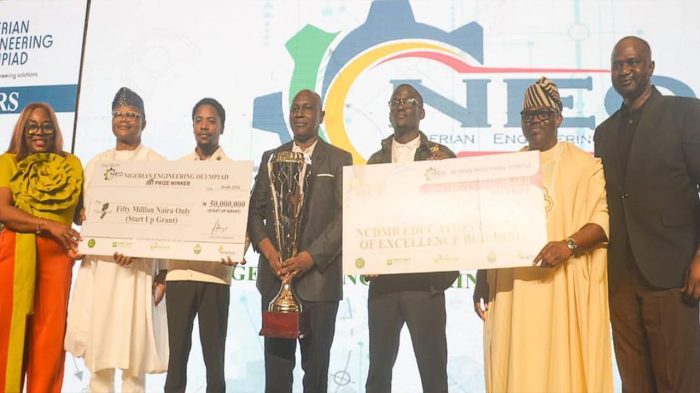
Four Nigerian universities have won a combined N235 million in grants and infrastructure support after emerging as winners of the maiden edition of the Nigerian Engineering Olympiad (NEO), a national competition aimed at promoting engineering innovation and accelerating the commercialisation of locally developed technologies.
At the grand finale held in Lagos on June 30, Modibbo Adama University of Technology (MAUT), Yola, emerged overall winner, receiving N50 million in seed funding for its innovation and a Centre of Excellence Building for its Faculty of Engineering.
The University of Ibadan (UI) came second, winning N30 million in seed funding and a N75 million grant to strengthen its engineering faculty, while the University of Jos (UniJos) secured third place with N20 million. The University of Nigeria, Nsukka (UNN) finished fourth, receiving N10 million in seed funding and a N50 million faculty development grant.
In addition to the financial rewards, the winning teams will benefit from technical mentorship, business development support, industry partnerships and commercialisation opportunities to help transform their ideas into viable businesses.
MAUT clinched the top prize with “Ubuntu Sapphire,” a decentralised, community-powered rapid alert and security intelligence platform designed for rural and peri-urban communities where internet connectivity is limited and conventional security infrastructure is weak.
The University of Ibadan’s “Aurora Birth” secured second place with an innovative healthcare solution designed to reduce neonatal deaths caused by birth asphyxia, particularly in low-resource communities.
The University of Jos impressed judges with “Sentra,” a solar-powered, artificial intelligence-enabled crop diagnostic device capable of detecting pests, crop diseases and soil nutrient deficiencies before visible symptoms appear, enabling farmers to take early corrective action.
UNN’s “Flameless” project, which converts associated gas into electricity through a modular power-generation system, earned fourth place for its potential to provide affordable and reliable electricity to homes, businesses and communities.
The four winning innovations were selected for their practical application, scalability, commercial potential and ability to address critical challenges in security, healthcare, agriculture and energy.
The competition attracted 984 students from 80 tertiary institutions, with 375 teams submitting eligible entries. Following regional screening and assessments, 30 teams advanced to zonal competitions held across Nigeria’s six geopolitical zones.
Each shortlisted team received ₦3 million to develop working prototypes before competing at regional contests in Yenagoa, Enugu, Ibadan, Abuja, Yola and Kano.
The top 12 teams subsequently participated in a national innovation bootcamp in Lagos, where they received mentorship from engineers, entrepreneurs, investors and business leaders before the final four winners emerged.
Other News
Speaking at the event, the immediate past President of the Nigerian Society of Engineers (NSE), Engr. Margaret Oguntola, described the Olympiad as a major initiative to unlock the potential of young Nigerian engineers.
She said the competition was designed to bridge the gap between the abundance of engineering talent in Nigerian universities and the country’s industrialisation aspirations.
Also speaking, Engr. Olutosin Ogunmola, who represented the NSE on the Olympiad’s Steering Committee, said engineering remains central to national development and economic transformation.
He noted that while sectors such as music and entertainment have benefited from healthy competition and public recognition, the Olympiad was created to foster similar competitiveness within engineering education.
Country Director of Enactus Nigeria, Mr. Michael Ajayi, said the initiative aligns with the organisation’s commitment to developing youth leadership and entrepreneurship through innovation.
According to him, Nigeria must deliberately harness the creativity and technical abilities of its young people to solve real-life problems, build sustainable businesses and create jobs.
Executive Secretary of the Nigerian Content Development and Monitoring Board (NCDMB), Engr. Felix Omatsola Ogbe, represented by the Board’s Director of Planning, Research and Statistics, Mr. Silas Omomehin Ajimijaye, reaffirmed the agency’s commitment to supporting engineering talent development.
He urged stakeholders to ensure that the winning innovations move beyond the competition stage and are successfully commercialised to improve lives and contribute to national development.
Funding partner Renaissance Africa Energy Company Limited announced that prototype development grants for participating teams will increase from ₦3 million to ₦5 million in the next edition of the competition.
Another sponsor, FIRST Exploration & Petroleum Development Company (FIRST E&P), described the Olympiad as an important platform for strengthening science, technology, engineering and mathematics (STEM) education while helping to curb brain drain.
The National Agency for Science and Engineering Infrastructure (NASENI) also commended the initiative, describing it as a strategic platform for identifying engineering talents capable of driving Nigeria’s industrial transformation.
The Nigerian Engineering Olympiad is a collaborative initiative of the NCDMB, Renaissance Africa Energy Company Limited, FIRST E&P, the Nigerian Society of Engineers, and Enactus Nigeria. Organisers said the programme is expected to produce more than 150 engineering prototypes and several technology start-ups over the next three years, supporting innovation, industrialisation and economic growth in Nigeria.