Follow Us on Google
…There’s sufficient cash, flawless digital platforms, bank chiefs assure
…Private sector lending climbs to N74trn
By Chinwendu Obienyi
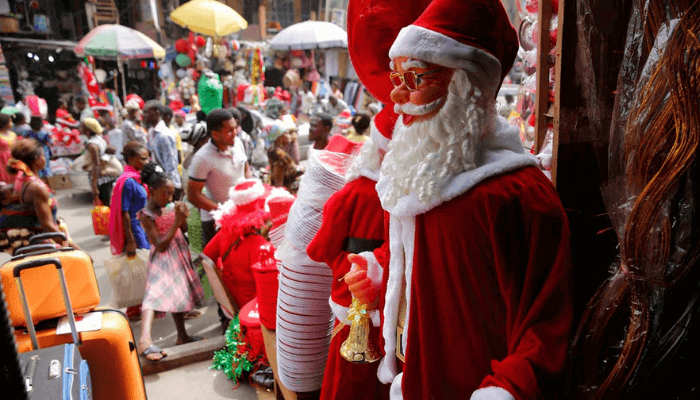
As Nigerians gear up for the usual Christmas rush, demand for physical cash has begun to spike across major cities, driven by lingering fears of network hiccups during peak festive shopping.
But bank chief executive officers say there is no cause for alarm, assuring that vaults are well-stocked and digital platforms fully fortified for seamless transactions throughout the yuletide.
Though overall currency in circulation remains high, Daily Sun learnt that some Nigerians are struggling to withdraw cash, sparking fears of ATM droughts and last-minute cash hoarding.
As of March 2025, N4.6 trillion, about 91.9 per cent of all currency issued, was held outside the formal banking system. In September 2025, approximately N4.47 trillion in currency was held outside banks, representing about 90.2 per cent of the total circulation at that time.
This phenomenon has held steady for months, reflecting deep structural and behavioural reliance on physical cash, especially among traders, informal-sector workers and low-income households who depend on daily cash transactions.
However, the Chairman of the Body of Bank CEOs, Dr. Oliver Alawuba, said lenders are “fully activated” to keep ATMs loaded, banking halls efficient and electronic channels stable during the yuletide, a period traditionally marked by heavy transactions.
He linked the industry’s readiness to renewed economic stability brought about by the Cardoso-led Central Bank reforms.
According to him, bold coordination between the CBN Governor and the Minister of Finance has lifted foreign reserves to $47.5 billion, restored Nigeria’s credibility in global markets and removed the country from restrictive watchlists that once deterred capital inflows.
“These improvements are not accidental, they are the result of reforms and strong cooperation between monetary and fiscal authorities,” he noted, adding that international credit-rating agencies have begun to acknowledge the progress.
Alawuba also disclosed that private-sector lending has climbed to N74 trillion, showing that the financial system is now better positioned to stimulate growth. But he cautioned that the sustainability of this momentum depends on responsible borrowing.
“Bank credit is not a gift or a grant. When loans are repaid, banks can lend more, and when banks lend more, the economy grows,” he said. He emphasised the need for a stronger risk-management framework and reaffirmed the banks’ resolve to continue backing SMEs, women entrepreneurs and youth-driven ventures, segments he described as engines of resilience.
On the technology front, Alawuba acknowledged the expanding digital economy but warned of rising cross-border, AI-enabled fraud. The banking sector, he said, is working closely with the CBN and NIBSS to shield depositors and maintain trust in electronic channels.
With preparations in full gear, Alawuba reassured Nigerians that the festive season will be smooth and stress-free: “We are committed to ensuring that cash circulates freely during the yuletide, and that all e-banking channels perform seamlessly.”
For households and businesses counting down to Christmas, the message is that the banks are ready.
With festive spending expected to spike driven by markets, family visits, travel and celebrations, demand for cash has equally intensified.
Yet, for many customers, access remains uncertain. In major cities such as Lagos at the weekend, there were mild queues at ATMs and banks.
Access Bank, in a notification sent to its customers, said “Dear valued customer, you may experience some difficulty reaching us, receiving transfers and using our channels. Please bear with us as we work swiftly to restore service.
Other News
If you have been debited for any transaction, kindly allow sometime for the credit or reversal to reflect once this issue is resolved.
We apologize for the inconvenience this may cause and thank you for trusting Access Bank”
Furthermore, many customers, Daily Sun learnt, have turned to Point-of-Sale (PoS) operators only to face steep charges. Reports indicate some PoS operators now charge disproportionately high fees, squeezing already tight household budgets.
Afeez Obalola, a PoS operator who banks with one of the tier-1 banks located in Victoria Island, was visibly rushing to get more money from the counter and ATM. When asked, he said, “The reason why I am in a rush is because I feel these ATMs working now, might not work and so with December coming, which has always been the case, I feel that there may be a bit of cash scarcity”.
Several economists and analysts warn that the prevalence of huge sums of cash outside banks undermines the effectiveness of monetary policy, cripples banking intermediation and constrains broader economic growth.
For instance, a 2024 commentary described the phenomenon as a “stranglehold on cash supply,” arguing that long-term scarcity is not simply accidental, but becomes structural when the central bank, security agencies and financial institutions fail to coordinate effectively.
Others note that when large volumes of currency remain outside the banking system, traditional policy tools, like adjusting interest rates or reserve requirements, lose much of their bite.
This diminishes the ability of the central bank to steer inflation, liquidity, or credit supply.
A 2025 study examining Nigeria’s “cashless policy” and currency-redesign efforts found that while the reforms aim to modernise payments and strengthen the financial system, their benefits remain elusive without adequate infrastructure, trust and behavioural change.
Hence, economic experts warn that persistent cash hoarding and hoarding outside banks suppress deposit mobilisation, reduce banks’ ability to lend and limit the financial sector’s contribution to real-sector investments and growth.
Faced with mounting public complaints and evidence of cash shortages, the CBN stepped up pressure on commercial banks. In January 2025, it imposed fines totalling N1.35 billion on nine deposit money banks for failing to make cash available via ATMs during the festive season.
In announcing the sanctions, the CBN reiterated its commitment to ensuring smooth cash circulation, emphasising that disruptions in cash supply undermine public trust and economic stability.
According to guidelines issued by the apex bank, random spot checks at bank branches and ATMs as well as periodic reviews of Point-of-Sale operators and other cash distribution channels, will continue.
Recently, at the briefing of the Monetary Policy Committee (MPC) meeting held in Abuja, CBN Governor, Olayemi Cardoso, said commercial banks remain committed to creating “robust cash buffers” to meet national demand.
He noted that many commercial banks are undergoing recapitalisation to bolster their capacity to serve clients nationwide, a process that, in his view, should strengthen the banking system’s resilience and readiness to meet demand.
Cardoso said, “We talk at CBN about creating buffers and we have been doing so as you have seen in the recent past. So with the commercial banks, they are also in the process of creating buffers because this is exactly what comes as a result of the recapitalisation that they are presently going through. 16 of them have fully complied, 27 of them have through various means raised capital.
We are monitoring the developments and from every indication, it is going in the right trajectory. We feel that we are in a stage of building a financial industry that will be very fit for purpose in terms of building buffers, support the country into the next few years”.