Follow Us on Google
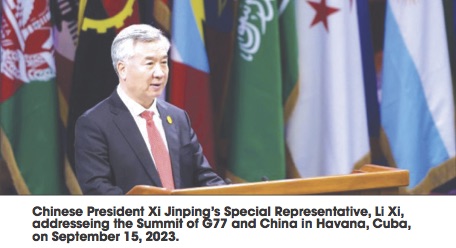

Chinese President Xi Jinping’s Special Representative, Li Xi, who is also a Member of the Standing Committee of the Political Bureau of the Communist Party of China (CPC) Central Committee and Secretary of the CPC Central Commission for Discipline Inspection, on September 15, 2023, local time, addressed the Summit of the Group of 77 (G77) and China in Havana.
In his address, Li said that the world is undergoing changes on a scale unseen in a century, with developing countries becoming stronger. Li noted that the South-South cooperation is playing an increasingly important role in driving the momentum of collective rise of developing countries and in sustaining the continued global economic growth.
Li however said at the same time, unilateralism and hegemonism were becoming rampant, in particular, some countries were resorting to unilateral sanctions, decoupling, and disruption of industrial and supply chains, seriously undermining the legitimate development rights and interests of developing countries and their space for development.
According to Li, “Developing countries generally hope to strengthen solidarity and cooperation, working to make global governance more just and equitable. China is ready to work with Cuba and other G77 members to build a global South community with a shared future, and usher in a new era of common development.”
Li further made a three-point proposal in respect of cooperation between the G77 and China. Li proposed staying true to the original aspiration of the G77 for independence and greater collective strength through unity. The G77 and China, Li stated, must uphold the common values of humanity, reject bloc confrontation and the Cold War mentality, and seek to resolve differences and disputes between countries by peaceful means to maintain world peace and tranquility.
Li also advocated equity, justice, equality and inclusiveness, saying that the G77 and China must make their voice heard loud and clear and uphold justice at the United Nations General Assembly and other major international occasions.
Li further proposed pursuing development, revitalization and win-win cooperation, emphasizing the need for the G77 and China to work in synergy to revitalize the global development partnership, foster new drivers for their development, and focus on cooperation in areas of food security, poverty alleviation, industrialization, green development, digital technology and artificial intelligence to build an open, inclusive and mutually beneficial system for South-South scientific and technological cooperation, so that all countries can equally benefit from digital dividends, and no developing country will be left behind or left out in the development of new technologies and industries.
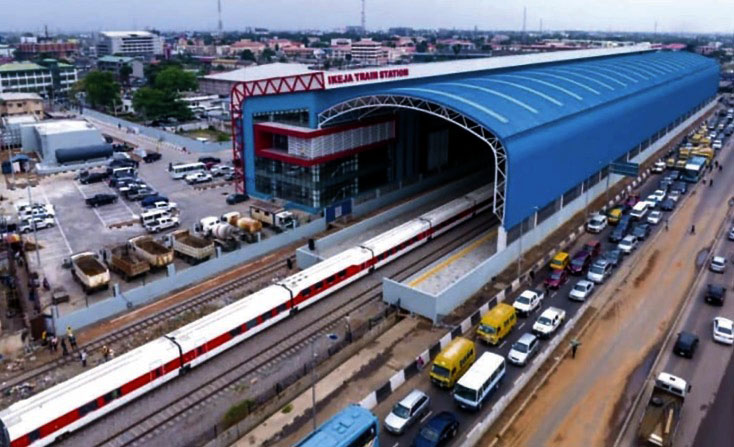
Chinese-Constructed Light Rail Begins Commercial Operation in Lagos

Commuters who had long endured the challenges of overcrowded roads and prolonged commute time in Nigeria’s Lagos were visibly thrilled by the convenience, comfort, and speed of the city’s light rail which began commercial operation recently.
As the train glided along its tracks from the iconic Marina Station on Lagos Island down to Mile 2, a busy district in the city, many Lagos residents on board the China-built electric-powered light rail could not contain their delight. The air-conditioned coaches offered a stark contrast to the daily commuting struggles many had grown accustomed to.
Undertaken by China Civil Engineering Construction Corporation (CCECC) in July, 2010, and completed in December 2022, the first phase of the LRMT Blue Line Corridor spans 13 kilometer and covers five stations. The LRMT Blue Line is the first rail infrastructure traversing Okokomaiko, a densely populated area in the western part of Lagos, and Marina.
The train system, which is expected to convey 175,000 passengers on a daily basis, will run 12 trips per day for a period of two weeks, and the service will gradually increase, according to Abimbola Akinajo, managing director of the Lagos Metropolitan Area Transport Authority.
Farida Ahmed, a businesswoman who made the inaugural commercial ride on the Lagos Rail Mass Transit (LRMT) Blue Line Corridor, said: “With this train, there is no stress; we are able to move around. You can work with your time, and your mental health is intact now; gone are the days we complained about traffic and all of that.”
Also speaking, Olusola Mustapha, a 22-year-old student of the Lagos State University, described the commercial operation of the light rail as “the game-changer.”
Chinese Telecom Firms Boosting Africa’s Quest to Unlock Digital Economy
The curiosity of visitors was palpable as they gazed at the stand erected by China Unicom at the vast exhibition hall in one of the high-end hotels in the Kenyan capital of Nairobi when Africa Telecoms Week opened on September 12. Looking impressed by sleek brochures and well-arranged furniture at China Unicom’s stand, the visitors had a lengthy conversation with the company’s executives, keen to learn about its product portfolio. Some of the visitors to the Chinese telecoms operator stand included technology enthusiasts and entrepreneurs who had a positive impression of its range of products and services, after listening to the executives.
Billed as a premier gathering of telecommunication industry players, the Africa Telecoms Week, which took place in Nairobi from September 12 to 14, shone a spotlight on the growing influence of Chinese technology firms in the continent’s digital economy.
Some of the Chinese telecommunication firms which participated in the three-day event that ran parallel with an exhibition included China Unicom and China Mobile International Limited.
Bringing together more than 700 participants from 28 African countries, the 2023 Africa Telecoms Week provided a platform for industry players to network, forge business ties, and inject vitality into the continent’s digital economy.
The Chief Executive Officer of China Unicom Global, Africa, Yao Siyang, said the company has rallied behind the continent’s digitization efforts through investment in supportive infrastructure like submarine cable.
Chinese Economy on the Up
…As China Surpasses Japan, Becomes World’s Largest Auto Exporter in First Half of 2023
Against the backdrop of sluggish global trade, China’s foreign trade is generally stable, with improved structure and greater resilience. The total volume in yuan terms edged down 0.1 percent year-on-year in the first eight months of 2023. The auto exports remained a bright spot, with the export value of automobiles during the period surging 104.4 percent from a year earlier. China surpassed Japan to become the world’s largest auto exporter in the first half of this year.
Policy and institutional support is increasing the confidence and opportunities of private companies. This is clearly seen in the rise of the country’s Small and Medium Enterprises Development Index, which reflects the performances and expectations of small and medium-sized enterprises, in August for the third straight month. Recently, China also set up a bureau specializing in promoting the private economy’s development under the National Development and Reform Commission, the country’s top economic planner.
The current hot-selling products, tech giant Huawei’s Mate 60 series smartphones and Luckin Coffee’s latte with the flavor of China’s famous liquor Moutai, offer a glimpse of robust consumer spending in China, not to mention the tourism boom during the summer holiday period. Consumption contributed to 77.2 percent of the country’s economic growth in H1.
Chinese Modernization: Modernization Pursued Under the Leadership of the CPC
Modernization Pursued Under the Leadership of the CPC Suits China’s National Conditions After the 1840 Opium War, visionary people in China pressed ahead against the odds in pursuit of a path to modernization for China. From the late Qing Dynasty to the Republic of China period, there had been the Westernization Movement aimed to learn from Western military technology and the Reform Movement of 1898 and the Revolution of 1911 intended to establish constitutional monarchy or other Western systems. However, all these plans to blindly copy Western models ended in failure for not being suitable for China’s national conditions.
What has happened proves that a Western path to modernization is not an option for China and does not work in China. Since its inception, the CPC, by seeking truth from facts and painstaking searches, has led the Chinese people in finding the right path toward national independence, people’s liberation, and prosperity of the country. It were the Chinese Communists who first learned and applied Marxism to advance socialist modernization in light of China’s specific conditions back then. This path to modernization enjoys strong vitality because it is in line with the spirit of the Chinese civilization and based on China’s national reality.
Modernization Pursued Under the Leadership of the CPC Serves the People
The CPC Constitution stipulates that the CPC is the vanguard of the Chinese people and the Chinese nation, and it represents the fundamental interests of the greatest possible majority of the Chinese people. Chinese modernization is people-centered and its immutable goal is to meet the people’s aspirations for a better life.
As an ancient Chinese saying goes, “The people are the foundation of a country and only when the people lead a good life can the country thrive.” Mencius, a foremost representative of the Confucian thought in the Warring States period (475-221 B.C.), said, “There is a way to win (people’s) hearts: amass for them what they desire, do not impose on them what they detest, and it is as simple as that.” This observation highlighted the importance to win pubic support and bring benefit to the people. The people-centered philosophy of the CPC, drawn political wisdom from traditional Chinese culture, has become a defining feature of Chinese modernization.
Under the leadership of the CPC, China won the largest battle against poverty in human history, which lifted 800 million people out of poverty and met ten years ahead of schedule the poverty eradication target set out in the 2030 Agenda for Sustainable Development. China has also built the world’s largest social security network with 1.34 billion Chinese having access to basic medical insurance in 2022. China has also made tremendous efforts to address environmental problems that has a direct bearing on the people. As a result, sand and dust storms and smog have been significantly reduced. There are more lush mountains and lucid waters. Every improvement in people’s daily life forms a strong momentum for Chinese modernization.
Modernization Pursued Under the Leadership of the CPC Benefits the World.
The CPC has been maintaining a global vision. In leading the efforts to pursue modernization, it is dedicated to not only seeking happiness for the Chinese people and rejuvenation for the Chinese nation, but also promoting human progress and world harmony.
The CPC-led modernization embodies the idea that “All people under the heaven are of one family.” China will continue to provide more opportunities for the world with its own development, contributing to common development and shared prosperity for all.