Follow Us on Google


Henry Akubuiro
It is a cool evening in Yenagoa, Bayelsa State. Mike Afenfia sits on a cushion, cross-legged, in a hotel studio in the state capital, book in hand. The obsequies of Gabriel Okara, the famous poet, journalist and novelist, who lived over a 100 hundred years, have just elapsed.
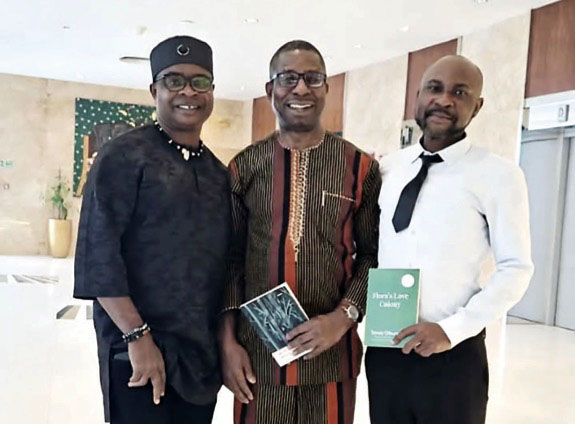
Afenfia is among the younger breeds of writers from this part waiting to hog the limelight. A lawyer turned writer, he is author of three novels: When the Moon Caught Fire, A Street Called Lonely and Don’t Die on Wednesday. A fourth, The Mechanics of Yenagoa, is on the way.
The author, who, currently, works as the Speechwriter to the Governor of Bayelsa State, was the Chairman of the Bayelsa State Chapter of the Association of Nigerian Authors, ANA, from 2015 to 2017, admits the forthcoming novel is a byproduct of an online weekly series, set to be published later this year.
Okara’s grandeur is music to everybody’s ears at this moment, needless to say the manner he answered the call of the River Nun with pomp and pageantry. “I think it is a befitting farewell to somebody who has done so much, not just for Niger Delta but for the entire literary community in Nigeria, from as far back as in 1950s. His poems and other writings caught the attention of the global literary community,” he says.
Okara, everybody agrees, wore humility like cloth, endearing himself to many people. What endeared him to Okara? Afenfia responds, “I think it is his consistency. He continued writing, even when he was in his 90s. He was consistent in his craft, and, because of that, he was identified as somebody who could occupy leadership positions in public service.
“I think because of the way he lived his life, and, of course, his humility, he was approachable, ready to serve, to help and to advice. These are some of the qualities that stood Okara out from everybody, especially at a time when the society seem to only celebrate rich people –or, in our case, people who are involved in militancy because sometimes it comes with some material benefits.”
Besides, Afenfia benefitted personally from the late literary icon, “I would say I gained directly from my interaction with him, to take my craft seriously to the point where, when you speak, people would listen. People tend to see you as an authority on everything and they take you seriously.”
Okara may have gone, but poetry, which he won renown with, will continue to flourish here from the look of things. “I am most excited about the renaissance of poetry and spoken words in Bayelsa,” he says, “and I am happy that it has been championed by the generation younger than mine who have taken up these challenge and are doing things for themselves by themselves, and not waiting for the government.
“There was a time we did not have young people interested in poetry, going on radio to discuss or recite poems or having events where they gather and have conversations on poetry, prose and writing generally. So I am happy that there is that renaissance, like an awakening among the newer generation of writers in Bayelsa, and they are doing great things. I can only imagine what the next ten, twenty or thirty years would be like.”
During his spell as the chairman of the Bayelsa State chapter of ANA, he was inspired by the comment of a visiting ANA president, who said Bayelsa could be the literally capital of the Niger Delta.
“And so every time, I had that at the back of my mind. So I organised competitions to expose the young writers to opportunities and expose their crafts. I tried to build a bridge between the literally community and even the government so that, now, there is that recognition.
“There is a lot of pop culture influence and more competitions. I feel like, as writers, we should not be lost from what is going on with the society. What is the popular culture? What are the tendencies that our youths are attracted to? We should, then, infuse that to our own literary works so that youths in Bayelsa would be excited to be in a literary event; they would be excited to pick up a book and want to read it.”
Afenfia has taken a cue from that already. “I try to be fluid, engaging and almost reinvented my writing style, so that I can relate more with younger people. That also influenced the series I started, The Mechanics of Yenagoa, about two years ago. By the grace of God, that series is now going to be a novel, because it attracted the attention of some publishers who approached me to say, ‘This is good and we want it to be a book, so everybody can have access to it.’ So, hopefully, it shall be released later this year.
‘Even though I have a generic writing style, which is basically simple and much easy to read, I have delved into different areas in every book I have written. I have tried something new; I have left my comfort zone every time I have the opportunity to do a book. Just as Gabriel Okara was –who would do prose and then essays or even children’s literature, poetry and all that.
“I think I also enjoy that kind of challenge of not being boxed in or not being caged and stereotyped to say that Michael cannot write this; he can only do this. If you take him out of here, he would be scared. So, I have tried to show different sides of me in my writing and, for the Mechanics of Yenagoa. I wanted to be more humourous. So it is an easy-to-read story that is very relatable.”
He has had people come up to him to say, “I am not used to reading; I never read a book before; and the only time I had was when I was in school and that was, because I was compelled by examination to read text books; but since I started reading the Mechanics of Yenagoa, I know that this can be fun and that reading can be interesting.” But that shouldn’t be the case.
Writing in that simple humorous style, for him, means getting down to that level where anybody can pick up your work and be interested in the story and be inspired by it.
He tells The Sun Literary Review, “I actually even had instances where people read the series and they will send me an article or send me a poem not just inspiring them to read but inspiring them to write as well. I think this is that book that when eventually published would do that for me. It is not just for entertainment; it is not about the didactic message, but it is inspirational to a point where you can drive anybody to say, ‘Look, it’s not too hard after all. I can do this’.”
Interestingly, discussions with his publishers have gone a long way, including different possible titles. “But, again, when we are having this conversation about what the book was going to be called and if it was going to be different from the series, Gabriel Okara died. I think that Okara’s accomplishments and his many achievements have inspired me to retain the title, The Mechanics of Yenagoa,” he declares.