Follow Us on Google
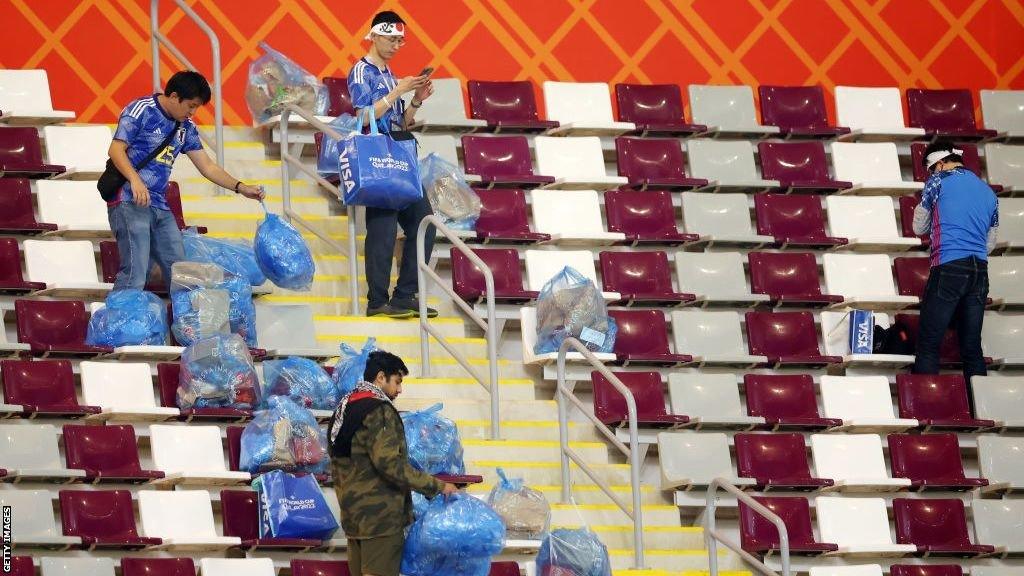
Japanese fans left the stands spotless after their World Cup Group F match against the Netherlands in Texas on Sunday, reinforcing a long-standing cultural habit of cleaning up after themselves.
Following the 2-2 draw at Dallas Stadium in Arlington, fans remained behind to collect litter, carefully picking up cups, wrappers and other waste before leaving the venue in an orderly fashion.
“It is Japanese culture,” said fan Eita Tanaka. “We have to think about everyone.”
He added that the practice is deeply rooted in early education. “Japanese people think that when we use a certain place, we were told that you have to make that place look tidier when you leave than it was when you arrived,” he said.
“At school in our classrooms we tidy it up after ourselves without our teacher telling us.”
Japan, competing at their eighth consecutive World Cup, have seen their supporters’ behaviour become widely recognised internationally as a hallmark of discipline and collective responsibility.
NFL quarterback Jameis Winston was also seen joining the clean-up effort after the match, wearing a Japan shirt with his name on the back.
Fan Futo Hagiwara said the gesture reflects national values.
“This is our culture, that means everywhere we go we need to clean it after ourselves; it’s our spiritual way, our attitude,” he said.
Other News
Sociologist Masachi Ohsawa said the behaviour reflects a mix of social responsibility and strong peer influence, particularly in shared public spaces.
“When it comes to people who they share the same space with or have direct personal contact with, they feel a strong desire not to cause them any trouble or make them feel uncomfortable,” he said.
In Japan, cleaning is embedded in education from an early age, with pupils routinely responsible for maintaining their classrooms. Public litter bins are also limited, encouraging people to take waste home and sort it carefully.
Emeritus sociology professor Scott North of the University of Osaka said community clean-ups are also a common feature of social life.
He noted that group coordination plays a key role in encouraging participation, with social expectation discouraging refusal once collective action begins.
Sociologist Ohsawa added that the phenomenon is often described locally as “reading the air”, where individuals conform to group behaviour to avoid standing out.
“In this case, the primary motivation isn’t so much a desire to keep the stadium clean,” he said, “but a desire not to be seen as a nuisance in one’s own group.”
Japan’s supporters are expected to continue the practice throughout the tournament, as the team prepares to face Tunisia in their next group match in Mexico on Saturday.