Follow Us on Google
From Juliana Taiwo-Obalonye, Abuja
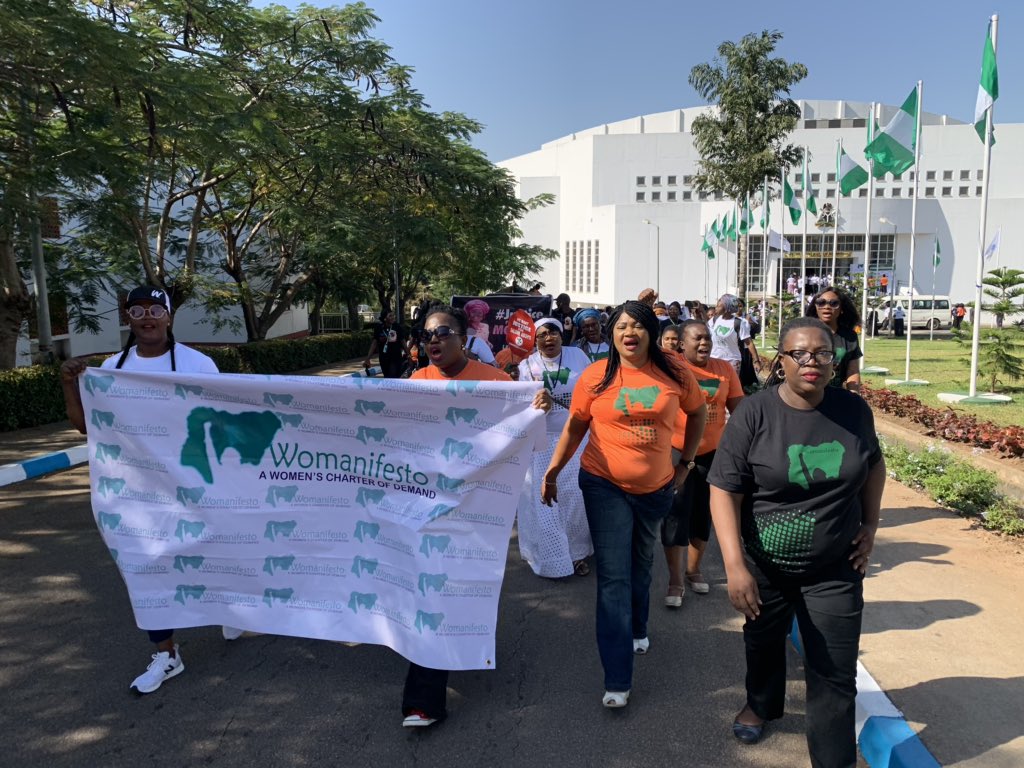
More women should be appointed to leadership posts at the National and State Assemblies, according to the WOMANIFESTO, which is made up of over 200 civil society organizations. Additionally, the five gender bills that the legislative arm rejected should be re-discussed and put to a vote.
These demands were contained in a statement by WOMANIFESTO signed by its Co-convener, Dr Abiola Akiyode-Afolabi.
Recall that the President of the Senate, Ahmad Lawan said he is sad that members of the National Assembly voted against all five gender bills that sought to promote more opportunities for women in political parties, governance, and society at large.
He had, however, said all hope was not lost, advocating for a different strategy to be adopted and more lawmakers should be engaged to push for the passage of the bills in the 10th Assembly.
But Akiyode-Afolabi stressed in the statement that the Gender and Equal Opportunities (GEO) Bill must be passed, saying that the country, the women of Nigeria, and its social capital have all suffered greatly as a result of the rejection of the five gender legislation.
The women also called for more resource allocation to pursue an equal society.
The statement reads:
At least 44% of Nigeria’s voting population are women, yet less than 5% of the 1,553 women who contested the 2023 Elections across Nigeria were elected. Despite the consistent push for increased representation of women in politics–elective and appointive positions, the just concluded 2023 Presidential and National Assembly elections show alarming underrepresentation of women.
For instance, of the 1,459 Legislative seats at the state and national levels, so far, women have won only 75 seats. Alarmingly, there are 15 states without a single woman in their State House of Assembly.
It is of great concern that in the election into the Nigerian parliament from 1999 till date, only 176 women have been elected (new and repeat) as compared to 3,107 for their male counterparts.
In the coming 10th National Assembly, there is a reduction from eight women in the Senate to three, while in the House of Representatives, only 17 women have been elected so far compared to the 13 in the outgoing 9th Assembly. It is no wonder that as of February 2023, the Inter-Parliamentary Union (IPU) ranks Nigeria 183 out of 193 countries in Women’s Representation in National Parliaments.
In Nigeria’s 24 years of democracy, no woman has been Senate President or Deputy Senate President. Patricia Etteh is the only woman to be the Speaker of the House of Representatives from June to October 2007. Hon. Mulikat Akande was the first woman elected as Majority Leader at the Federal Legislative level in 2011.
More women need to be elected to leadership positions in the National Assembly of Nigeria irrespective of the current numbers. These women represent about 50% of Nigeria’s population and this should be reflected in the parliament’s leadership. This is a matter of equity and social inclusion.
The National Assembly is constitutionally vested with several functions, such as lawmaking, confirmation of nominations, representation, oversight, scrutinizing bills, legislative proposals, and motions, etc. Most of these functions are achieved through Committees made up of Distinguished Senators and Honorable Members of the House of Representatives. Section 62(1) of the Constitution of the Federal Republic of Nigeria (1999) empowers the Senate and the House of Representatives to appoint Committees of special and general purpose as may be expedient.
The Senate is charged with intervening in matters of national security, epidemic, poverty drought, and government and labor union disputes for industrial unity. Senate also confirms the President’s nominations for senior diplomats, federal judges, and members of INEC. Federal and state lawmakers duly elected to the National Assembly are vanguards of Nigeria’s democracy, peace, development, and unity. Decisions being made in parliament need to mainstream gender inclusion and equity. With Nigerian women successfully leading in various fields globally, it is vital that they take the lead in parliament and its Committees. Besides, gender equity and inclusion are a matter of efficiency and merit.
In light of the foregoing, we demand the inclusion of women among the top three slots of Principal Officers of the Nigerian Parliament either as Senate President, Deputy Senate President, or Speaker. There are qualified women among the elected National Assembly and State Houses of Assembly. In addition, it is the reality of the day that gender equity is critical to sustainable development; and Nigeria cannot afford to be left behind. Having women serve as parliamentary Principal Officers would contribute tremendously to inclusive governance and national development in the next dispensation.
More than ever, WE DEMAND THAT:
The Gender and Equal Opportunities (GEO) Bill be passed.
The five gender bills be re-debated and voted for, as the rejection of these bills has harmed Nigerian women, the country, and our social capital.
More resources be allocated to pursue an equal society.